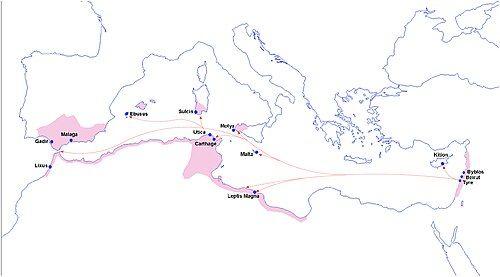
Materials covered in this trivia questions quiz
Study Hint 1
Question: In the context of Western civilization, which of the following cultures is acknowledged as having stimulated and influenced its development alongside Ancient Greece and Rome?
Trivia Question Study Fact: While Ancient Greece and Rome are central to Western civilization, the Phoenician city-states of the Mediterranean region also played a significant role, stimulating and influencing the development of Western culture alongside other Near-Eastern civilizations. This influence occurred during periods of cultural exchange and syncretism, demonstrating that Western culture's origins are multifaceted and not solely derived from Greco-Roman traditions.
Trivia Question Explanation: The source text explicitly states that the Phoenician city-states, along with Ancient Egypt and several Near-Eastern cultures, stimulated and influenced Western culture. This highlights the diverse origins of Western civilization beyond just the classical Greek and Roman periods.
Return to Question
Study Hint 2
Question: In the context of Western culture, which of the following ancient societies is acknowledged as having stimulated and influenced its development alongside Ancient Greece and Rome?
Trivia Question Study Fact: While Western culture is often linked to Ancient Greece and Rome, the Phoenician city-states of the Mediterranean region also significantly influenced its development. These ancient societies, alongside cultures from the Near East, contributed to the syncretism – the blending of different cultural and religious beliefs – that characterized the Hellenistic period and subsequently shaped early Christian and Jewish traditions within Western culture.
Trivia Question Explanation: The source text explicitly states that the Phoenician city-states, along with Near-Eastern cultures, stimulated and influenced the development of Western culture alongside Ancient Greece and Rome, particularly during the Hellenistic period.
Return to Question
Study Hint 3
Question: In the context of Greek colonisation, Phoenicia is considered…
Trivia Question Study Fact: During the period of Greek colonisation (8th-6th centuries BC), the establishment of *apoikiai* – settlements intentionally founded and directed from a *metropolis* – marked a shift from earlier, less organised migrations. These colonies, while originating from existing Greek city-states, often developed into independent poleis with their own governance and identity.
Trivia Question Explanation: The source text details Greek colonisation across the Mediterranean and Black Seas, focusing on expansion *from* Greek city-states. It does not mention Phoenicia as a destination, origin, or area involved in these movements, indicating it was separate from this specific colonial activity.
Return to Question
Study Hint 4
Question: In the context of North Africa during classical antiquity, Phoenician presence is considered…
Trivia Question Study Fact: During classical antiquity in North Africa, the region of ancient Libya was primarily inhabited by Berber tribes, but its coastal areas also saw the establishment of settlements founded by both Phoenician and Greek peoples, indicating a period of diverse cultural interaction and trade.
Trivia Question Explanation: The source indicates that Phoenicians established colonies specifically along the coast of Libya during the classical antiquity period, coexisting with the indigenous Berber tribes.
Return to Question
Study Hint 5
Question: In the context of the Mediterranean region, Phoenicia is considered…
Trivia Question Study Fact: The Mediterranean Sea served as a crucial transportation and exchange network connecting diverse cultures across Western Asia, North Africa, and Southern Europe, and within this network, Phoenicia emerged as a significant maritime power alongside civilizations like Egypt, Greece, and Carthage.
Trivia Question Explanation: Phoenicia thrived as a seafaring civilization, leveraging the Mediterranean Sea to establish extensive trade routes and cultural connections between Western Asia, North Africa, and Southern Europe.
Return to Question
Study Hint 6
Question: In the context of Phoenicia, what is the significance of the term 'Phoenicia' itself?
Trivia Question Study Fact: Despite referring to themselves as Canaanites and identifying their land as Canaan, the term 'Phoenicia' was a Greek exonym, meaning a name given to them by outsiders. Modern historians consider the distinction between Canaanites and Phoenicians after approximately 1200 BC to be largely artificial, suggesting a continuity of culture and identity.
Trivia Question Explanation: The Phoenicians themselves identified as Canaanites, and the name 'Phoenicia' was applied to them by the Greeks, highlighting that it wasn't a term they used to describe themselves or their culture.
Return to Question
Study Hint 7
Question: In the context of Greek colonies, Phoenicia is considered…
Trivia Question Study Fact: During the period of Greek colonization (8th-6th centuries BC), the establishment of *apoikiai* – settlements intentionally directed from a *metropolis* – marked a shift from earlier, less organized migrations. These colonies weren't simply extensions of the mother city, but developed into independent city-states with their own governance and identity, though maintaining a historical connection to their origin.
Trivia Question Explanation: The Greek colonization primarily focused on areas around the Mediterranean and Black Seas, and the provided text does not mention any Greek colonial activity involving Phoenicia, suggesting it remained outside the scope of this expansion.
Return to Question
Study Hint 8
Question: In the context of Hellenization, what was a common consequence of Greek colonization in the ancient period?
Trivia Question Study Fact: During the Hellenistic period, following Alexander the Great's conquests, numerous territories experienced a significant shift as indigenous populations adopted aspects of Greek culture, religion, language, and identity, a process known as Hellenization. This adoption frequently occurred as a consequence of Greek colonization in earlier periods.
Trivia Question Explanation: Greek colonization frequently resulted in the assimilation of local populations, who began to incorporate Greek customs, beliefs, and language into their own societies, leading to the widespread adoption of Greek culture.
Return to Question
Study Hint 9
Question: In the context of Carthage, the method used by Queen Dido to acquire land for the city is considered...
Trivia Question Study Fact: According to legend, the founding of Carthage, which later became a dominant power in the Southwest Mediterranean, was initiated by Queen Dido who, after requesting land from a local tribe, cleverly used an oxhide to delineate the city's boundaries, demonstrating the resourcefulness and ambition that would characterize the Punic empire.
Trivia Question Explanation: The legend recounts that Dido obtained land by cleverly cutting an oxhide into strips to encompass the desired area, showcasing her ingenuity and ability to negotiate rather than relying on force or diplomacy.
Return to Question
Study Hint 10
Question: In the context of Lebanon, Phoenicia is considered…
Trivia Question Study Fact: Between 3200 and 539 BC, the region now known as Lebanon was a core territory of Phoenicia, a prominent maritime civilization that exerted influence throughout the Mediterranean Basin through trade and seafaring.
Trivia Question Explanation: Phoenicia flourished in the region of modern-day Lebanon as a seafaring civilization, establishing extensive trade networks and colonies across the Mediterranean.
Return to Question