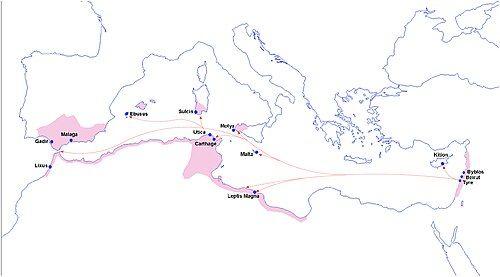
Materials covered in this trivia questions quiz
Study Hint 1
Question: In the context of Early Christianity, Phoenicians are identified as being among the first to do what?
Trivia Question Study Fact: During the early stages of Christianity, the faith expanded beyond its Jewish origins to include individuals from various backgrounds within the Roman Empire and the Eastern Mediterranean. Notably, the first converts weren't exclusively Jewish; people from Phoenicia, now modern-day Lebanon, also embraced the new religion alongside Jewish Christians.
Trivia Question Explanation: The earliest followers of Christianity included both Jews who converted and individuals from other groups, such as those from Phoenicia, who also adopted the faith during this initial period of expansion.
Return to Question
Study Hint 2
Question: In the context of Early Christianity, Phoenicians are specifically identified as being among the first to embrace the new faith, becoming known by what subsequent designation?
Trivia Question Study Fact: During the early stages of Christianity, the faith wasn't limited to Jewish converts; it also found initial followers among the Phoenicians, who became known as Lebanese Christians. This demonstrates an early expansion beyond its Jewish origins within the Eastern Mediterranean region.
Trivia Question Explanation: The source text explicitly states that Phoenicians were among the first followers of Christianity and are identified as Lebanese Christians, indicating an early presence of the faith in that region.
Return to Question
Study Hint 3
Question: In the context of Cadmus, Phoenicia is most notably associated with…
Trivia Question Study Fact: According to Greek mythology, Cadmus is recognized as the Phoenician founder of the city of Thebes, establishing a significant cultural link between Phoenicia and ancient Greece. His origins trace back to the Phoenician city of Tyre, where he was born a prince, and his founding of Thebes led to the city's acropolis being named Cadmeia in his honor.
Trivia Question Explanation: Cadmus is specifically identified as the Phoenician founder of Thebes, and the city’s acropolis was named Cadmeia in his honor, demonstrating a direct connection between Phoenicia and the establishment of this Greek city.
Return to Question
Study Hint 4
Question: In the context of Punic culture, the term 'Punic' itself signifies a distinction between Phoenician civilization and…
Trivia Question Study Fact: The term 'Punic,' derived from the Greek word for Phoenician, is used in modern scholarship to specifically denote Phoenician settlements and culture within the Western Mediterranean, distinguishing them from those remaining in their Levantine homeland. While maintaining ties to Phoenicia, these Punic communities developed unique cultural traits through interaction with local populations like Berbers, Iberians, and Greeks.
Trivia Question Explanation: The term 'Punic' specifically refers to Phoenicians who migrated to and settled in the Western Mediterranean, evolving a distinct culture separate from those who remained in their original homeland of Phoenicia.
Return to Question
Study Hint 5
Question: In the context of Tunisia, the Phoenicians are considered foundational to the development of which significant ancient city?
Trivia Question Study Fact: Beginning in the 12th century BC, Phoenicians established settlements along the coast of what is now Tunisia, with Carthage eventually becoming the most prominent of these settlements. These Phoenician settlers and their descendants became known as the Punic people, and Carthage grew into a major mercantile empire that rivaled the Roman Republic for centuries.
Trivia Question Explanation: The Phoenicians established settlements along the Tunisian coast starting in the 12th century BC, and among these, Carthage rose to become the most powerful, eventually developing into a major mercantile empire.
Return to Question
Study Hint 6
Question: In the context of the Ionic alphabet, how did the Greeks modify the Phoenician alphabet to better suit the Greek language?
Trivia Question Study Fact: Following the collapse of the Linear B syllabic script used for Mycenaean Greek, the Greeks adopted the Phoenician alphabet around the 9th-8th centuries BC. However, the Phoenician system, focused primarily on consonants, was not ideally suited for the Greek language, which required a more explicit representation of vowels. To address this, the Greeks adapted Phoenician letters—including those representing sounds absent in Greek—and utilized 'matres lectionis' (letters used to indicate vowels) according to the acrophonic principle to consistently represent Greek vowels.
Trivia Question Explanation: The Greek language required a more explicit representation of vowels than the Phoenician alphabet provided, which primarily focused on consonants. Therefore, the Greeks creatively repurposed existing Phoenician letters and vowel indicators to create a system better suited to their linguistic needs.
Return to Question
Study Hint 7
Question: In the context of Ancient Carthage, the founding population’s origins can be traced back to which Phoenician city-state?
Trivia Question Study Fact: Carthage, a significant ancient civilization in North Africa, was initially established as a Phoenician settlement around 814 BC by colonists from Tyre, a prominent city-state in present-day Lebanon. Following the decline of Phoenician power due to the Neo-Assyrian Empire, Carthage gained independence and expanded its influence throughout the western Mediterranean.
Trivia Question Explanation: Carthage was founded by colonists originating from Tyre, a leading Phoenician city-state located in modern-day Lebanon, around 814 BC, establishing a new settlement in North Africa.
Return to Question
Study Hint 8
Question: In the context of Punic people, how did their relationship with Phoenicia evolve after migrating to the Western Mediterranean?
Trivia Question Study Fact: The Punic people, often referred to as Carthaginians or Western Phoenicians, originated as migrants from Phoenicia during the Early Iron Age. While maintaining connections to Phoenicia, they established a widespread network of settlements across the Western Mediterranean, including North Africa, Sicily, Sardinia, and the Iberian Peninsula, and developed unique cultural traits distinct from their Phoenician origins.
Trivia Question Explanation: Although the Punic people migrated from Phoenicia, the source indicates they retained links with their homeland throughout their history, but simultaneously developed unique cultural characteristics through interactions with other Western Mediterranean peoples.
Return to Question
Study Hint 9
Question: In the context of Dido’s story, Phoenicia is most directly associated with…
Trivia Question Study Fact: Dido, also known as Elissa, is a legendary figure credited with founding and ruling the Phoenician city-state of Carthage in North Africa. Accounts state she fled from Tyre, a Phoenician city, to establish her own independent settlement, though the historical accuracy of these accounts is debated due to their origin in Greek and Roman sources written long after the city's founding.
Trivia Question Explanation: Dido is described as originally being from Tyre, a city within Phoenicia, and fleeing to found Carthage. This makes Phoenicia the place of her origin and the source of the circumstances that led to her founding Carthage.
Return to Question
Study Hint 10
Question: In the context of Tyre, Lebanon, Phoenician influence is considered most prominently demonstrated through its association with…
Trivia Question Study Fact: Tyre, a prominent city in Lebanon, held significant importance as one of the earliest metropolises established by the Phoenicians. Beyond its commercial and political role, Tyre was deeply embedded in Greek mythology, being traditionally regarded as the birthplace of figures like Europa, Cadmus, Phoenix, and Dido, the founder of Carthage.
Trivia Question Explanation: Tyre is described as the legendary birthplace of Europa, Cadmus, Phoenix, and Dido, all significant figures in Greek mythology, highlighting the Phoenician city’s connection to these narratives.
Return to Question