Materials covered in this trivia questions quiz
Study Hint 1
Question: In the context of thalassocracy, Phoenician city-states are considered distinct from traditional empires because their power was primarily focused on…
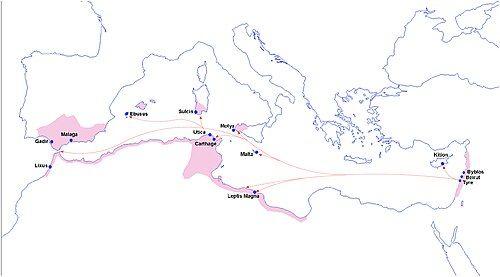
Trivia Question Study Fact: Phoenician states like Tyre and Sidon exemplify thalassocracies – empires built on maritime power – as their influence and control were primarily exercised through sea lanes and coastal trade rather than extensive inland territories. This contrasts with tellurocracies, which establish dominance over land-based interiors.
Trivia Question Explanation: Phoenician states, such as Tyre and Sidon, built their empires through maritime trade and naval power, controlling sea lanes and establishing coastal colonies rather than focusing on conquering and governing extensive inland areas.
Return to Question
Study Hint 2
Question: In the context of Agenor, Phoenicia is considered to have existed as a kingdom with a documented ruler as early as…
Trivia Question Study Fact: According to Greek historian Herodotus, Agenor was a Phoenician king of either Tyre or Sidon who lived significantly before the Greco-Persian Wars, with estimates placing his existence between 1450 and 1050 BC. This makes him a figure from a very early period in Phoenician history, predating much of the documented interaction between Phoenicia and the Greeks.
Trivia Question Explanation: Herodotus estimated Agenor lived either 1000 or 1600 years before his visit to Tyre around 450 BC, placing the reign of this Phoenician king in the mid-second millennium BC, well before many other historically recognized periods.
Return to Question
Study Hint 3
Question: In the context of Antigonus I Monophthalmus’s rise to power, Phoenicia was considered…
Trivia Question Study Fact: Following Alexander the Great's death, Antigonus I Monophthalmus gained control of a substantial empire encompassing Greece, Asia Minor, Syria, Phoenicia, and parts of Mesopotamia, briefly becoming the most powerful of Alexander's successors before facing a coalition that led to his defeat.
Trivia Question Explanation: Antigonus I Monophthalmus briefly ruled over a vast empire that included Phoenicia, making it a part of his domain during his most powerful period as one of Alexander the Great’s successors.
Return to Question
Study Hint 4
Question: In the context of Early Christianity, Phoenicians are notable for being among the first populations, alongside Jewish communities, to embrace the new faith, becoming known as what regional Christian group?
Trivia Question Study Fact: During the early spread of Christianity, the faith wasn't limited to Jewish communities within the Holy Land and the Jewish diaspora. It also found early adherents among the Phoenicians, who became some of the first non-Jewish Christians, establishing a presence known as Lebanese Christians.
Trivia Question Explanation: The earliest followers of Christianity included both Jewish Christians and Phoenicians, who were identified as Lebanese Christians due to their geographical origin and early adoption of the faith.
Return to Question
Study Hint 5
Question: In the context of Early Christianity, Phoenicians are noted for being among the first to do what?
Trivia Question Study Fact: During the early stages of Christianity, the faith wasn't limited to Jewish converts; it also found initial followers among the Phoenicians, who were establishing Christian communities in regions like modern-day Lebanon. This demonstrates an early expansion beyond its Jewish origins within the Eastern Mediterranean.
Trivia Question Explanation: The earliest followers of Christianity included both Jewish converts and individuals from other groups, such as the Phoenicians, who simultaneously embraced the new faith alongside Jewish Christians, contributing to its initial spread.
Return to Question
Study Hint 6
Question: In the context of the Phoenician alphabet, what key innovation distinguished it from previous writing systems?
Trivia Question Study Fact: The Phoenician alphabet, emerging in the 1st millennium BC, represents a significant milestone in the history of writing systems as it was one of the earliest alphabets and notably established a consistent writing direction – horizontally from right to left – a departure from the multi-directional approaches of earlier scripts.
Trivia Question Explanation: Prior to the Phoenician alphabet, writing systems often utilized multiple directions, making reading less standardized. The Phoenician script’s consistent right-to-left horizontal direction streamlined the writing process and improved readability.
Return to Question
Study Hint 7
Question: In the context of the Euclidean alphabet, how did the Greeks modify the Phoenician alphabet to better suit the Greek language?
Trivia Question Study Fact: Following the Late Bronze Age collapse and Greek Dark Age, the Greeks adopted the Phoenician alphabet, but adapted it significantly. The Phoenician system primarily represented consonants, which was less suitable for the Greek language. To address this, the Greeks utilized 'matres lectionis' – originally used by the Phoenicians to indicate some vowels – and repurposed Phoenician consonant letters representing sounds absent in Greek to consistently represent Greek vowels.
Trivia Question Explanation: The Phoenician alphabet was consonant-focused, which didn't align with the structure of the Greek language. Greeks creatively repurposed Phoenician letters, including those originally indicating vowels ('matres lectionis'), to consistently represent vowel sounds in Greek.
Return to Question
Study Hint 8
Question: In the context of the Canary Current, Phoenician settlements along the Northwest African coast were primarily focused on exploiting which resource?
Trivia Question Study Fact: The Canary Current, a slow-moving surface current off the coast of Northwest Africa, played a significant role in the early maritime activities of the Phoenicians. They utilized the current for navigation and settlement along the coasts of modern-day Morocco and Spanish Sahara, and importantly, established a dye-extraction facility at Iles Purpuraires to produce Tyrian purple from murex snails found within the current's zone.
Trivia Question Explanation: The Phoenicians established a factory at Iles Purpuraires specifically for extracting Tyrian purple dye from murex snails, demonstrating a focused exploitation of this marine resource within the Canary Current's zone.
Return to Question
Study Hint 9
Question: In the context of a merchant, Phoenicia is considered a civilization where evidence suggests…
Trivia Question Study Fact: The practice of merchant trade, involving international import and export, has a long history, with evidence of merchant activity and networks existing in ancient civilizations including Phoenicia alongside Babylonia, Assyria, Egypt, Greece, and Rome, demonstrating early interconnectedness through commerce.
Trivia Question Explanation: Historical records indicate that Phoenicia, alongside other ancient civilizations, actively participated in trade and commerce, establishing merchant networks for both domestic and international exchange.
Return to Question
Study Hint 10
Question: In the context of Africa as a Roman province, Phoenicia is considered…
Trivia Question Study Fact: Prior to Roman control of the region that became the province of Africa, Phoenician settlements were established along the North African coast starting in the 9th century BC. These settlements, originating from the Levant, were crucial for expanding Phoenician shipping networks, with Carthage eventually becoming the most prominent of these colonies before its conquest by Rome.
Trivia Question Explanation: Before Roman rule, Phoenicians established settlements along the North African coast to support their trade routes, and Carthage, a Phoenician colony, became a dominant power before being conquered by Rome.
Return to Question