Materials covered in this trivia questions quiz
Study Hint 1
Question: In the context of Europa, Phoenicia is considered…
Trivia Question Study Fact: According to Greek mythology, Europa was a princess originating from Phoenicia, specifically the city of Tyre. She is best known as the mother of King Minos of Crete, with her story involving an abduction by Zeus in the guise of a bull being a significant Cretan narrative.
Trivia Question Explanation: Europa's mythological background details her as a Phoenician princess from Tyre, establishing Phoenicia as her ancestral homeland and the source of her royal status.
Return to Question
Study Hint 2
Question: In the context of Hellenization, Phoenicia is considered…
Trivia Question Study Fact: During the Hellenistic period, following Alexander the Great's conquests, numerous territories experienced Hellenization, a process involving the adoption of Greek culture, religion, language, and identity by non-Greek populations. This cultural assimilation often occurred as a consequence of Greek colonization in earlier periods.
Trivia Question Explanation: The provided text explicitly states that many territories conquered by Alexander the Great were Hellenized, indicating that regions like Phoenicia experienced the adoption of Greek culture, religion, language, and identity.
Return to Question
Study Hint 3
Question: In the context of Ceuta, Phoenician involvement is considered…
Trivia Question Study Fact: Ceuta's strategic location as a port city has been contested for centuries, with Phoenicians establishing a settlement there and subsequent control shifting between various powers including Romans, Byzantines, Arab Caliphates, and eventually Portugal and Spain. This control was often tied to dominance over the Strait of Gibraltar, a crucial waterway.
Trivia Question Explanation: The source text details how Phoenicians founded a settlement in Ceuta, which later became a key contested port due to its location along the Strait of Gibraltar and between the Mediterranean and Atlantic Oceans.
Return to Question
Study Hint 4
Question: In the context of Palermo, the original Phoenician name for the city, reflecting its early origins, was…
Trivia Question Study Fact: Palermo, a city in modern-day Sicily, was initially founded as a Phoenician settlement around 734 BC under the name 'Sis,' meaning 'flower.' It later came under Carthaginian control and was also known by the Greek name 'Panormos,' which the Carthaginians adopted for their coinage.
Trivia Question Explanation: The Phoenicians established Palermo around 734 BC and named it 'Sis,' which translates to 'flower' in their language, signifying the city's initial founding and cultural roots.
Return to Question
Study Hint 5
Question: In the context of Libya, Phoenicia is considered to have primarily contributed to the development of what aspect of the region during classical antiquity?
Trivia Question Study Fact: Historically, the region of modern-day Libya was not solely inhabited by Berber populations. During classical antiquity, Phoenician traders and settlers established city-states and trading posts along the western coast of Libya, demonstrating early commercial activity and cultural exchange in the area.
Trivia Question Explanation: The Phoenicians were a maritime people known for establishing trading networks and settlements throughout the Mediterranean, and the source text specifically states they established city-states and trading posts in western Libya.
Return to Question
Study Hint 6
Question: In the context of European_colonies, Phoenicia is considered significant primarily for what historical distinction?
Trivia Question Study Fact: Prior to the Age of Discovery, various ancient civilizations, including the Phoenicians, established colonies across different regions. However, the Portuguese, beginning around 1450, initiated a new phase of European colonialism driven by expansionism, religious aims, and economic motivations, utilizing a newly developed ship, the caravel, which was based on North African fishing boats.
Trivia Question Explanation: The text highlights that the Phoenicians were among several ancient civilizations that engaged in colonization, demonstrating that the practice wasn't exclusive to the later European colonial period.
Return to Question
Study Hint 7
Question: In the context of Iberian culture, Phoenician influence is primarily associated with which group of people?
Trivia Question Study Fact: Ancient authors used the term 'Iberian' in two ways: broadly to encompass all inhabitants of the Iberian Peninsula, and more specifically to refer to the pre-Indo-European people of the eastern and southern coasts who, by the 6th century BC, had integrated cultural elements from Phoenicians, Carthaginians, and Greeks into their society.
Trivia Question Explanation: By the 6th century BC, the Iberians of the eastern and southern Iberian coasts had absorbed cultural influences from the Phoenicians, alongside the Carthaginians and Greeks, shaping their societal development.
Return to Question
Study Hint 8
Question: In the context of Canaanite and Aramaic inscriptions, Phoenicia is considered a key focus of study due to its representation within which broader linguistic grouping?
Trivia Question Study Fact: Understanding the societies and histories of Phoenicia relies heavily on Canaanite and Aramaic inscriptions, which provide crucial extra-Biblical evidence. These inscriptions, categorized as Northwest Semitic, encompass languages like Phoenician, Hebrew, and Aramaic, appearing on various materials from stone slabs to pottery shards.
Trivia Question Explanation: Canaanite and Aramaic inscriptions are collectively known as Northwest Semitic inscriptions, and these inscriptions are the primary source for understanding the histories of Phoenicia, Israelites, and Arameans, all of whom spoke languages within this grouping.
Return to Question
Study Hint 9
Question: In the context of Early Christianity, Phoenicians are noted for being among the first to do what?
Trivia Question Study Fact: During the early stages of Christianity, the faith wasn't limited to Jewish converts; it also found initial followers among the Phoenicians, who were establishing Christian communities in regions like modern-day Lebanon. This demonstrates an early expansion beyond its Jewish origins within the Eastern Mediterranean.
Trivia Question Explanation: The initial spread of Christianity included not only Jewish converts, but also Phoenicians who simultaneously established Christian communities, indicating a broadening of the faith's reach beyond its Jewish roots in the Eastern Mediterranean.
Return to Question
Study Hint 10
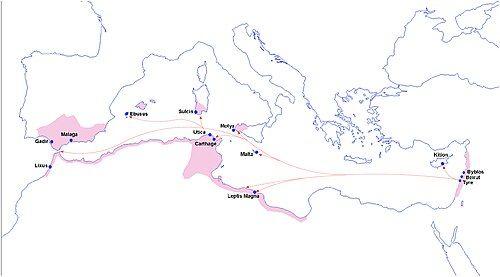
Question: In the context of the Mediterranean world, Phoenicia is considered…
Trivia Question Study Fact: Within the broader history of the Mediterranean region, Phoenicia emerged as a significant culture alongside many others – including Mesopotamian, Egyptian, and Carthaginian civilizations – benefiting from the Mediterranean Sea’s role as a central hub for transport, trade, and cultural exchange between Western Asia, North Africa, and Southern Europe.
Trivia Question Explanation: Phoenicia flourished due to its location within the Mediterranean Sea, which served as a vital superhighway for trade and cultural exchange between three continents, allowing Phoenician merchants to connect diverse regions.
Return to Question