Materials covered in this trivia questions quiz
Study Hint 1
Question: In the context of Athens, which civilization was most significantly impacted by its advancements in democracy, the arts, and philosophy during its Classical period?
Trivia Question Study Fact: While Athens is recognized as the birthplace of democracy and a significant center for philosophy and the arts within Ancient Greece, its influence extended far beyond its borders, profoundly impacting the development of Ancient Rome and ultimately contributing to the foundations of Western civilization.
Trivia Question Explanation: The source text explicitly states that Classical Athens was highly influential throughout the European continent, particularly in Ancient Rome, due to its contributions to democracy, the arts, education, and philosophy.
Return to Question
Study Hint 2
Question: In the context of the Municipality of Athens, Classical Athens is considered…
Trivia Question Study Fact: Within the context of the Municipality of Athens, Classical Athens flourished as a dominant city-state in ancient Greece, becoming a pivotal center for democratic governance, artistic expression, philosophical inquiry, and education, profoundly influencing the development of Western civilization and even impacting Ancient Rome.
Trivia Question Explanation: Classical Athens gained prominence as a hub of intellectual and political innovation, fostering advancements in democracy, the arts, and philosophical thought, which subsequently shaped the course of Western civilization.
Return to Question
Study Hint 3
Question: In the context of Classical Greece, Classical Athens is considered a significant historical entity primarily due to its role in…
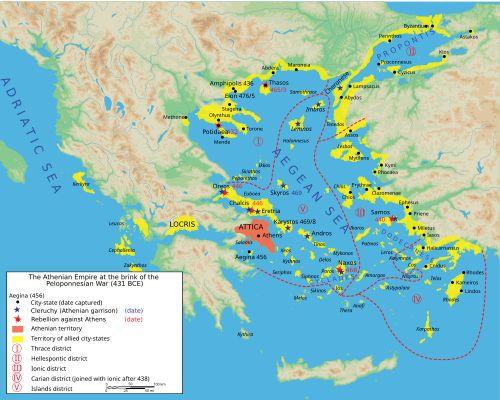
Trivia Question Study Fact: During the classical period (480–323 BC), Classical Athens served as a dominant city-state in ancient Greece, leading the Delian League against Sparta in the Peloponnesian War. This period also saw the establishment of Athenian democracy, which, despite some interruptions, remained stable for 180 years, fostering a unique environment for philosophical and artistic development.
Trivia Question Explanation: Classical Athens distinguished itself through its leadership of the Delian League and the establishment of a democratic system that, despite some interruptions, endured for a substantial period, influencing the course of ancient Greek history.
Return to Question
Study Hint 4
Question: In the context of Ancient Greece, the emergence of Greek city-states and subsequent colonization of the Mediterranean Basin directly preceded which significant historical period?
Trivia Question Study Fact: Following a period of decline after the Bronze Age collapse, Greek city-states, known as poleis, began to emerge in the 8th century BC. This marked the beginning of the Archaic period and a wave of colonization throughout the Mediterranean Basin, eventually leading to the era of Classical Greece, which included the significant conflicts of the Peloponnesian War between Athens and Sparta.
Trivia Question Explanation: The provided text explicitly states that the formation of Greek poleis in the 8th century BC ushered in the Archaic period, directly preceding the era of Classical Greece.
Return to Question
Study Hint 5
Question: In the context of Athenian democracy, which of the following best describes the prevalence of democratic governance among other Greek city-states?
Trivia Question Study Fact: While Athenian democracy is the most well-known example of democratic governance in ancient Greece, it wasn't unique; numerous other Greek city-states experimented with similar constitutions before and during Athens' democratic period, with as many as half of the over one thousand Greek cities potentially embracing democratic principles by the late 4th century BC.
Trivia Question Explanation: Historical accounts suggest that Athenian democracy, while influential, was not an isolated phenomenon, as a significant portion of Greek city-states explored democratic models during the same period.
Return to Question
Study Hint 6
Question: In the context of the history of theatre, Classical Athens is considered…
Trivia Question Study Fact: Though performative elements exist universally, the formal study of theatre as a distinct art form traces its origins to Classical Athens in the 5th century BC, marking a pivotal moment in its development as an autonomous cultural activity.
Trivia Question Explanation: The development of theatre as an autonomous activity, separate from other performative elements in society, is generally acknowledged to have begun in Classical Athens during the 5th century BC.
Return to Question
Study Hint 7
Question: In the context of Philip II of Macedon, Classical Athens is most notably associated with which subsequent development?
Trivia Question Study Fact: Following victories over Classical Athens and Thebes at the Battle of Chaeronea in 338 BC, Philip II of Macedon spearheaded the creation of the Hellenic League, a federation of Greek states. He was designated as the league's hegemon and commander-in-chief, intending to lead a joint invasion of the Achaemenid Empire.
Trivia Question Explanation: Philip II's victory at the Battle of Chaeronea resulted in Athens becoming part of the Hellenic League, a federation he established and led, designed to unite Greek states for a campaign against the Achaemenid Empire.
Return to Question
Study Hint 8
Question: In the context of Attica, Classical Athens is considered...
Trivia Question Study Fact: The historical region of Attica, a peninsula projecting into the Aegean Sea, served as the territory of the classical Athens city-state. During the Golden Age of Athens in the classical period, Attica was a prominent region in Ancient Greece, divided into demes – municipalities – categorized as urban, coastal, or inland.
Trivia Question Explanation: The source text explicitly states that the history of Attica is closely linked with that of Athens and that Attica was the most prominent region in Ancient Greece, especially during the Golden Age of Athens.
Return to Question
Study Hint 9
Question: In the context of Tragedy, Classical Athens is considered particularly important because of its role in…
Trivia Question Study Fact: Tragedy, originating in ancient Greece, developed as a dramatic genre focused on human suffering and sorrowful events befalling a central character. This form of drama held particular significance for Classical Athens and later Western civilization, serving as a means of cultural self-definition and historical continuity alongside other periods like the Elizabethan era, fostering a sense of shared cultural identity through its enduring themes and artistic expression.
Trivia Question Explanation: The origins of tragedy lie in ancient Greece, and the genre played a unique role in shaping the self-understanding and historical continuity of Classical Athens and, subsequently, Western civilization.
Return to Question
Study Hint 10
Question: In the context of Ancient Greek comedy, Classical Athens is considered the origin point for which key development in dramatic arts?
Trivia Question Study Fact: Within the theatre of classical Greece, comedy distinguished itself from tragedy and satyr plays through its characteristic happy endings and reliance on exaggerated character archetypes, ultimately shaping the modern understanding of comedic performance. Athenian comedy evolved through three distinct periods – Old, Middle, and New – with significant works surviving from Aristophanes and Menander.
Trivia Question Explanation: Ancient Greek comedy, particularly in Athens, saw a clear progression through Old, Middle, and New Comedy, with notable playwrights like Aristophanes and Menander defining each era and establishing a tradition of comedic writing.
Return to Question