Materials covered in this trivia questions quiz
Study Hint 1
Question: In the context of Classical Athens, which role among the archons was primarily responsible for lending their name to the year in which they held office?
Trivia Question Study Fact: In Classical Athens, the system of nine archons included the eponymous archon, who held the highest political office and was distinguished by the practice of lending their name to the year in which they served, a system similar to the Roman consular years.
Trivia Question Explanation: The eponymous archon’s unique contribution was to provide the name for the year, a practice mirroring the Roman system of dating by consular years, signifying their prominent position within Athenian governance.
Return to Question
Study Hint 2
Question: In the context of cleruchies, Classical Athens is considered…
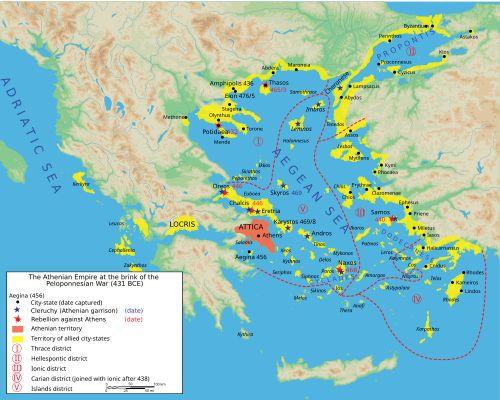
Trivia Question Study Fact: During Classical Greece, Athens established unique colonies known as cleruchies. These weren't typical settlements; instead, they were specialized colonies where Athenian citizens, selected by lottery, were granted land and tasked with military service and promoting Athenian culture in newly acquired territories.
Trivia Question Explanation: Cleruchies were distinct from other Greek colonies because they involved Athenian citizens being granted land and assigned military responsibilities in these new settlements, a system determined by lottery.
Return to Question
Study Hint 3
Question: In the context of the Battle of the Echinades, Classical Athens is considered…
Trivia Question Study Fact: During the Lamian War (323–322 BC), the Athenian navy engaged in a naval battle against the Macedonian fleet led by Cleitus the White, marking a significant moment in the conflict between Classical Athens and the expanding Macedonian power.
Trivia Question Explanation: The Battle of the Echinades was a direct confrontation between the Athenian and Macedonian navies as part of the larger Lamian War, demonstrating Athens' involvement in resisting Macedonian influence.
Return to Question
Study Hint 4
Question: In the context of the Battle of Amorgos, Classical Athens is considered to have experienced what significant shift in its power and status?
Trivia Question Study Fact: The Battle of Amorgos, a naval conflict during the Lamian War, marked a turning point for Classical Athens, effectively ending its period of dominance at sea – known as a thalassocracy – and its political independence despite relatively light losses.
Trivia Question Explanation: The Battle of Amorgos resulted in a decisive Athenian defeat, signaling the conclusion of Athens’ thalassocracy and its ability to function as an independent political entity, despite not incurring substantial losses.
Return to Question
Study Hint 5
Question: In the context of the Greco-Persian Wars, what immediate consequence did the joint actions of Classical Athens and Eretria have following their involvement in the Ionian Revolt?
Trivia Question Study Fact: During the Greco-Persian Wars, the Ionian Revolt, which began in 499 BC, saw several Greek city-states, including Classical Athens and Eretria, provide military assistance to the rebellious cities of Asia Minor. In 498 BC, Athenian and Eretrian forces collaborated to capture and burn the Persian regional capital of Sardis, prompting a vow of revenge from Darius the Great.
Trivia Question Explanation: The source text explicitly states that after Athenian and Eretrian forces burned Sardis, Darius the Great vowed to have revenge on Athens and Eretria for this act, demonstrating the direct consequence of their involvement.
Return to Question
Study Hint 6
Question: In the context of Attic Greek, Classical Athens is most notably recognized as:
Trivia Question Study Fact: Attic Greek, the dialect spoken in ancient Attica including Classical Athens, gained prestige throughout the Greek world for centuries. Its influence extended into the Hellenistic period, serving as the foundation for Koine Greek and remaining the standard form taught to students of Ancient Greek, demonstrating its enduring significance as a linguistic ancestor to modern Greek.
Trivia Question Explanation: Classical Athens, situated within Attica, was the birthplace of Attic Greek, a dialect that achieved widespread prestige and served as a crucial foundation for the development of Koine Greek, highlighting its lasting impact on the Greek language.
Return to Question
Study Hint 7
Question: In the context of the Trial of Socrates, Classical Athens considered accusations of *asebeia* to primarily concern what aspect of Socrates’s actions?
Trivia Question Study Fact: In 399 BC, the trial of Socrates in Classical Athens centered on accusations of *asebeia*, or impiety, specifically regarding his religious beliefs and their perceived impact on the city’s traditional pantheon. He was accused of both failing to recognize the established gods and introducing new ones, charges that ultimately led to his conviction and execution.
Trivia Question Explanation: Socrates was formally accused of impiety, or *asebeia*, which involved both a rejection of the city’s recognized gods and the introduction of new deities, demonstrating a challenge to the traditional religious framework of Athens.
Return to Question
Study Hint 8
Question: In the context of Plato's dialogues, Classical Athens is considered most significantly for what role?
Trivia Question Study Fact: Within the context of Plato's dialogues, Classical Athens served as the location for the Platonic Academy, a philosophical school founded by Plato where he taught a collection of philosophical theories that would later be recognized as Platonism. This demonstrates that Athens was not merely a backdrop for Plato's work, but a central hub for the development and dissemination of his philosophical ideas.
Trivia Question Explanation: The provided text explicitly states that Plato founded the Platonic Academy in Classical Athens, where he taught philosophical theories that became known as Platonism. This highlights Athens's importance as a location for Plato's philosophical endeavors, rather than as a source of inspiration or a political ideal.
Return to Question
Study Hint 9
Question: In the context of Socratic irony, Classical Athens is notable for witnessing the frequent application of a philosophical technique where Socrates and his interlocutors would typically arrive at what state?
Trivia Question Study Fact: Within Plato's dialogues, Socrates frequently employed a method of questioning known as 'elenchus,' characterized by short exchanges and aimed at exploring abstract meanings, often related to virtues. This process typically resulted in an impasse, where participants realized they could not define what they initially believed they understood, highlighting Socrates's claim of ignorance.
Trivia Question Explanation: Plato's dialogues detail Socrates's use of 'elenchus,' a questioning method that often led to a point of impasse, demonstrating a lack of clear understanding despite initial assumptions. This highlights the core of Socratic inquiry and his famous declaration of ignorance.
Return to Question
Study Hint 10
Question: In the context of the Greco-Persian Wars, Classical Athens’ initial involvement stemmed from supporting which event, ultimately provoking a direct response from the Persian king Darius the Great?
Trivia Question Study Fact: During the Greco-Persian Wars, the involvement of Classical Athens began with providing military support to the Ionian Revolt, specifically aiding in the capture and burning of the Persian regional capital of Sardis in 498 BC. This act of defiance directly led to Darius the Great’s vow of revenge against Athens and Eretria, escalating the conflict.
Trivia Question Explanation: Athens and Eretria provided military support to the Ionian cities rebelling against Persian rule, and their combined forces successfully captured and burned Sardis, a key Persian city, which prompted Darius the Great to seek retribution.
Return to Question