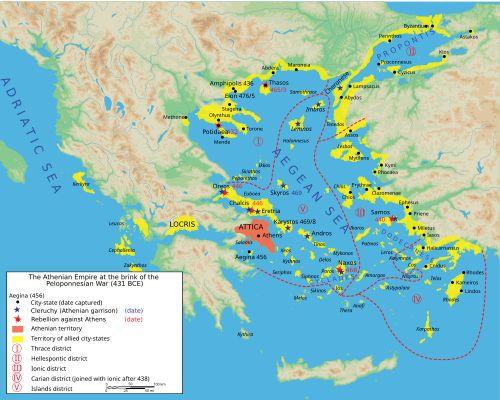
Materials covered in this trivia questions quiz
Study Hint 1
Question: In the context of Athens, Classical Athens is considered…
Trivia Question Study Fact: Classical Athens, a prominent city-state in ancient Greece, distinguished itself as a hub for democracy, artistic expression, education, and philosophical inquiry. Its influence extended significantly throughout the European continent, notably impacting Ancient Rome, and earned it recognition as a foundational element of Western civilization and the origin point of democratic principles.
Trivia Question Explanation: Classical Athens flourished as a center of intellectual and political life, pioneering democratic governance, fostering artistic innovation, and advancing philosophical thought, which profoundly shaped Western civilization.
Return to Question
Study Hint 2
Question: In the context of the Battle of Thermopylae, Classical Athens is considered instrumental in what key aspect of the Greek defense against the Persian invasion?
Trivia Question Study Fact: Following the Athenian victory at Marathon in 490 BC, the Persian Empire, under Xerxes I, launched a second invasion of Greece a decade later. This invasion prompted Athenian strategist Themistocles to advocate for a dual defensive strategy: holding the Persian army at Thermopylae and simultaneously engaging their navy at the Straits of Artemisium, demonstrating Athens' proactive role in organizing Greek resistance.
Trivia Question Explanation: Themistocles, an Athenian politician and general, proposed the strategy of simultaneously defending Thermopylae by land and Artemisium by sea, which formed the core of the Greek defensive plan against Xerxes’ invasion.
Return to Question
Study Hint 3
Question: In the context of criticism of religion, Classical Athens is considered…
Trivia Question Study Fact: Early documented criticism of religion, specifically questioning religious validity, emerged in 5th century BCE Athens, with figures like Diagoras of Melos being noted for their skeptical views. This represents one of the earliest historical instances of challenging established religious beliefs within a developed city-state.
Trivia Question Explanation: Historical records indicate that criticism of religion dates back to at least the 5th century BCE in Athens, with individuals like Diagoras of Melos openly questioning religious tenets, making it a significant early location for such discourse.
Return to Question
Study Hint 4
Question: In the context of Ancient Greece, Classical Athens is best characterized as existing within a political structure that was predominantly…
Trivia Question Study Fact: Classical Athens existed within a broader Ancient Greek civilization comprised of independent city-states, experiencing periods of both internal conflict, like the Peloponnesian War with Sparta, and external challenges, such as the Greco-Persian Wars. While briefly unified under Macedonian rule, most of its history involved a 'loose collection' of these independent communities.
Trivia Question Explanation: Ancient Greece, including Classical Athens, was not a unified country but rather a network of independent city-states, each with its own government and laws, though sharing cultural and linguistic similarities.
Return to Question
Study Hint 5
Question: In the context of the Macedonian Empire, Classical Athens is considered to have been…
Trivia Question Study Fact: Prior to the 4th century BC, Macedonia existed as a smaller kingdom on the periphery of Classical Greece, often overshadowed by prominent city-states like Athens, Sparta, and Thebes, and even experienced a period of subordination to the Achaemenid Empire. However, under Philip II, Macedonia rose to prominence, ultimately conquering much of mainland Greece and establishing a dominant position that paved the way for his son, Alexander the Great, to create a vast empire.
Trivia Question Explanation: Before Macedonia’s rise to power, Athens was one of the dominant city-states in Greece. Philip II of Macedonia defeated Athens at the Battle of Chaeronea in 338 BC, bringing the city-state under Macedonian control, and this control continued under Alexander the Great.
Return to Question
Study Hint 6
Question: In the context of Athens, Greece, Classical Athens is considered…
Trivia Question Study Fact: Classical Athens, a prominent city-state in ancient Greece, flourished as a hub of democracy, arts, education, and philosophy. Its influence extended throughout the European continent, notably impacting Ancient Rome, and it is widely considered a foundational location for both Western civilization and the development of democratic principles.
Trivia Question Explanation: Classical Athens served as a significant center for democracy, arts, education, and philosophy, profoundly influencing the course of Western civilization and leaving a lasting legacy on European thought and culture.
Return to Question
Study Hint 7
Question: In the context of Classical Athens, the position of *basilinna* was primarily associated with which aspect of Athenian society?
Trivia Question Study Fact: In ancient Athens, the *basilinna* was a ceremonial role held by the wife of the *archon basileus*, originating from the time when Athens was ruled by kings and their wives served as priestesses. Her qualifications, including Athenian birth and unmarried status, were formally inscribed on a stele within the sanctuary of Dionysus at Limnai, though the strictness of these requirements is debated.
Trivia Question Explanation: The *basilinna*’s role stemmed from the wives of kings acting as priestesses, and she was the wife of the *archon basileus*, indicating a connection to both religious duties and the vestiges of Athens’s earlier royal structure.
Return to Question
Study Hint 8
Question: In the context of Lower Macedonia, the location of both the original capital, Aigai, and the later capital, Pella, places these significant cities within the borders of modern-day…
Trivia Question Study Fact: Lower Macedonia, the historical heartland of the ancient kingdom of Macedon, was a geographically defined coastal plain encompassing districts like Emathia, Pieria, and Bottiaea. This region, watered by rivers like the Haliacmon and Axius, served as the core of the Argead dynasty and was the setting for key cities like Aigai and Pella, which were central to the development of Classical Athens’ northern neighbor and eventual conqueror.
Trivia Question Explanation: Both Aigai (near Vergina) and Pella, crucial cities in the history of Macedon, are located within the modern regional unit of Central Macedonia in Greece, as established by contemporary geographical boundaries.
Return to Question
Study Hint 9
Question: In the context of the Antigonid Macedonian army, Classical Athens is considered…
Trivia Question Study Fact: The Antigonid Macedonian army, evolving from the kingdom of Macedonia, became a dominant military power in Hellenistic Greece between 276 and 168 BC, engaging in conflicts with various Greek city-states and leagues, including Athens, Sparta, and Rhodes. These campaigns demonstrate a shift in power dynamics within the region following the decline of the classical Greek period.
Trivia Question Explanation: The Antigonid army fought campaigns against numerous Hellenistic powers, and Athens is specifically listed among those opponents, indicating a history of conflict between the two.
Return to Question
Study Hint 10
Question: In the context of *Oedipus Rex*, Classical Athens’ understanding of the term “tyrant” differed from modern interpretations primarily because it…
Trivia Question Study Fact: Sophocles's *Oedipus Rex*, a foundational work of Athenian tragedy, initially circulated simply as *Oedipus* before being distinguished from his later play, *Oedipus at Colonus*, by the addition of the title *Tyrannus*. In Classical Athens, the term 'tyrant' did not automatically carry a negative meaning, but rather denoted a ruler without a legitimate claim to power.
Trivia Question Explanation: The source text explains that in antiquity, the term 'tyrant' simply described a ruler without a legitimate claim to rule, and did not inherently carry a negative connotation, which contrasts with its modern usage.
Return to Question