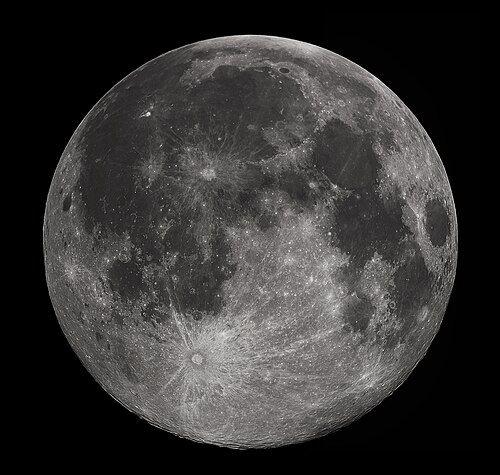
Materials covered in this trivia questions quiz
Study Hint 1
Question: In the context of conjunctions, the Moon is considered to be involved when…
Trivia Question Study Fact: An astronomical conjunction happens when two celestial bodies appear near each other in the sky from Earth's perspective, often because they share similar positions relative to the ecliptic. This phenomenon can occur between planets, or between a planet and the Moon, indicating a close apparent approach.
Trivia Question Explanation: A conjunction is defined as the apparent closeness of two astronomical objects in the sky, and the Moon frequently participates in these events by appearing near planets or the Sun when viewed from Earth.
Return to Question
Study Hint 2
Question: In the context of lunar phases, the duration of a lunar month – the time it takes for the Moon to cycle through all its phases – is not constant. What primarily causes this variation?
Trivia Question Study Fact: The apparent changes in the Moon's appearance, known as lunar phases, are a result of the varying amounts of the sunlit side of the Moon becoming visible as it orbits Earth. This cycle of phases takes approximately 29.5 days to complete, representing the time between successive recurrences of the same phase, and is influenced by the Moon's slightly elliptical orbit.
Trivia Question Explanation: The Moon's orbit around Earth isn't a perfect circle; it's slightly elliptical, meaning its distance from Earth varies. This eccentricity affects the time it takes to complete a full cycle of phases, causing the lunar month to fluctuate slightly around an average of 29.5 days.
Return to Question
Study Hint 3
Question: In the context of Twenty-Eight Mansions, the Moon is considered to be tracked according to what celestial measurement?
Trivia Question Study Fact: The Twenty-Eight Mansions, a component of the Chinese constellations system, function similarly to the Western zodiac but are based on the Moon’s orbital path through the sidereal month, tracking its movement rather than the Sun’s path through the tropical year.
Trivia Question Explanation: The Twenty-Eight Mansions system focuses on the Moon’s apparent movement across the sky, specifically measuring its progress through a sidereal month, which is based on the stars rather than the Sun’s position.
Return to Question
Study Hint 4
Question: In the context of Zodiac constellations, the Moon's presence within the zodiac belt is notable because it appears…
Trivia Question Study Fact: The zodiac is a region of the sky centered around the ecliptic – the Sun's apparent path – and includes the Moon and planets within its boundaries. This belt is divided into twelve signs, each 30 degrees of celestial longitude, which historically corresponded to constellations and were used to mark the time of year based on the Sun's position.
Trivia Question Explanation: The zodiac is defined as a belt around the ecliptic, which is the apparent path of the Sun, and the Moon's orbit also falls within this region, making its presence within these boundaries a key characteristic.
Return to Question
Study Hint 5
Question: In the context of lunar distance (navigation), the Moon is considered essential for…
Trivia Question Study Fact: Before the widespread adoption of accurate marine chronometers, navigators utilized a technique called 'lunar distance' which involved measuring the angular distance between the Moon and other celestial bodies, alongside a nautical almanac, to determine Greenwich Mean Time and subsequently calculate a ship's position. This method, first detailed by Johannes Werner in 1524, remained a crucial navigational tool for roughly 300 years.
Trivia Question Explanation: The lunar distance method relies on precisely measuring the Moon's angular distance from other celestial objects, combined with data from a nautical almanac, to establish a ship's longitude and time.
Return to Question
Study Hint 6
Question: In the context of months, the Moon is considered…
Trivia Question Study Fact: The very concept of a 'month' as a unit of time originated from observing the cycles of the Moon's phases, with early humans tracking days in relation to the Moon as far back as the Paleolithic age. This connection is reflected in the etymological relationship between the words 'month' and 'Moon', as they share a common linguistic origin.
Trivia Question Explanation: Early calendars were developed by observing the natural phases of the Moon, and the word 'month' itself is historically linked to the word 'Moon', demonstrating its foundational role in timekeeping.
Return to Question
Study Hint 7
Question: In the context of calendars, how does a lunar calendar differ from a solar calendar in its primary method of tracking time?
Trivia Question Study Fact: A lunar calendar organizes time based on the cycles of the Moon's phases, specifically synodic months or lunations, which are approximately 29.5 days long. This results in a lunar year of roughly 354 days, making it significantly shorter than a solar year and causing lunar months to cycle through all seasons over a 33-34 year period.
Trivia Question Explanation: Lunar calendars are fundamentally defined by their alignment with the monthly phases of the Moon, using lunations to determine the length of months, unlike solar calendars which are based on the Earth's orbit around the Sun.
Return to Question
Study Hint 8
Question: In the context of lunar months, how is the beginning of a month typically determined?
Trivia Question Study Fact: A lunar month, as used in lunar calendars, isn't defined by the Moon's orbit around Earth in a fixed period, but rather by the time elapsed between two similar alignments – either two new moons or two full moons – marking the start and end of the month.
Trivia Question Explanation: Lunar months are defined by the time between two successive syzygies – alignments of the Sun, Earth, and Moon – which manifest as either new or full moons, rather than a consistent duration based on the Moon’s orbit.
Return to Question
Study Hint 9
Question: In the context of the Islamic New Year, how is the start of a new year most commonly determined?
Trivia Question Study Fact: The Islamic New Year, also known as the Hijri New Year, marks the beginning of the lunar Hijri year and is determined either by physical sightings of the crescent moon or, increasingly, by astronomical calculations. This determination impacts the timing of all Islamic religious observances, including prayer, fasting, pilgrimage, and festivals.
Trivia Question Explanation: While historically determined by observing the new moon, many Islamic institutions and countries now utilize astronomical calculations to establish the dates of the Islamic calendar, including the start of the Hijri New Year.
Return to Question
Study Hint 10
Question: In the context of free fall, the Moon is considered…
Trivia Question Study Fact: Although commonly associated with downward motion, free fall is defined as movement solely under the influence of gravity. This means an object moving upwards can still be in free fall, and celestial bodies like the Moon are perpetually in a state of free fall as they orbit Earth, prevented from crashing due to their orbital speed.
Trivia Question Explanation: The Moon maintains its orbit not because it escapes gravity, but because its forward velocity and the Earth's gravitational pull are balanced, resulting in a continuous state of falling *around* the Earth.
Return to Question