Sheet music in the context of Rag-time


Sheet music in the context of Rag-time

Sheet music Study page number 1 of 3

Play TriviaQuestions Online!

or

Skip to study material about Sheet music in the context of "Rag-time"


⭐ Core Definition: Sheet music

Sheet music is a handwritten or printed form of musical notation that uses musical symbols to indicate the pitches, rhythms, or chords of a song or instrumental musical piece. Like its analogs – printed books or pamphlets in English, Arabic, or other languages – the medium of sheet music typically is paper (or, in earlier centuries, papyrus or parchment). However, access to musical notation since the 1980s has included the presentation of scores on computer screens and the development of scorewriter computer programs that can notate a song or piece electronically, and, in some cases, "play back" the notated music using a synthesizer or virtual instruments.

The use of the term sheet is intended to differentiate written or printed forms of music from sound recordings (on vinyl record, cassette, CD), radio or TV broadcasts or recorded live performances, which may capture film or video footage of the performance as well as the audio component. In everyday use, sheet music (or simply music) can refer to the print publication of commercial sheet music in conjunction with the release of a new film, TV show, record album, or other unique or popular event which involves music. The first printed sheet music made with a printing press was made in 1473.

↓ Menu
HINT:

In this Dossier

Sheet music in the context of Song lyrics

Lyrics are words that make up a song, usually consisting of verses and choruses. The writer of lyrics is a lyricist. The words to an extended musical composition such as an opera are, however, usually known as a "libretto" and their writer, as a "librettist". Rap songs and grime contain rap lyrics (often with a variation of rhyming words) that are meant to be spoken rhythmically rather than sung. The meaning of lyrics can either be explicit or implicit. Some lyrics are abstract, almost unintelligible, and, in such cases, their explication emphasizes form, articulation, meter, and symmetry of expression.

View the full Wikipedia page for Song lyrics
↑ Return to Menu

Sheet music in the context of Musical composition

Musical composition can refer to an original piece or work of music, either vocal or instrumental, the structure of a musical piece or to the process of creating or writing a new piece of music. People who create new compositions are called composers. Composers of primarily songs are usually called songwriters; with songs, the person who writes lyrics for a song is the lyricist. In many cultures, including Western classical music, the act of composing typically includes the creation of music notation, such as a sheet music "score", which is then performed by the composer or by other musicians. In popular music and traditional music, songwriting may involve the creation of a basic outline of the song, called the lead sheet, which sets out the melody, lyrics and chord progression. In classical music, orchestration (choosing the instruments of a large music ensemble such as an orchestra which will play the different parts of music, such as the melody, accompaniment, countermelody, bassline and so on) is typically done by the composer, but in musical theatre and in pop music, songwriters may hire an arranger to do the orchestration. In some cases, a pop or traditional songwriter may not use written notation at all and instead compose the song in their mind and then play, sing or record it from memory. In jazz and popular music, notable sound recordings by influential performers are given the weight that written or printed scores play in classical music.

Although a musical composition often uses musical notation and has a single author, this is not always the case. A work of music can have multiple composers, which often occurs in popular music when all members of a band collaborate to write a song or in musical theatre, when one person writes the melodies, a second person writes the lyrics and a third person orchestrates the songs.

View the full Wikipedia page for Musical composition
↑ Return to Menu

Sheet music in the context of Lithography

Lithography (from Ancient Greek λίθος (líthos) 'stone' and γράφω (gráphō) 'to write') is a planographic method of printing originally based on the immiscibility of oil and water. The printing is from a stone (lithographic limestone) or a metal plate with a smooth surface. It was invented in 1796 by the German author and actor Alois Senefelder and was initially used mostly for musical scores and maps. Lithography can be used to print text or images onto paper or other suitable material. A lithograph is something printed by lithography, but this term is only used for fine art prints and some other, mostly older, types of printed matter, not for those made by modern commercial lithography.

Traditionally, the image to be printed was drawn with a greasy substance, such as oil, fat, or wax onto the surface of a smooth and flat limestone plate. The stone was then treated with a mixture of weak acid and gum arabic ("etch") that made the parts of the stone's surface that were not protected by the grease more hydrophilic (water attracting). For printing, the stone was first moistened. The water adhered only to the etched, hydrophilic areas, making them even more oil-repellant. An oil-based ink was then applied, and would stick only to the original drawing. The ink would finally be transferred to a blank sheet of paper, producing a printed page. This traditional technique is still used for fine art printmaking.

View the full Wikipedia page for Lithography
↑ Return to Menu

Sheet music in the context of Orchestration

Orchestration is the study or practice of writing music for an orchestra (or, more loosely, for any musical ensemble, such as a concert band) or of adapting music composed for another medium for an orchestra. Also called "instrumentation", orchestration is the assignment of different instruments to play the different parts (e.g., melody, bassline, etc.) of a musical work. For example, a work for solo piano could be adapted and orchestrated so that an orchestra could perform the piece, or a concert band piece could be orchestrated for a symphony orchestra.

In classical music, composers have historically orchestrated their own music. Only gradually over the course of music history did orchestration come to be regarded as a separate compositional art and profession in itself. In modern classical music, composers almost invariably orchestrate their own work. Two notable exceptions to this are Ravel's orchestration of Mussorgsky's solo piano work Pictures at an Exhibition and Malcolm Arnold's orchestration of William Walton's String Quartet in A minor, producing the latter's Sonata for Strings.

View the full Wikipedia page for Orchestration
↑ Return to Menu

Sheet music in the context of Conducting

Conducting is the art of directing a musical performance, such as an orchestral or choral concert. It has been defined as "the art of directing the simultaneous performance of several players or singers by the use of gesture." The primary duties of the conductor are to interpret the score in a way that reflects the specific indications in that score, set the tempo, ensure correct entries by ensemble members, and "shape" the phrasing where appropriate. Conductors communicate with their musicians primarily through hand gestures, usually with the aid of a baton, and may use other gestures or signals such as facial expression and eye contact. A conductor usually supplements their direction with verbal instructions to their musicians in rehearsal.

The conductor typically stands on a raised podium with a large music stand for the full score, which contains the musical notation for all the instruments or voices. Since the mid-19th century, most conductors have not played an instrument when conducting, although in earlier periods of classical music history, leading an ensemble while playing an instrument was common. In Baroque music, the group would typically be led by the harpsichordist or first violinist (concertmaster), an approach that in modern times has been revived by several music directors for music from this period. Conducting while playing a piano or synthesizer may also be done with musical theatre pit orchestras. Instrumentalists may perform challenging works while conducting - for instance, it is not uncommon to see a pianist perform a concerto while also conducting the orchestra. Communication is typically non-verbal during a performance. However, in rehearsals, frequent interruptions allow the conductor to give verbal directions as to how music should be performed.

View the full Wikipedia page for Conducting
↑ Return to Menu

Sheet music in the context of Part (music)

A part in music refers to a component of a musical composition. Because there are multiple ways to separate these components, there are several contradictory senses in which the word "part" is used:

  • any individual melody (or voice), whether vocal or instrumental, that can be abstracted as continuous and independent from other notes being performed simultaneously in polyphony. Within the music played by a single pianist, one can often identify outer parts (the top and bottom parts) or an inner part (those in between). On the other hand, within a choir, "outer parts" and "inner parts" would refer to music performed by different singers. (See § Polyphony and part-writing)
  • the musical instructions for any individual instrument or voice (often given as a handwritten, printed, or digitized document) of sheet music (as opposed to the full score which shows all parts of the ensemble in the same document). A musician's part usually does not contain instructions for the other players in the ensemble, only instructions for that individual.
  • the music played by any group of musicians who all perform together for a given piece; in a symphony orchestra, a dozen or more cello players may all play "the same part" even if they each have their own physical copy of the music. This part may be in unison or may be harmonized, and may even sometimes contain counter-melodies within it. A percussion part may sometimes only contain rhythm. This sense of "part" does not require a written copy of the music; a bass player in a rock band "plays the bass part" even if there is no written version of the song.
  • a section in the large-scale form of a piece. (See § Musical form)
View the full Wikipedia page for Part (music)
↑ Return to Menu

Sheet music in the context of Musical phrasing

Musical phrasing is the method by which a musician shapes a sequence of notes in a passage of music to allow expression, much like when speaking English a phrase may be written identically but may be spoken differently, and is named for the interpretation of small units of time known as phrases (half of a period). A musician accomplishes this by interpreting the music—from memory or sheet music—by altering tone, tempo, dynamics, articulation, inflection, and other characteristics. Phrasing can emphasise a concept in the music or a message in the lyrics, or it can digress from the composer's intention, aspects of which are commonly indicated in musical notation called phrase marks or phrase markings. For example, accelerating the tempo or prolonging a note may add tension.

Giuseppe Cambini—a composer, violinist, and music teacher of the Classical period—had this to say about bowed string instruments, specifically violin, phrasing:

View the full Wikipedia page for Musical phrasing
↑ Return to Menu

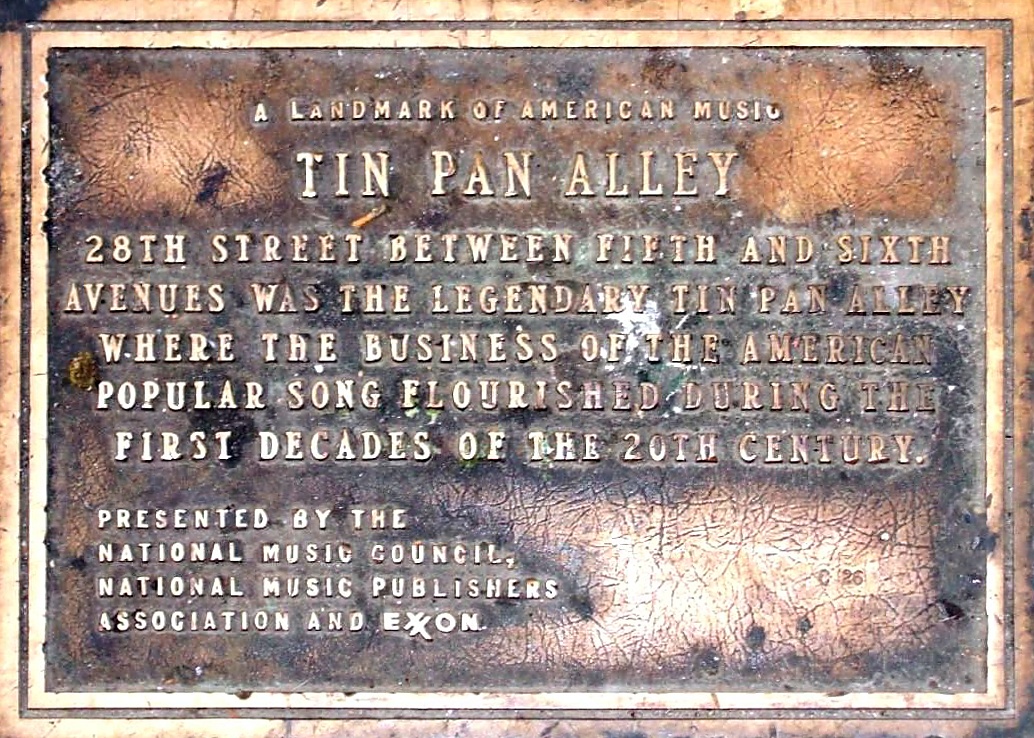
Sheet music in the context of Tin Pan Alley

Tin Pan Alley was a collection of music publishers and songwriters in New York City that dominated the popular music of the United States in the late 19th and early 20th centuries. Originally, it referred to a specific location on West 28th Street, between Fifth and Sixth Avenues in the Flower District of Manhattan, as commemorated by a plaque on 28th Street between Broadway and Sixth. Several buildings on Tin Pan Alley are protected as New York City designated landmarks, and the section of 28th Street from Fifth to Sixth Avenue is also officially co-named Tin Pan Alley.

The start of Tin Pan Alley is usually dated to about 1885, when a number of music publishers set up shop in the same district of Manhattan. The end of Tin Pan Alley is less clear cut. Some date it to the start of the Great Depression in the 1930s when the phonograph, radio, and motion pictures supplanted sheet music as the driving force of American popular music, while others consider Tin Pan Alley to have continued into the 1950s when earlier styles of music were upstaged by the rise of rock and roll, which was centered on the Brill Building. Brill Building songwriter Neil Sedaka described his employer as being a natural outgrowth of Tin Pan Alley, in that the older songwriters were still employed in Tin Pan Alley firms while younger songwriters such as Sedaka found work at the Brill Building.

View the full Wikipedia page for Tin Pan Alley
↑ Return to Menu

Sheet music in the context of Music industry

The music industry are individuals and organizations that earn money by writing songs and musical compositions, creating and selling recorded music and sheet music, presenting concerts, as well as the organizations that aid, train, represent and supply music creators. Among the many individuals and organizations that operate in the industry are: the songwriters and composers who write songs and musical compositions; the singers, musicians, conductors, and bandleaders who perform the music; the record labels, music publishers, recording studios, music producers, audio engineers, retail and digital music stores, and performance rights organizations who create and sell recorded music and sheet music; and the booking agents, promoters, music venues, road crew, and audio engineers who help organize and sell concerts.

The industry also includes a range of professionals who assist singers and musicians with their music careers. These include talent managers, artists and repertoire managers, business managers, entertainment lawyers; those who broadcast audio or video music content (satellite, Internet radio stations, broadcast radio and TV stations); music journalists and music critics; DJs; music educators and teachers; manufacturers of musical instruments and music equipment; as well as many others. In addition to the businesses and artists there are organizations that also play an important role, including musician's unions (e.g. American Federation of Musicians), not-for-profit performance-rights organizations (e.g. American Society of Composers, Authors and Publishers) and other associations (e.g. International Alliance for Women in Music, a non-profit organization that advocates for women composers and musicians).

View the full Wikipedia page for Music industry
↑ Return to Menu

Sheet music in the context of Silent film

A silent film is a film without synchronized recorded sound (or more generally, no audible dialogue). Though silent films convey narrative and emotion visually, various plot elements (such as a setting or era) or key lines of dialogue may, when necessary, be conveyed by the use of inter-title cards.

The term "silent film" is something of a misnomer, as these films were almost always accompanied by live sounds. During the silent era, which existed from the mid-1890s to the late 1920s, a pianist, theater organist—or even, in larger cities, an orchestra—would play music to accompany the films. Pianists and organists would play either from sheet music, or improvisation. Sometimes a person would even narrate the inter-title cards for the audience. Though at the time the technology to synchronize sound with the film did not exist, music was seen as an essential part of the viewing experience. "Silent film" is typically used as a historical term to describe an era of cinema prior to the invention of synchronized sound, but it also applies to such sound-era films as City Lights, Modern Times and Silent Movie which are accompanied by a music-only soundtrack in place of dialogue.

View the full Wikipedia page for Silent film
↑ Return to Menu

Sheet music in the context of Scorewriter

A scorewriter, or music notation program is software for creating, editing and printing sheet music. A scorewriter is to music notation what a word processor is to text, in that they typically provide flexible editing and automatic layout, and produce high-quality printed results.

The first modern score manipulation program was Mockingbird, written by John Maxwell and Severo Ornstein at Xerox PARC in 1980 on a Dorado computer. It preceded MIDI so an electronic keyboard had to be modified to enable interaction (input and playback) with the program. The WYSIWYG program was envisioned as a composer's amanuensis, but as it was an experimental program it never reached beyond PARC, though it influenced commercial programs which soon followed.

View the full Wikipedia page for Scorewriter
↑ Return to Menu

Sheet music in the context of Music publisher (popular music)

A music publisher is a type of publisher that specializes in distributing music. Music publishers originally published sheet music. When copyright became legally protected, music publishers began to play a role in the management of the intellectual property of composers. Today, music publishers license compositions, collect royalties, and make sure songwriters and composers are paid when their work is used.

View the full Wikipedia page for Music publisher (popular music)
↑ Return to Menu

Sheet music in the context of Hit record

A hit song, also known as a hit record, hit single, or simply hit, is a recorded song or instrumental that becomes broadly popular or well-known. Although hit song means any widely played or big-selling song, the specific term hit record usually refers to a single that has appeared in an official music chart through repeated radio airplay audience impressions or significant streaming data and commercial sales.

Prior to the dominance of recorded music, commercial sheet music sales of individual songs were similarly promoted and tracked as singles and albums are now. For example, in 1894, Edward B. Marks and Joe Stern released The Little Lost Child, which sold more than a million copies nationwide, based mainly on its success as an illustrated song, analogous to what later became music videos.

View the full Wikipedia page for Hit record
↑ Return to Menu