Large Hadron Collider in the context of Strangeness production


Large Hadron Collider in the context of Strangeness production

Large Hadron Collider Study page number 1 of 1

Play TriviaQuestions Online!

or

Skip to study material about Large Hadron Collider in the context of "Strangeness production"


⭐ Core Definition: Large Hadron Collider

The Large Hadron Collider (LHC) is the world's largest and highest-energy particle accelerator. It was built by the European Organization for Nuclear Research (CERN) between 1998 and 2008, in collaboration with over 10,000 scientists, and hundreds of universities and laboratories across more than 100 countries. It lies in a tunnel 27 kilometres (17 mi) in circumference and as deep as 175 metres (574 ft) beneath the France–Switzerland border near Geneva.

The first collisions were achieved in 2010 at an energy of 3.5 tera-electronvolts (TeV) per beam, about four times the previous world record. The discovery of the Higgs boson at the LHC was announced in 2012. Between 2013 and 2015, the LHC was shut down and upgraded; after those upgrades it reached 6.5 TeV per beam (13.0 TeV total collision energy). At the end of 2018, it was shut down for maintenance and further upgrades, and reopened over three years later in April 2022.

↓ Menu
HINT:

👉 Large Hadron Collider in the context of Strangeness production

In high-energy nuclear physics, strangeness production in relativistic heavy-ion collisions is a signature and diagnostic tool of quark–gluon plasma (QGP) formation and properties. Unlike up and down quarks, from which everyday matter is made, heavier quark flavors such as strange and charm typically approach chemical equilibrium in a dynamic evolution process. QGP (also known as quark matter) is an interacting localized assembly of quarks and gluons at thermal (kinetic) and not necessarily chemical (abundance) equilibrium. The word plasma signals that color charged particles (quarks and/or gluons) are able to move in the volume occupied by the plasma. The abundance of strange quarks is formed in pair-production processes in collisions between constituents of the plasma, creating the chemical abundance equilibrium. The dominant mechanism of production involves gluons only present when matter has become a quark–gluon plasma. When quark–gluon plasma disassembles into hadrons in a breakup process, the high availability of strange antiquarks helps to produce antimatter containing multiple strange quarks, which is otherwise rarely made. Similar considerations are at present made for the heavier charm flavor, which is made at the beginning of the collision process in the first interactions and is only abundant in the high-energy environments of CERN's Large Hadron Collider.

↓ Explore More Topics
In this Dossier

Large Hadron Collider in the context of Experimental physics

Experimental physics is the category of disciplines and sub-disciplines in the field of physics that are concerned with the observation of physical phenomena and experiments. Methods vary from discipline to discipline, from simple experiments and observations, such as experiments by Galileo Galilei, to more complicated ones, such as the Large Hadron Collider.

View the full Wikipedia page for Experimental physics
↑ Return to Menu

Large Hadron Collider in the context of Ultra-high vacuum

Ultra-high vacuum (often spelled ultrahigh in American English, UHV) is the vacuum regime characterised by pressure lower than about 1×10 torrs (1×10 mbar; 1×10 Pa). UHV conditions are created by pumping the gas out of a UHV chamber. At these low pressures the mean free path of a gas molecule is greater than approximately 40 km, so the gas is in free molecular flow, and gas molecules will collide with the chamber walls many times before colliding with each other. Almost all molecular interactions therefore take place on various surfaces in the chamber.

UHV conditions are integral to scientific research. Surface science experiments often require a chemically clean sample surface with the absence of any unwanted adsorbates. Surface analysis tools such as X-ray photoelectron spectroscopy and low energy ion scattering require UHV conditions for the transmission of electron or ion beams. For the same reason, beam pipes in particle accelerators such as the Large Hadron Collider are kept at UHV.

View the full Wikipedia page for Ultra-high vacuum
↑ Return to Menu

Large Hadron Collider in the context of Electroweak interaction

In particle physics, the electroweak interaction or electroweak force is the unified description of two of the fundamental interactions of nature: electromagnetism (electromagnetic interaction) and the weak interaction. Although these two forces appear very different at everyday low energies, the theory models them as two different aspects of the same force. Above the unification energy, on the order of 246 GeV, they would merge into a single force. Thus, if the temperature is high enough – approximately 10 K – then the electromagnetic force and weak force merge into a combined electroweak force.

During the quark epoch (shortly after the Big Bang), the electroweak force split into the electromagnetic and weak force. It is thought that the required temperature of 10 K has not been seen widely throughout the universe since before the quark epoch, and currently the highest human-made temperature in thermal equilibrium is around 5.5×10 K (from the Large Hadron Collider).

View the full Wikipedia page for Electroweak interaction
↑ Return to Menu

Large Hadron Collider in the context of Particle accelerator

A particle accelerator is a machine that uses electromagnetic fields to propel charged particles to very high speeds and energies to contain them in well-defined beams. Small accelerators are used for fundamental research in particle physics. Accelerators are also used as synchrotron light sources for the study of condensed matter physics. Smaller particle accelerators are used in a wide variety of applications, including particle therapy for oncological purposes, radioisotope production for medical diagnostics, ion implanters for the manufacturing of semiconductors, and accelerator mass spectrometers for measurements of rare isotopes such as radiocarbon.

Large accelerators include the Relativistic Heavy Ion Collider at Brookhaven National Laboratory in New York, and the largest accelerator, the Large Hadron Collider near Geneva, Switzerland, operated by CERN. It is a collider accelerator, which can accelerate two beams of protons to an energy of 6.5 TeV and cause them to collide head-on, creating center-of-mass energies of 13 TeV. There are more than 30,000 accelerators in operation around the world.

View the full Wikipedia page for Particle accelerator
↑ Return to Menu

Large Hadron Collider in the context of Big science

Big science is a term used by scientists and historians of science to describe a series of changes in science which occurred in industrial nations during and after World War II, as scientific progress increasingly came to rely on large-scale projects usually funded by national governments or groups of governments. Individual or small group efforts, or small science, are still relevant today as theoretical results by individual authors may have a significant impact, but very often the empirical verification requires experiments using constructions, such as the Large Hadron Collider, costing between $5 and $10 billion.

View the full Wikipedia page for Big science
↑ Return to Menu

Large Hadron Collider in the context of Mechanical, electrical, and plumbing

Mechanical, Electrical, and Plumbing (MEP) refers to the installation of services which provide a functional and comfortable space for the building occupants. In residential and commercial buildings, these elements are often designed by specialized MEP engineers. MEP's design is important for planning, decision-making, accurate documentation, performance- and cost-estimation, construction, and operating/maintaining the resulting facilities.

MEP specifically encompasses the in-depth design and selection of these systems, as opposed to a tradesperson simply installing equipment. For example, a plumber may select and install a commercial hot water system based on common practice and regulatory codes. A team of MEP engineers will research the best design according to the principles of engineering, and supply installers with the specifications they develop. As a result, engineers working in the MEP field must understand a broad range of disciplines, including dynamics, mechanics, fluids, thermodynamics, heat transfer, chemistry, electricity, and computers. Because MEP designs directly influence system sizing and component selection, the mechanical estimating process plays a key role in calculating quantities, assessing cost impacts, and ensuring that engineered solutions remain feasible within project budgets.

View the full Wikipedia page for Mechanical, electrical, and plumbing
↑ Return to Menu

Large Hadron Collider in the context of DØ experiment

The DØ experiment (sometimes written D0 experiment, or DZero experiment) was a worldwide collaboration of scientists conducting research on the fundamental nature of matter. DØ was one of two major experiments (the other was the CDF experiment) located at the Tevatron Collider at Fermilab in Batavia, Illinois. The Tevatron was the world's highest-energy accelerator from 1983 until 2009, when its energy was surpassed by the Large Hadron Collider. The DØ experiment stopped taking data in 2011, when the Tevatron shut down, but data analysis is still ongoing. The DØ detector is preserved in Fermilab's DØ Assembly Building as part of a historical exhibit for public tours.

DØ research is focused on precise studies of interactions of protons and antiprotons at the highest available energies. These collisions result in "events" containing many new particles created through the transformation of energy into mass according to the relation E=mc. The research involves an intense search for subatomic clues that reveal the character of the building blocks of the universe.

View the full Wikipedia page for DØ experiment
↑ Return to Menu

Large Hadron Collider in the context of Higgs mechanism

In the Standard Model of particle physics, the Higgs mechanism is essential to explain the generation mechanism of the property "mass" for gauge bosons. Without the Higgs mechanism, all bosons (one of the two classes of particles, the other being fermions) would be considered massless, but measurements show that the W, W, and Z bosons actually have relatively large masses of around 80 GeV/c. The Higgs field resolves this conundrum. The simplest description of the mechanism adds to the Standard Model a quantum field (the Higgs field), which permeates all of space. Below some extremely high temperature, the field causes spontaneous symmetry breaking during interactions. The breaking of symmetry triggers the Higgs mechanism, causing the bosons with which it interacts to have mass. In the Standard Model, the phrase "Higgs mechanism" refers specifically to the generation of masses for the W, and Z weak gauge bosons through electroweak symmetry breaking. The Large Hadron Collider at CERN announced results consistent with the Higgs particle on 14 March 2013, making it extremely likely that the field, or one like it, exists, and explaining how the Higgs mechanism takes place in nature.

The view of the Higgs mechanism as involving spontaneous symmetry breaking of a gauge symmetry is technically incorrect since by Elitzur's theorem gauge symmetries never can be spontaneously broken. Rather, the Fröhlich–Morchio–Strocchi mechanism reformulates the Higgs mechanism in an entirely gauge invariant way, generally leading to the same results.

View the full Wikipedia page for Higgs mechanism
↑ Return to Menu

Large Hadron Collider in the context of Minimal Supersymmetric Standard Model

The Minimal Supersymmetric Standard Model (MSSM) is an extension to the Standard Model that realizes supersymmetry. MSSM is the minimal supersymmetrical model as it considers only "the [minimum] number of new particle states and new interactions consistent with "Reality". Supersymmetry pairs bosons with fermions, so every Standard Model particle has a (yet undiscovered) superpartner. If discovered, such superparticles could be candidates for dark matter, and could provide evidence for grand unification or the viability of string theory. The failure to find evidence for MSSM using the Large Hadron Collider has strengthened an inclination to abandon it.

View the full Wikipedia page for Minimal Supersymmetric Standard Model
↑ Return to Menu

Large Hadron Collider in the context of LHCb

46°14′28″N 06°05′49″E / 46.24111°N 6.09694°E / 46.24111; 6.09694

The LHCb (Large Hadron Collider beauty) experiment is a particle physics detector collecting data at the Large Hadron Collider at CERN. LHCb specializes in the measurements of the parameters of CP violation in the interactions of b- and c-hadrons (heavy particles containing a bottom and charm quarks). Such studies can help to explain the matter-antimatter asymmetry of the Universe. The detector is also able to perform measurements of production cross sections, exotic hadron spectroscopy, and electroweak physics in the forward region. The LHCb collaborators, who built, operate and analyse data from the experiment, are composed of approximately 1650 people from 98 scientific institutes, representing 22 countries. Vincenzo Vagnoni succeeded on July 1, 2023 as spokesperson for the collaboration from Chris Parkes (spokesperson 2020–2023). The experiment is located at point 8 on the LHC tunnel close to Ferney-Voltaire, France just over the border from Geneva. The (small) MoEDAL experiment shares the same cavern.

View the full Wikipedia page for LHCb
↑ Return to Menu

Large Hadron Collider in the context of Electroweak scale

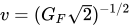
In particle physics, the electroweak scale, also known as the Fermi scale, is the energy scale around 246 GeV, a typical energy of processes described by the electroweak theory. The particular number 246 GeV is taken to be the vacuum expectation value of the Higgs field (where is the Fermi coupling constant). In some cases the term electroweak scale is used to refer to the temperature of electroweak symmetry breaking, 159.5±1.5 GeV. In other cases, the term is used more loosely to refer to energies in a broad range around 10 - 10 GeV. This is within reach of the Large Hadron Collider (LHC), which is designed for about 10 GeV in proton–proton collisions.

Interactions may have been above this scale during the electroweak epoch. In the unextended Standard Model, the transition from the electroweak epoch was not a first or a second order phase transition but a continuous crossover, preventing any baryogenesis. However many extensions to the standard model including supersymmetry and the inert double model have a first order electroweak phase transition (but still lack additional CP violation).

View the full Wikipedia page for Electroweak scale
↑ Return to Menu

Large Hadron Collider in the context of Tevatron

The Tevatron was a circular particle accelerator (active until 2011) in the United States, at the Fermi National Accelerator Laboratory (called Fermilab), east of Batavia, Illinois, and was the highest energy particle collider until the Large Hadron Collider (LHC) of the European Organization for Nuclear Research (CERN) was built near Geneva, Switzerland. The Tevatron was a synchrotron that accelerated protons and antiprotons in a 6.28 km (3.90 mi) circumference ring to energies of up to 1 TeV, hence its name. The Tevatron was completed in 1983 at a cost of $120 million and significant upgrade investments were made during its active years of 1983–2011.

The main achievement of the Tevatron was the discovery in 1995 of the top quark—the last fundamental fermion predicted by the Standard Model of particle physics. On July 2, 2012, scientists of the CDF and collider experiment teams at Fermilab announced the findings from the analysis of around 500 trillion collisions produced from the Tevatron collider since 2001, and found that the existence of the suspected Higgs boson was highly likely with a confidence of 99.8%, later improved to over 99.9%.

View the full Wikipedia page for Tevatron
↑ Return to Menu

Large Hadron Collider in the context of Synchrotron

A synchrotron is a particular type of cyclic particle accelerator, descended from the cyclotron, in which the accelerating particle beam travels around a fixed closed-loop path. The strength of the magnetic field which bends the particle beam into its closed path increases with time during the accelerating process, being synchronized to the increasing kinetic energy of the particles.

The synchrotron is one of the first accelerator concepts to enable the construction of large-scale facilities, since bending, beam focusing and acceleration can be separated into different components. The most powerful modern particle accelerators use versions of the synchrotron design. The largest synchrotron-type accelerator, also the largest particle accelerator in the world, is the 27-kilometre-circumference (17 mi) Large Hadron Collider (LHC) near Geneva, Switzerland, completed in 2008 by the European Organization for Nuclear Research (CERN). It can accelerate beams of protons to an energy of 7 teraelectronvolts (TeV or 10 eV).

View the full Wikipedia page for Synchrotron
↑ Return to Menu

Large Hadron Collider in the context of Relativistic Heavy Ion Collider

The Relativistic Heavy Ion Collider (RHIC /ˈrɪk/) is the first and one of only two operating heavy-ion colliders, and the only spin-polarized proton collider ever built. Located at Brookhaven National Laboratory (BNL) in Upton, New York, and used by an international team of researchers, it is the only operating particle collider in the US. By using RHIC to collide ions traveling at relativistic speeds, physicists study the primordial form of matter that existed in the universe shortly after the Big Bang. By colliding spin-polarized protons, the spin structure of the proton is explored.

RHIC is as of 2019 the second-highest-energy heavy-ion collider in the world, with nucleon energies for collisions reaching 100 GeV for gold ions and 250 GeV for protons. As of November 7, 2010, the Large Hadron Collider (LHC) has collided heavy ions of lead at higher energies than RHIC. The LHC operating time for ions (lead–lead and lead–proton collisions) is limited to about one month per year.

View the full Wikipedia page for Relativistic Heavy Ion Collider
↑ Return to Menu