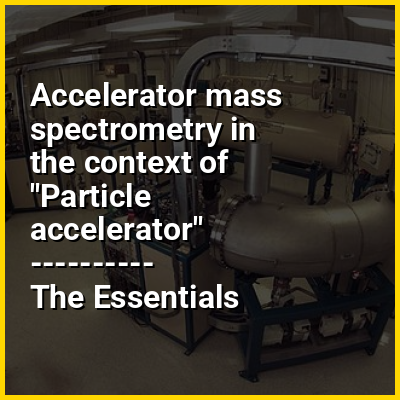
A particle accelerator is a machine that uses electromagnetic fields to propel charged particles to very high speeds and energies to contain them in well-defined beams. Small accelerators are used for fundamental research in particle physics. Accelerators are also used as synchrotron light sources for the study of condensed matter physics. Smaller particle accelerators are used in a wide variety of applications, including particle therapy for oncological purposes, radioisotope production for medical diagnostics, ion implanters for the manufacturing of semiconductors, and accelerator mass spectrometers for measurements of rare isotopes such as radiocarbon.
Large accelerators include the Relativistic Heavy Ion Collider at Brookhaven National Laboratory in New York, and the largest accelerator, the Large Hadron Collider near Geneva, Switzerland, operated by CERN. It is a collider accelerator, which can accelerate two beams of protons to an energy of 6.5 TeV and cause them to collide head-on, creating center-of-mass energies of 13 TeV. There are more than 30,000 accelerators in operation around the world.