Gluon in the context of Strangeness production


Gluon in the context of Strangeness production

Gluon Study page number 1 of 1

Play TriviaQuestions Online!

or

Skip to study material about Gluon in the context of "Strangeness production"


⭐ Core Definition: Gluon

A gluon (/ˈɡlɒn/ GLOO-on) is a type of massless elementary particle that mediates the strong interaction between quarks, acting as the exchange particle for the interaction. Gluons are massless vector bosons, thereby having a spin of 1. Through the strong interaction, gluons bind quarks into groups according to quantum chromodynamics (QCD), forming hadrons such as protons and neutrons.

Gluons carry the color charge of the strong interaction, thereby participating in the strong interaction as well as mediating it. Because gluons carry the color charge, QCD is more difficult to analyze compared to quantum electrodynamics (QED) where the photon carries no electric charge.

↓ Menu
HINT:

👉 Gluon in the context of Strangeness production

In high-energy nuclear physics, strangeness production in relativistic heavy-ion collisions is a signature and diagnostic tool of quark–gluon plasma (QGP) formation and properties. Unlike up and down quarks, from which everyday matter is made, heavier quark flavors such as strange and charm typically approach chemical equilibrium in a dynamic evolution process. QGP (also known as quark matter) is an interacting localized assembly of quarks and gluons at thermal (kinetic) and not necessarily chemical (abundance) equilibrium. The word plasma signals that color charged particles (quarks and/or gluons) are able to move in the volume occupied by the plasma. The abundance of strange quarks is formed in pair-production processes in collisions between constituents of the plasma, creating the chemical abundance equilibrium. The dominant mechanism of production involves gluons only present when matter has become a quark–gluon plasma. When quark–gluon plasma disassembles into hadrons in a breakup process, the high availability of strange antiquarks helps to produce antimatter containing multiple strange quarks, which is otherwise rarely made. Similar considerations are at present made for the heavier charm flavor, which is made at the beginning of the collision process in the first interactions and is only abundant in the high-energy environments of CERN's Large Hadron Collider.

↓ Explore More Topics
In this Dossier

Gluon in the context of Boson

In particle physics, a boson (/ˈbzɒn/ /ˈbsɒn/) is a subatomic particle whose spin quantum number has an integer value (0, 1, 2, ...). Bosons form one of the two fundamental classes of subatomic particle, the other being fermions, which have half odd-integer spin (1/2, 3/2, 5/2, ...). Every observed subatomic particle is either a boson or a fermion. Paul Dirac coined the name boson to commemorate the contribution of Satyendra Nath Bose, an Indian physicist.

Some bosons are elementary particles occupying a special role in particle physics, distinct from the role of fermions (which are sometimes described as the constituents of "ordinary matter"). Certain elementary bosons (e.g. gluons) act as force carriers, which give rise to forces between other particles, while one (the Higgs boson) contributes to the phenomenon of mass. Other bosons, such as mesons, are composite particles made up of smaller constituents.

View the full Wikipedia page for Boson
↑ Return to Menu

Gluon in the context of Strong interaction

In nuclear physics and particle physics, the strong interaction, also called the strong force or strong nuclear force, is one of the four known fundamental interactions. It confines quarks into protons, neutrons, and other hadron particles, and also binds neutrons and protons to create atomic nuclei, where it is called the nuclear force.

Most of the mass of a proton or neutron is the result of the strong interaction energy; the individual quarks provide only about 1% of the mass of a proton. At the range of 10 m (1 femtometer, slightly more than the radius of a nucleon), the strong force is approximately 100 times as strong as electromagnetism, 10 times as strong as the weak interaction, and 10 times as strong as gravitation.

View the full Wikipedia page for Strong interaction
↑ Return to Menu

Gluon in the context of Quark–gluon plasma

Quark–gluon plasma (QGP or quark soup) is an interacting localized assembly of quarks and gluons at thermal (local kinetic) and (close to) chemical (abundance) equilibrium. The word plasma signals that free color charges are allowed. In a 1987 summary, Léon Van Hove pointed out the equivalence of the three terms: quark gluon plasma, quark matter and a new state of matter. Since the temperature is above the Hagedorn temperature—and thus above the scale of light u,d-quark mass—the pressure exhibits the relativistic Stefan–Boltzmann format governed by temperature to the fourth power () and many practically massless quark and gluon constituents. It can be said that QGP emerges to be the new phase of strongly interacting matter which manifests its physical properties in terms of nearly free dynamics of practically massless gluons and quarks. Both quarks and gluons must be present in conditions near chemical (yield) equilibrium with their color charge open for a new state of matter to be referred to as QGP.

View the full Wikipedia page for Quark–gluon plasma
↑ Return to Menu

Gluon in the context of Zero-point energy

Zero-point energy (ZPE) is the lowest possible energy that a quantum mechanical system may have. Unlike in classical mechanics, quantum systems constantly fluctuate in their lowest energy state as described by the Heisenberg uncertainty principle. Therefore, even at absolute zero, atoms and molecules retain some vibrational motion. Apart from atoms and molecules, the empty space of the vacuum also has these properties. According to quantum field theory, the universe can be thought of not as isolated particles but continuous fluctuating fields: matter fields, whose quanta are fermions (i.e., leptons and quarks), and force fields, whose quanta are bosons (e.g., photons and gluons). All these fields have zero-point energy. These fluctuating zero-point fields lead to a kind of reintroduction of an aether in physics since some systems can detect the existence of this energy. However, this aether cannot be thought of as a physical medium if it is to be Lorentz invariant such that there is no contradiction with Albert Einstein's theory of special relativity.

The notion of a zero-point energy is also important for cosmology, and physics currently lacks a full theoretical model for understanding zero-point energy in this context; in particular, the discrepancy between theorized and observed vacuum energy in the universe is a source of major contention. Yet according to Einstein's theory of general relativity, any such energy would gravitate, and the experimental evidence from the expansion of the universe, dark energy and the Casimir effect shows any such energy to be exceptionally weak. One proposal that attempts to address this issue is to say that the fermion field has a negative zero-point energy, while the boson field has positive zero-point energy and thus these energies somehow cancel out each other. This idea would be true if supersymmetry were an exact symmetry of nature; however, the Large Hadron Collider at CERN has so far found no evidence to support it. Moreover, it is known that if supersymmetry is valid at all, it is at most a broken symmetry, only true at very high energies, and no one has been able to show a theory where zero-point cancellations occur in the low-energy universe we observe today. This discrepancy is known as the cosmological constant problem and it is one of the greatest unsolved mysteries in physics. Many physicists believe that "the vacuum holds the key to a full understanding of nature".

View the full Wikipedia page for Zero-point energy
↑ Return to Menu

Gluon in the context of Quantum chromodynamics

In theoretical physics, quantum chromodynamics (QCD) is the study of the strong interaction between quarks mediated by gluons. Quarks are fundamental particles that make up composite hadrons such as the proton, neutron and pion. QCD is a type of quantum field theory called a non-abelian gauge theory, with symmetry group SU(3). The QCD analog of electric charge is a property called color. Gluons are the force carriers of the theory, just as photons are for the electromagnetic force in quantum electrodynamics. The theory is an important part of the Standard Model of particle physics. A large body of experimental evidence for QCD has been gathered over the years.

View the full Wikipedia page for Quantum chromodynamics
↑ Return to Menu

Gluon in the context of Quantum fluctuation

In quantum physics, a quantum fluctuation (also known as a vacuum state fluctuation or vacuum fluctuation) is the temporary random change in the amount of energy in a point in space, as prescribed by Werner Heisenberg's uncertainty principle. They are minute random fluctuations in the values of the fields which represent elementary particles, such as electric and magnetic fields which represent the electromagnetic force carried by photons, W and Z fields which carry the weak force, and gluon fields which carry the strong force.

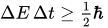
The uncertainty principle states the uncertainty in energy and time can be related by , where 1/2ħ5.27286×10 J⋅s. This means that pairs of virtual particles with energy and lifetime shorter than are continually created and annihilated in empty space. Although the particles are not directly detectable, the cumulative effects of these particles are measurable. For example, without quantum fluctuations, the "bare" mass and charge of elementary particles would be infinite; from renormalization theory the shielding effect of the cloud of virtual particles is responsible for the finite mass and charge of elementary particles.

View the full Wikipedia page for Quantum fluctuation
↑ Return to Menu

Gluon in the context of Color confinement

In quantum chromodynamics (QCD), color confinement or infrared slavery, often simply called confinement, is the phenomenon that color-charged particles (such as quarks and gluons) cannot be isolated, and therefore cannot be directly observed in normal conditions below the Hagedorn temperature of approximately 2 terakelvin (corresponding to energies of approximately 130–140 MeV per particle). Quarks and gluons must clump together to form hadrons. The two main types of hadron are the mesons (one quark, one antiquark) and the baryons (often three quarks or antiquarks, though other exotic variants exist). In addition, colorless glueballs formed only of gluons are also consistent with confinement, though difficult to identify experimentally. Quarks and gluons cannot be separated from their parent hadron without producing new hadrons.

View the full Wikipedia page for Color confinement
↑ Return to Menu

Gluon in the context of Color charge

Color charge is a property of quarks and gluons that is related to the particles' strong interactions in the theory of quantum chromodynamics (QCD). Like electric charge, it determines how quarks and gluons interact through the strong force; however, rather than there being only positive and negative charges, there are three "charges", commonly called red, green, and blue. Additionally, there are three "anti-colors", commonly called anti-red, anti-green, and anti-blue. Unlike electric charge, color charge is never observed in nature: in all cases, red, green, and blue (or anti-red, anti-green, and anti-blue) or any color and its anti-color combine to form a "color-neutral" system. For example, the three quarks making up any baryon universally have three different color charges, and the two quarks making up any meson universally have opposite color charge.

The "color charge" of quarks and gluons is completely unrelated to the everyday meaning of color, which refers to the frequency of photons, the particles that mediate a different fundamental force, electromagnetism. The term color and the labels red, green, and blue became popular simply because of the loose but convenient analogy to the primary colors.

View the full Wikipedia page for Color charge
↑ Return to Menu

Gluon in the context of Identical particles

In quantum mechanics, indistinguishable particles (also called identical or indiscernible particles) are particles that cannot be distinguished from one another, even in principle. Species of identical particles include, but are not limited to, elementary particles (such as electrons), composite subatomic particles (such as atomic nuclei), as well as atoms and molecules. Although all known indistinguishable particles only exist at the quantum scale, there is no exhaustive list of all possible sorts of particles nor a clear-cut limit of applicability, as explored in quantum statistics. They were first discussed by Werner Heisenberg and Paul Dirac in 1926.

There are two main categories of identical particles: bosons, which can share quantum states, and fermions, which cannot (as described by the Pauli exclusion principle). Examples of bosons are photons, gluons, phonons, helium-4 nuclei and all mesons. Examples of fermions are electrons, neutrinos, quarks, protons, neutrons, and helium-3 nuclei.

View the full Wikipedia page for Identical particles
↑ Return to Menu

Gluon in the context of Glueball

In particle physics, a glueball (also gluonium, gluon-ball) is a hypothetical composite particle. It consists solely of gluons, without valence quarks. Such a state is possible because gluons carry color charge and experience the strong interaction between themselves. Glueballs are extremely difficult to identify in particle accelerators, because they mix with ordinary meson states. In pure gauge theory, glueballs are the only states of the spectrum and some of them are stable.

Theoretical calculations show that glueballs should exist at energy ranges accessible with current collider technology. However, due to the aforementioned difficulty (among others), they have so far not been observed and identified with certainty, although phenomenological calculations have suggested that an experimentally identified glueball candidate, denoted f0(1710), has properties consistent with those expected of a Standard Model glueball.

View the full Wikipedia page for Glueball
↑ Return to Menu

Gluon in the context of Gauge boson

In particle physics, a gauge boson is a bosonic elementary particle that acts as the force carrier for elementary fermions. Elementary particles whose interactions are described by a gauge theory interact with each other by the exchange of gauge bosons, usually as virtual particles.

Photons, W and Z bosons, and gluons are gauge bosons. All known gauge bosons have a spin of 1 and therefore are vector bosons. For comparison, the Higgs boson has spin zero and the hypothetical graviton has a spin of 2.

View the full Wikipedia page for Gauge boson
↑ Return to Menu

Gluon in the context of Quark matter

Quark matter or QCD matter (quantum chromodynamic) refers to any of a number of hypothetical phases of matter whose degrees of freedom include quarks and gluons, of which the prominent example is quark-gluon plasma. Several series of conferences in 2019, 2020, and 2021 were devoted to this topic.

Quarks are liberated into quark matter at extremely high temperatures and/or densities, and some of them are still only theoretical as they require conditions so extreme that they cannot be produced in any laboratory, especially not at equilibrium conditions. Under these extreme conditions, the familiar structure of matter, where the basic constituents are nuclei (consisting of nucleons which are bound states of quarks) and electrons, is disrupted. In quark matter it is more appropriate to treat the quarks themselves as the basic degrees of freedom.

View the full Wikipedia page for Quark matter
↑ Return to Menu

Gluon in the context of Feynman diagram

In theoretical physics, a Feynman diagram is a pictorial representation of the mathematical expressions describing the behavior and interaction of subatomic particles. The scheme is named after American physicist Richard Feynman, who introduced the diagrams in 1948.

The calculation of probability amplitudes in theoretical particle physics requires the use of large, complicated integrals over a large number of variables. Feynman diagrams instead represent these integrals graphically.

View the full Wikipedia page for Feynman diagram
↑ Return to Menu