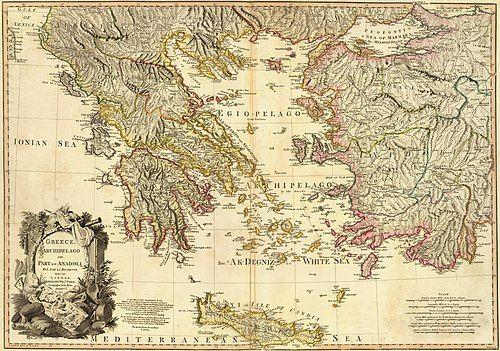
Materials covered in this trivia questions quiz
Study Hint 1
Question: In the context of Empedocles’ philosophy, what fundamental concept did he introduce regarding the composition of all matter in the universe?
Trivia Question Study Fact: Empedocles, a pre-Socratic Greek philosopher from Sicily, is renowned for his cosmogonic theory proposing that all matter is composed of four classical elements – earth, air, fire, and water – and that these elements are governed by the opposing forces of Love and Strife, which dictate their combination and separation.
Trivia Question Explanation: Empedocles posited that all matter was comprised of four elements – earth, air, fire, and water – and that these elements were brought together by the force of Love and separated by the force of Strife, forming the basis of his cosmogonic theory.
Return to Question
Study Hint 2
Question: In the context of Democritus, Ancient Greek philosophical thought is characterized by a reliance on what type of historical source for understanding pre-Socratic ideas?
Trivia Question Study Fact: Democritus, a pre-Socratic philosopher from Ancient Greece, is best known for developing an atomic theory of the universe, positing that all matter is composed of indivisible particles. Despite his prolific writing, none of his original works survive today, and our understanding of his ideas relies on accounts from later philosophers like Aristotle.
Trivia Question Explanation: Democritus’s original writings have not survived, meaning modern understanding of his philosophy is largely based on how his ideas were documented and discussed by thinkers who came after him, such as Aristotle.
Return to Question
Study Hint 3
Question: In the context of Sophists, Ancient Greece is considered the birthplace of a unique educational approach focused on preparing young men for public life. What was the central concept these teachers aimed to instill in their students?
Trivia Question Study Fact: During the fifth and fourth centuries BC in ancient Greece, Sophists were itinerant teachers who offered instruction in a variety of subjects – including philosophy, rhetoric, music, athletics, and mathematics – with the primary goal of imparting *arete*, or excellence, to aspiring young leaders from noble families.
Trivia Question Explanation: Sophists were dedicated to teaching *arete*, a Greek term encompassing virtue, skill, and excellence, believing it was essential for success in politics and leadership roles within ancient Greek society.
Return to Question
Study Hint 4
Question: In the context of Ephesus, Ancient Greek political organization is considered demonstrated by its participation in…
Trivia Question Study Fact: Ephesus, a significant ancient Greek city on the coast of Ionia (modern-day Turkey), was initially founded in the 10th century BC by Attic and Ionian Greek colonists upon the site of the earlier Arzawan capital, Apasa. It later became a member of the Ionian League during the Classical Greek period and eventually fell under Roman control in 129 BC.
Trivia Question Explanation: During the Classical Greek era, Ephesus was one of twelve cities that formed the Ionian League, a political and cultural alliance among Ionian cities.
Return to Question
Study Hint 5
Question: In the context of Hellenistic philosophy, Ancient Greece is considered…
Trivia Question Study Fact: Hellenistic philosophy represents a distinct phase of Ancient Greek philosophical thought, emerging after the death of Alexander the Great and lasting until the Battle of Actium. This period saw the rise of influential schools like Stoicism, Epicureanism, and Skepticism, which shaped intellectual discourse for centuries.
Trivia Question Explanation: Hellenistic philosophy directly followed the Classical period of Ancient Greece and unfolded within its geographical and cultural boundaries, beginning with Alexander the Great’s death and ending with the Battle of Actium.
Return to Question
Study Hint 6
Question: In the context of Ancient Greece, Athens is considered…
Trivia Question Study Fact: Athens, as a prominent city-state in Ancient Greece, distinguished itself not only through its size and longevity—with a recorded history spanning over 3,400 years—but also as a central hub for advancements in democracy, the arts, education, and philosophy, profoundly influencing the development of Western civilization and even impacting Ancient Rome.
Trivia Question Explanation: Athens flourished as a center of intellectual and political life in Ancient Greece, pioneering democratic principles and fostering significant developments in the arts, education, and philosophical thought, which subsequently shaped Western civilization.
Return to Question
Study Hint 7
Question: In the context of a list of ancient Greek cities, which characteristic defines inclusion beyond simply being a Greek-speaking or sovereign polis?
Trivia Question Study Fact: The categorization of settlements as 'ancient Greek cities' extends beyond purely Greek-speaking populations or independent city-states (poleis). The list includes colonies established by Greeks that were later assimilated into other languages, and even non-Greek settlements that significantly contributed to Hellenic culture within a region, demonstrating a broader cultural definition of what constituted a Greek city in antiquity.
Trivia Question Explanation: The definition of an ancient Greek city, as outlined in the list, encompasses settlements that either had a Greek-speaking population at some point or contributed to the broader Hellenic culture of the region, even if they weren't fully independent or maintained Greek as their primary language over time.
Return to Question
Study Hint 8
Question: In the context of Halicarnassus, Ancient Greece is considered unusual because this city maintained what form of governance for an extended period?
Trivia Question Study Fact: Halicarnassus distinguished itself among ancient Greek city-states by maintaining a monarchical government long after most others had adopted different systems, and notably remained loyal to the Persian Empire when many neighboring Ionian cities revolted. This unique position within the broader context of Ancient Greece shaped its political and historical trajectory until its capture by Alexander the Great in 333 BC.
Trivia Question Explanation: Halicarnassus was exceptional among Greek city-states for preserving a monarchical government, unlike the majority which transitioned to other forms of rule.
Return to Question
Study Hint 9
Question: In the context of the Battle of Marathon, what prior action by Athens directly provoked the Persian invasion and Darius I’s desire for vengeance?
Trivia Question Study Fact: The Battle of Marathon in 490 BC was a direct consequence of Athenian support for the Ionian Revolt against Persian rule, specifically after Athens and Eretria successfully burned the Persian city of Sardis. This act of defiance prompted Darius I to vow retribution against Athens, initiating the first Persian invasion of Greece and culminating in the battle at Marathon.
Trivia Question Explanation: Darius I vowed to punish Athens for its role in the Ionian Revolt, specifically for aiding in the capture and burning of the city of Sardis, which directly led to his decision to invade Greece and confront the Athenians at Marathon.
Return to Question
Study Hint 10
Question: In the context of the Battle of Thermopylae, Ancient Greece’s prior military experience with the Achaemenid Persian Empire significantly influenced the strategic planning for the defense of the pass?
Trivia Question Study Fact: The Battle of Thermopylae in 480 BC was a key engagement in the second Persian invasion of Greece, occurring concurrently with the naval Battle of Artemisium. This invasion was a direct response to the Greek victory at the Battle of Marathon a decade prior, where Athenian forces successfully repelled the first Persian invasion led by Darius I. The strategy at Thermopylae, proposed by Themistocles, aimed to simultaneously halt the Persian army's land advance and their naval fleet's progress.
Trivia Question Explanation: The second Persian invasion, culminating in the Battle of Thermopylae, was a direct response to the Greek victory at Marathon, prompting the Greeks to prepare for both a land and naval assault, mirroring the previous conflict's outcome.
Return to Question