Unit circle in the context of Loop (topology)


Unit circle in the context of Loop (topology)

Unit circle Study page number 1 of 1

Play TriviaQuestions Online!

or

Skip to study material about Unit circle in the context of "Loop (topology)"


⭐ Core Definition: Unit circle

In mathematics, a unit circle is a circle of unit radius—that is, a radius of 1. Frequently, especially in trigonometry, the unit circle is the circle of radius 1 centered at the origin (0, 0) in the Cartesian coordinate system in the Euclidean plane. In topology, it is often denoted as S because it is a one-dimensional unit n-sphere.

If (x, y) is a point on the unit circle's circumference, then |x| and |y| are the lengths of the legs of a right triangle whose hypotenuse has length 1. Thus, by the Pythagorean theorem, x and y satisfy the equation

↓ Menu
HINT:

👉 Unit circle in the context of Loop (topology)

In mathematics, a loop in a topological space X is a continuous function f from the unit interval I = [0,1] to X such that f(0) = f(1). In other words, it is a path whose initial point is equal to its terminal point.

A loop may also be seen as a continuous map f from the pointed unit circle S into X, because S may be regarded as a quotient of I under the identification of 0 with 1.

↓ Explore More Topics
In this Dossier

Unit circle in the context of Sine

In mathematics, sine and cosine are trigonometric functions of an angle. The sine and cosine of an acute angle are defined in the context of a right triangle: for the specified angle, its sine is the ratio of the length of the side opposite that angle to the length of the longest side of the triangle (the hypotenuse), and the cosine is the ratio of the length of the adjacent leg to that of the hypotenuse. For an angle , the sine and cosine functions are denoted as and .

The definitions of sine and cosine have been extended to any real value in terms of the lengths of certain line segments in a unit circle. More modern definitions express the sine and cosine as infinite series, or as the solutions of certain differential equations, allowing their extension to arbitrary positive and negative values and even to complex numbers.

View the full Wikipedia page for Sine
↑ Return to Menu

Unit circle in the context of Identity (mathematics)

In mathematics, an identity is an equality relating one mathematical expression A to another mathematical expression B, such that A and B (which might contain some variables) produce the same value for all values of the variables within a certain domain of discourse. In other words, A = B is an identity if A and B define the same functions, and an identity is an equality between functions that are differently defined. For example, and are identities. Identities are sometimes indicated by the triple bar symbol instead of =, the equals sign. Formally, an identity is a universally quantified equality.

View the full Wikipedia page for Identity (mathematics)
↑ Return to Menu

Unit circle in the context of Limit of a sequence

In mathematics, the limit of a sequence is the value that the terms of a sequence "tend to", and is often denoted using the symbol (e.g., ). If such a limit exists and is finite, the sequence is called convergent. A sequence that does not converge is said to be divergent. The limit of a sequence is said to be the fundamental notion on which the whole of mathematical analysis ultimately rests.

Limits can be defined in any metric or topological space, but are usually first encountered in the real numbers.

View the full Wikipedia page for Limit of a sequence
↑ Return to Menu

Unit circle in the context of Hyperbolic functions

In mathematics, hyperbolic functions are analogues of the ordinary trigonometric functions, but defined using the hyperbola rather than the circle. Just as the points (cos t, sin t) form a circle with a unit radius, the points (cosh t, sinh t) form the right half of the unit hyperbola. Also, similarly to how the derivatives of sin(t) and cos(t) are cos(t) and –sin(t) respectively, the derivatives of sinh(t) and cosh(t) are cosh(t) and sinh(t) respectively.

Hyperbolic functions are used to express the angle of parallelism in hyperbolic geometry. They are used to express Lorentz boosts as hyperbolic rotations in special relativity. They also occur in the solutions of many linear differential equations (such as the equation defining a catenary), cubic equations, and Laplace's equation in Cartesian coordinates. Laplace's equations are important in many areas of physics, including electromagnetic theory, heat transfer, and fluid dynamics.

View the full Wikipedia page for Hyperbolic functions
↑ Return to Menu

Unit circle in the context of Implicitly defined

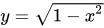
In mathematics, an implicit equation is a relation of the form where R is a function of several variables (often a polynomial). For example, the implicit equation of the unit circle is

An implicit function is a function that is defined by an implicit equation, that relates one of the variables, considered as the value of the function, with the others considered as the arguments. For example, the equation of the unit circle defines y as an implicit function of x, , assuming −1 ≤ x ≤ 1 and y is restricted to nonnegative values. Some equations do not admit an explicit solution.

View the full Wikipedia page for Implicitly defined
↑ Return to Menu

Unit circle in the context of Unit sphere

In mathematics, a unit sphere is a sphere of unit radius: the set of points at Euclidean distance 1 from some center point in three-dimensional space. More generally, the unit -sphere is an -sphere of unit radius in -dimensional Euclidean space; the unit circle is a special case, the unit -sphere in the plane. An (open) unit ball is the region inside of a unit sphere, the set of points of distance less than 1 from the center.

A sphere or ball with unit radius and center at the origin of the space is called the unit sphere or the unit ball. Any arbitrary sphere can be transformed to the unit sphere by a combination of translation and scaling, so the study of spheres in general can often be reduced to the study of the unit sphere.

View the full Wikipedia page for Unit sphere
↑ Return to Menu

Unit circle in the context of Circle group

In mathematics, the circle group, denoted by or , is the multiplicative group of all complex numbers with absolute value 1, that is, the unit circle in the complex plane or simply the unit complex numbers

The circle group forms a subgroup of , the multiplicative group of all nonzero complex numbers. Since is abelian, it follows that is as well.

View the full Wikipedia page for Circle group
↑ Return to Menu