Pythagorean theorem in the context of Unit circle


Pythagorean theorem in the context of Unit circle

Pythagorean theorem Study page number 1 of 2

Play TriviaQuestions Online!

or

Skip to study material about Pythagorean theorem in the context of "Unit circle"


⭐ Core Definition: Pythagorean theorem

In mathematics, the Pythagorean theorem or Pythagoras's theorem is a fundamental relation in Euclidean geometry between the three sides of a right triangle. It states that the area of the square whose side is the hypotenuse (the side opposite the right angle) is equal to the sum of the areas of the squares on the other two sides.

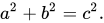
The theorem can be written as an equation relating the lengths of the sides a, b and the hypotenuse c, sometimes called the Pythagorean equation:The theorem is named for the Greek philosopher Pythagoras, born around 570 BC. The theorem has been proved numerous times by many different methods – possibly the most for any mathematical theorem. The proofs are diverse, including both geometric proofs and algebraic proofs, with some dating back thousands of years.
↓ Menu
HINT:

In this Dossier

Pythagorean theorem in the context of Greek mathematics

Ancient Greek mathematics refers to the history of mathematical ideas and texts in Ancient Greece during classical and late antiquity, mostly from the 5th century BC to the 6th century AD. Greek mathematicians lived in cities spread around the shores of the ancient Mediterranean, from Anatolia to Italy and North Africa, but were united by Greek culture and the Greek language. The development of mathematics as a theoretical discipline and the use of deductive reasoning in proofs is an important difference between Greek mathematics and those of preceding civilizations.

The early history of Greek mathematics is obscure, and traditional narratives of mathematical theorems found before the fifth century BC are regarded as later inventions. It is now generally accepted that treatises of deductive mathematics written in Greek began circulating around the mid-fifth century BC, but the earliest complete work on the subject is Euclid's Elements, written during the Hellenistic period. The works of renown mathematicians Archimedes and Apollonius, as well as of the astronomer Hipparchus, also belong to this period. In the Imperial Roman era, Ptolemy used trigonometry to determine the positions of stars in the sky, while Nicomachus and other ancient philosophers revived ancient number theory and harmonics. During late antiquity, Pappus of Alexandria wrote his Collection, summarizing the work of his predecessors, while Diophantus' Arithmetica dealt with the solution of arithmetic problems by way of pre-modern algebra. Later authors such as Theon of Alexandria, his daughter Hypatia, and Eutocius of Ascalon wrote commentaries on the authors making up the ancient Greek mathematical corpus.

View the full Wikipedia page for Greek mathematics
↑ Return to Menu

Pythagorean theorem in the context of Theorem

In mathematics and formal logic, a theorem is a statement that has been proven, or can be proven. The proof of a theorem is a logical argument that uses the inference rules of a deductive system to establish that the theorem is a logical consequence of the axioms and previously proved theorems.

In mainstream mathematics, the axioms and the inference rules are commonly left implicit, and, in this case, they are almost always those of Zermelo–Fraenkel set theory with the axiom of choice (ZFC), or of a less powerful theory, such as Peano arithmetic. Generally, an assertion that is explicitly called a theorem is a proved result that is not an immediate consequence of other known theorems. Moreover, many authors qualify as theorems only the most important results, and use the terms lemma, proposition and corollary for less important theorems.

View the full Wikipedia page for Theorem
↑ Return to Menu

Pythagorean theorem in the context of Euclid's Elements

The Elements (Ancient Greek: Στοιχεῖα Stoikheîa) is a mathematical treatise written c. 300 BC by the Ancient Greek mathematician Euclid.

The Elements is the oldest extant large-scale deductive treatment of mathematics. Drawing on the works of earlier mathematicians such as Hippocrates of Chios, Eudoxus of Cnidus, and Theaetetus, the Elements is a collection in 13 books of definitions, postulates, geometric constructions, and theorems with their proofs that covers plane and solid Euclidean geometry, elementary number theory, and incommensurability. These include the Pythagorean theorem, Thales' theorem, the Euclidean algorithm for greatest common divisors, Euclid's theorem that there are infinitely many prime numbers, and the construction of regular polygons and polyhedra.

View the full Wikipedia page for Euclid's Elements
↑ Return to Menu

Pythagorean theorem in the context of Samos

Samos (/ˈsmɒs/, also US: /ˈsæms, ˈsɑːmɔːs/; Greek: Σάμος, romanizedSámos, Greek pronunciation: [ˈsa.mos]) is a Greek island in the eastern Aegean Sea, south of Chios, north of Patmos and the Dodecanese archipelago, and off the coast of western Turkey, from which it is separated by the 1.6-kilometre-wide (1.0 mi) Mycale Strait. It is also a separate regional unit of the North Aegean region.

In ancient times, Samos was an especially rich and powerful city-state, particularly known for its vineyards and wine production. It is home to Pythagoreion and the Heraion of Samos, a UNESCO World Heritage Site that includes the Eupalinian aqueduct, a marvel of ancient engineering. Samos is the birthplace of the Greek philosopher and mathematician Pythagoras, after whom the Pythagorean theorem is named, the philosophers Melissus of Samos and Epicurus, and the astronomer Aristarchus of Samos, the first known individual to propose that the Earth revolves around the Sun. Samian wine was well known in antiquity and is still produced on the island.

View the full Wikipedia page for Samos
↑ Return to Menu

Pythagorean theorem in the context of Pythagoras

Pythagoras of Samos (Ancient Greek: Πυθαγόρας; c. 570 – c. 495 BC) was an ancient Ionian Greek philosopher, polymath, and the eponymous founder of Pythagoreanism. His political and religious teachings were well known in Magna Graecia and influenced the philosophies of Plato, Aristotle, and, through them, Western philosophy. Modern scholars disagree regarding Pythagoras's education and influences, but most agree that he travelled to Croton in southern Italy around 530 BC, where he founded a school in which initiates were allegedly sworn to secrecy and lived a communal, ascetic lifestyle.

In antiquity, Pythagoras was credited with mathematical and scientific discoveries, such as the Pythagorean theorem, Pythagorean tuning, the five regular solids, the theory of proportions, the sphericity of the Earth, the identity of the morning and evening stars as the planet Venus, and the division of the globe into five climatic zones. He was reputedly the first man to call himself a philosopher ("lover of wisdom"). Historians debate whether Pythagoras made these discoveries and pronouncements, as some of the accomplishments credited to him likely originated earlier or were made by his colleagues or successors, such as Hippasus and Philolaus.

View the full Wikipedia page for Pythagoras
↑ Return to Menu

Pythagorean theorem in the context of History of mathematics

The history of mathematics deals with the origin of discoveries in mathematics and the mathematical methods and notation of the past. Before the modern age and worldwide spread of knowledge, written examples of new mathematical developments have come to light only in a few locales. From 3000 BC the Mesopotamian states of Sumer, Akkad and Assyria, followed closely by Ancient Egypt and the Levantine state of Ebla began using arithmetic, algebra and geometry for taxation, commerce, trade, and in astronomy, to record time and formulate calendars.

The earliest mathematical texts available are from Mesopotamia and EgyptPlimpton 322 (Babylonian c. 2000 – 1900 BC), the Rhind Mathematical Papyrus (Egyptian c. 1800 BC) and the Moscow Mathematical Papyrus (Egyptian c. 1890 BC). All these texts mention the so-called Pythagorean triples, so, by inference, the Pythagorean theorem seems to be the most ancient and widespread mathematical development, after basic arithmetic and geometry.

View the full Wikipedia page for History of mathematics
↑ Return to Menu

Pythagorean theorem in the context of Hypotenuse

In geometry, a hypotenuse is the side of a right triangle opposite to the right angle. It is the longest side of any such triangle; the two other shorter sides of such a triangle are called catheti or legs. Every rectangle can be divided into a pair of right triangles by cutting it along either diagonal; the diagonals are the hypotenuses of these triangles.

The length of the hypotenuse can be found using the Pythagorean theorem, which states that the square of the length of the hypotenuse equals the sum of the squares of the lengths of the two legs. As an algebraic formula, this can be written as , where is the length of one leg, is the length of the other leg, and is the length of the hypotenuse. For example, if the two legs of a right triangle have lengths 3 and 4, respectively, then the hypotenuse has length , because .

View the full Wikipedia page for Hypotenuse
↑ Return to Menu

Pythagorean theorem in the context of Square root of 2

The square root of 2 (approximately 1.4142) is the positive real number that, when multiplied by itself or squared, equals the number 2. It may be written as or . It is an algebraic number, and therefore not a transcendental number. Technically, it should be called the principal square root of 2, to distinguish it from the negative number with the same property.

Geometrically, the square root of 2 is the length of a diagonal across a square with sides of one unit of length; this follows from the Pythagorean theorem. It was probably the first number known to be irrational. The fraction 99/70 (≈ 1.4142857) is sometimes used as a good rational approximation with a reasonably small denominator.

View the full Wikipedia page for Square root of 2
↑ Return to Menu

Pythagorean theorem in the context of G-force

The g-force or gravitational force equivalent is a mass-specific force (force per unit mass), expressed in units of standard gravity (symbol g or g0, not to be confused with "g", the symbol for grams).It is used for sustained accelerations that cause a perception of weight. For example, an object at rest on Earth's surface is subject to 1 g, equaling the conventional value of gravitational acceleration on Earth, about 9.8 m/s.More transient acceleration, accompanied with significant jerk, is called shock.

When the g-force is produced by the surface of one object being pushed by the surface of another object, the reaction force to this push produces an equal and opposite force for every unit of each object's mass. The types of forces involved are transmitted through objects by interior mechanical stresses. Gravitational acceleration is one cause of an object's acceleration in relation to free fall.

View the full Wikipedia page for G-force
↑ Return to Menu

Pythagorean theorem in the context of Plimpton 322

Plimpton 322 is a Babylonian clay tablet, believed to have been written around 1800 BC, that contains a mathematical table written in cuneiform script. Each row of the table relates to a Pythagorean triple, that is, a triple of integers that satisfies the Pythagorean theorem, , the rule that equates the sum of the squares of the legs of a right triangle to the square of the hypotenuse. The era in which Plimpton 322 was written was roughly 13 to 15 centuries prior to the era in which the major Greek discoveries in geometry were made.

At the time that Otto Neugebauer and Abraham Sachs first realized the mathematical significance of the tablet in the 1940s, a few Old Babylonian tablets making use of the Pythagorean rule were already known. In addition to providing further evidence that Mesopotamian scribes knew and used the rule, Plimpton 322 strongly suggested that they had a systematic method for generating Pythagorean triples as some of the triples are very large and unlikely to have been discovered by ad hoc methods. Row 4 of the table, for example, relates to the triple (12709,13500,18541).

View the full Wikipedia page for Plimpton 322
↑ Return to Menu

Pythagorean theorem in the context of Babylonian mathematics

Babylonian mathematics (also known as Assyro-Babylonian mathematics) is the mathematics developed or practiced by the people of Mesopotamia, as attested by sources mainly surviving from the Old Babylonian period (1830–1531 BC) to the Seleucid from the last three or four centuries BC. With respect to content, there is scarcely any difference between the two groups of texts. Babylonian mathematics remained constant, in character and content, for over a millennium.

In contrast to the scarcity of sources in Ancient Egyptian mathematics, knowledge of Babylonian mathematics is derived from hundreds of clay tablets unearthed since the 1850s. Written in cuneiform, tablets were inscribed while the clay was moist, and baked hard in an oven or by the heat of the sun. The majority of recovered clay tablets date from 1800 to 1600 BC, and cover topics that include fractions, algebra, quadratic and cubic equations and the Pythagorean theorem. The Babylonian tablet YBC 7289 gives an approximation of accurate to three significant sexagesimal digits (about six significant decimal digits).

View the full Wikipedia page for Babylonian mathematics
↑ Return to Menu

Pythagorean theorem in the context of Euclidean distance

In mathematics, the Euclidean distance between two points in a Euclidean space is the length of the line segment between them. It can be calculated from the Cartesian coordinates of the points using the Pythagorean theorem, and therefore is occasionally called the Pythagorean distance.

These names come from the ancient Greek mathematicians Euclid and Pythagoras. In the Greek deductive geometry exemplified by Euclid's Elements, distances were not represented as numbers but line segments of the same length, which were considered "equal". The notion of distance is inherent in the compass tool used to draw a circle, whose points all have the same distance from a common center point. The connection from the Pythagorean theorem to distance calculation was not made until the 18th century.

View the full Wikipedia page for Euclidean distance
↑ Return to Menu

Pythagorean theorem in the context of James A. Garfield

James Abram Garfield (November 19, 1831 – September 19, 1881) was the 20th president of the United States, serving from March 1881 until his death in September that year after being shot in July. A preacher, lawyer, and Civil War general, Garfield served nine terms in the United States House of Representatives and is the only sitting member of the House to be elected president. Before running for the presidency, he had been elected to the U.S. Senate by the Ohio General Assembly—a position he declined when he became president-elect.

Garfield was born into poverty in a log cabin and grew up in northeast Ohio. After graduating from Williams College in 1856, he studied law and became an attorney. He was a preacher in the Restoration Movement and president of the Western Reserve Eclectic Institute, affiliated with the Disciples. Garfield was elected as a Republican member of the Ohio State Senate in 1859, serving until 1861. He opposed Confederate secession, was a major general in the Union Army during the American Civil War, and fought in the battles of Middle Creek, Shiloh, and Chickamauga. He was elected to Congress in 1862 to represent Ohio's 19th district. Throughout his congressional service, he firmly supported the gold standard and gained a reputation as a skilled orator. He initially agreed with Radical Republican views on Reconstruction but later favored a Moderate Republican–aligned approach to civil rights enforcement for freedmen. Garfield's aptitude for mathematics extended to his own proof of the Pythagorean theorem, published in 1876, and his advocacy of using statistics to inform government policy.

View the full Wikipedia page for James A. Garfield
↑ Return to Menu