Saraswati in the context of "Tridevi"

Play Trivia Questions online!

or

Skip to study material about Saraswati in the context of "Tridevi"

Ad spacer

⭐ Core Definition: Saraswati

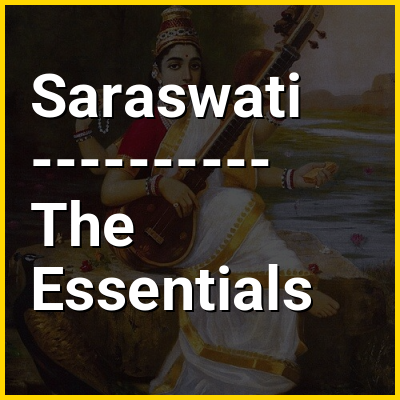
Saraswati (Sanskrit: सरस्वती, IAST: Sarasvatī), also spelled as Sarasvati, is one of the principal goddesses in Hinduism, revered as the goddess of knowledge, education, learning, arts, speech, poetry, music, creativity, purification, language and culture. Together with the goddesses Lakshmi and Parvati, she forms the trinity of chief goddesses, known as the Tridevi. Saraswati is a pan-Indian deity, venerated not only in Hinduism but also in Jainism and Buddhism.

She is one of the prominent goddesses in the Vedic tradition (1500 to 500 BCE) who retains her significance in later Hinduism. In the Vedas, her characteristics and attributes are closely connected with the Saraswati River, making her one of the earliest examples of a river goddess in Indian tradition. As a deity associated with a river, Saraswati is revered for her dual abilities to purify and to nurture fertility. In later Vedic literature, particularly the Brahmanas, Saraswati is increasingly identified with the Vedic goddess of speech, Vac, and eventually, the two merge into the singular goddess known in later tradition. Over time, her connection to the river diminishes, while her association with speech, poetry, music, and culture becomes more prominent. In classical and medieval Hinduism, Saraswati is primarily recognized as the goddess of learning, arts and poetic inspiration, and as the inventor of the Sanskrit language. She is linked to the creator god Brahma, either as his creation or consort. In the latter role, she represents his creative power (Shakti), giving reality a unique and distinctly human quality. She becomes linked with the dimension of reality characterized by clarity and intellectual order. Within the goddess-oriented Shaktism tradition, Saraswati is a key figure and venerated as the creative aspect of the Supreme Goddess. She is also significant in certain Vaishnava traditions, where she serves as one of Vishnu's consorts and assists him in his divine functions. Despite her associations with these male deities, Saraswati also stands apart as an independent goddess in the pantheon, widely worshipped as a celibate goddess, without a consort.
↓ Menu

>>>PUT SHARE BUTTONS HERE<<<

👉 Saraswati in the context of Tridevi

The Tridevi are a trinity of supreme divinity in Hinduism, joining a triad of eminent goddesses either as a feminine version of the Trimurti, or as consorts of a masculine Trimurti, depending on the denomination. This triad is typically personified by the Hindu goddesses Saraswati, Lakshmi, and Parvati. In Shaktism, these triune goddesses are the manifestations of Mula-Prakriti or Mahadevi.

↓ Explore More Topics
In this Dossier

Saraswati in the context of Hindu mythology

Hindu mythology refers to the collection of myths associated with Hinduism, derived from various Hindu texts and traditions. These myths are found in sacred texts such as the Vedas, the Itihasas (the Mahabharata and the Ramayana), and the Puranas. They also appear in regional and ethnolinguistic texts, including the Bengali Mangal Kavya and the Tamil Periya Puranam and Divya Prabandham. Additionally, Hindu myths are also found in widely translated fables like the Panchatantra and the Hitopadesha, as well as in Southeast Asian texts influenced by Hindu traditions.

↑ Return to Menu

Saraswati in the context of Shaktism

Shaktism (Sanskrit: शाक्तसम्प्रदायः, romanizedŚāktasampradāyaḥ) is a major Hindu denomination in which the ultimate reality is considered as Adi Parashakti.

In Shaktism, the divine feminine energy, Shakti, is revered as the supreme power and is personified as the Mahadevi (Great Goddess), who manifests in numerous forms, with each form having distinct functions and unique attributes. The most prominently worshiped goddesses include Durga, the fierce protector who vanquishes evil and restores cosmic order; Parvati, the gentle yet powerful mother goddess of fertility, devotion, and spiritual wisdom; and Kali, the primal force of time and transformation. Additionally, Shaktism reveres a broader pantheon, including goddesses like Saraswati, the goddess of knowledge and arts; Lakshmi, the goddess of wealth and prosperity; and Tripura Sundari, the goddess of beauty and grace. Also honoured are the various Gramadevata, local village guardian deities, who protect and bless their communities. Following the decline of Buddhism in India, elements of Hindu and Buddhist goddess worship gradually merged, culminating in the emergence of the Mahavidya, a revered group of ten fierce and esoteric goddesses central to the tantric traditions within Shaktism.

↑ Return to Menu

Saraswati in the context of Lakshmi

Lakshmi (/ˈlʌkʃmi/; Sanskrit: लक्ष्मी, IAST: Lakṣmī, sometimes spelled Laxmi), also known as Shri (Sanskrit: श्री, IAST: Śrī), is one of the principal goddesses in Hinduism, revered as the goddess of happiness, fortune, wealth, prosperity, beauty, fertility, sovereignty, and abundance. She along with Parvati and Sarasvati, form the trinity of goddesses called the Tridevi.

Lakshmi has been a central figure in Hindu tradition since pre-Buddhist times (1500 to 500 BCE) and remains one of the most widely worshipped goddesses in the Hindu pantheon. Although she does not appear in the earliest Vedic literature, the personification of the term shri—auspiciousness, glory, and high rank, often associated with kingship—eventually led to the development of Sri-Lakshmi as a goddess in later Vedic texts, particularly the Shri Suktam. Her importance grew significantly during the late epic period (around 400 CE), when she became particularly associated with the preserver god Vishnu as his consort. In this role, Lakshmi is seen as the ideal Hindu wife, exemplifying loyalty and devotion to her husband. Whenever Vishnu descended on the earth as an avatar, Lakshmi accompanied him as consort, for example, as Sita and Radha or Rukmini as consorts of Vishnu's avatars Rama and Krishna, respectively.

↑ Return to Menu

Saraswati in the context of Religion in Japan

Religion in Japan is manifested primarily in Shinto and in Buddhism, the two main faiths, which Japanese people often practice simultaneously. Syncretic combinations of both, known generally as shinbutsu-shūgō, are common; they represented Japan's dominant religion before the rise of State Shinto in the 19th century.

↑ Return to Menu

Saraswati in the context of Devi

Devī (/ˈdvi/; Sanskrit: देवी) is the Sanskrit word for 'goddess'; the masculine form is deva. Devi and deva mean 'heavenly, divine, anything of excellence', and are also gender-specific terms for a deity in Indian religions, such as Hinduism and its offshoots like Buddhism, Jainism, and Sikhism.

The concept of reverence for feminine manifestation of goddesses in Hinduism and its offshoots appears in the Vedas, which were composed around the 2nd millennium BCE. However, they did not play a vital role in that era. Goddesses such as Durga, Kali, Lakshmi, Parvati, Radha, Saraswati and Sita have continued to be revered in the modern era. The medieval era Puranas witness a major expansion in mythology and literature associated with Devi, with texts such as the Devi Mahatmya, wherein she manifests as the ultimate truth and supreme power. She has inspired the Shaktism tradition of Hinduism. Further, Devi is viewed as central in the Hindu traditions of Shaktism and Shaivism.

↑ Return to Menu

Saraswati in the context of Parameshvara (epithet)

Parameshvara (IAST: Parameśvara, Sanskrit: परमेश्वर) is an epithet used in Hindu literature. The term indicates the Supreme Being and Supreme Reality in Hinduism. Vaishnavas consider Vishnu and his avatars, such as Rama and Krishna as Parameshvara, while Shaivas consider Shiva as Parameshvara. In Shaktism, he plays a supporting role and is dependent on Parameshvari, that is the Adi Shakti/Mahadevi (known for her forms such as Durga, Tripura Sundari, Mahakali, Mahalakshmi, Mahasaraswati etc). Shakta traditions are focused on Parameshvari's superiority over Parameshvara, comparisons going as far as to calling Parameshwara a Shava (dead body) without Parameshwari (The supreme moving force of the universe). Whereas in Shaivism and Vaishnavism, she is considered the dependant consort of Parameshvara (as Uma/Sati/Parvati consort of Shiva in Shaivism and Lakshmi consort of Vishnu in Vaishnavism). Beyond sectarian interpretations, Hindus regard Parameshvara as the ultimate and highest reality, eternally pervading all matter. He is regarded by devotees to be totality itself, controlling the triple forces of creation, preservation, and destruction.

↑ Return to Menu

Saraswati in the context of Parvati

Parvati (Sanskrit: पार्वती, IAST: Pārvatī), also known as Uma (Sanskrit: उमा, IAST: Umā) and Gauri (Sanskrit: गौरी, IAST: Gaurī), is one of the principal goddesses in Hinduism, revered as the goddess of power, energy, nourishment, harmony, love, beauty, devotion, and motherhood. Along with Lakshmi and Sarasvati, she forms the trinity, known as the Tridevi.

From her first appearance as a goddess during the epic period (400 BCE – 400 CE), Parvati is primarily depicted as the consort of the god Shiva. According to various Puranas, Parvati is the reincarnation of Sati, Shiva's first wife, who relinquished her body to sever familial ties with her father, Daksha, after he had insulted Shiva. Parvati is often equated with the other goddesses such as Sati, Uma, Kali and Durga and due to this close connection, they are often treated as one and the same, with their stories frequently overlapping. In Hindu mythology, the birth of Parvati to the mountain lord Himavan and his wife Mena is primarily understood as a cosmic event meant to lure Shiva out of his ascetic withdrawal and into the realm of marriage and household life. As Shiva's wife, Parvati represents the life-affirming, creative force that complements Shiva's austere, world-denying nature, thus balancing the two poles of asceticism and householder life in Hindu philosophy. Parvati's role as wife and mother is central to her mythological persona, where she embodies the ideal of the devoted spouse who both supports and expands her husband's realm of influence. Parvati is also noted for her motherhood, being the mother of the prominent Hindu deities Ganesha and Kartikeya.

↑ Return to Menu

Saraswati in the context of Ishvari

Ishvari (Sanskrit: ईश्वरी, IAST: Īśvarī) is a Hindu epithet of Sanskrit origin, referring to the Goddess, the divine female counterpart of Ishvara. It is also a term that refers to the shakti, or the feminine energy of the Trimurti, which refer to Saraswati, Lakshmi, and Parvati.

↑ Return to Menu