Political cartoon in the context of Authority


Political cartoon in the context of Authority

Political cartoon Study page number 1 of 2

Play TriviaQuestions Online!

or

Skip to study material about Political cartoon in the context of "Authority"


⭐ Core Definition: Political cartoon

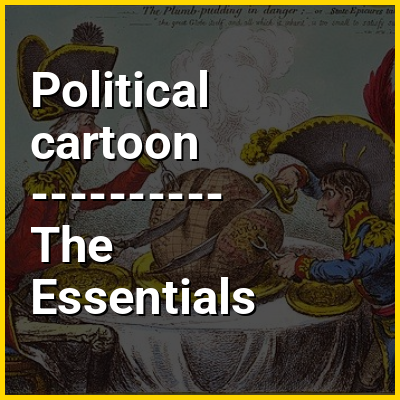
A political cartoon, also known as an editorial cartoon, is a cartoon graphic with caricatures of public figures, expressing the artist's opinion. An artist who writes and draws such images is known as an editorial cartoonist. They typically combine artistic skill, hyperbole and satire in order to either question authority or draw attention to corruption, political violence and other social ills.

Developed in England in the latter part of the 18th century, the political cartoon was pioneered by James Gillray, although his and others in the flourishing English industry were sold as individual prints in print shops. Founded in 1841, the British periodical Punch appropriated the term cartoon to refer to its political cartoons, which led to the term's widespread use.

↓ Menu
HINT:

In this Dossier

Political cartoon in the context of The Economist

The Economist is a British news and current affairs journal published in a weekly print magazine format and daily on digital platforms. Variously referred to as a magazine and a newspaper, it publishes stories on topics that include economics, business, geopolitics, technology and culture. Mostly written and edited in London, it has other editorial offices in the United States and in major cities in continental Europe, Asia, and the Middle East. The publication prominently features data journalism, and has a focus on interpretive analysis over original reporting, to both criticism and acclaim.

Founded in 1843, The Economist was first circulated by Scottish economist James Wilson to muster support for abolishing the British Corn Laws (1815–1846), a system of import tariffs. Over time, the newspaper's coverage expanded further into political economy and eventually began running articles on current events, finance, commerce, and British politics. Throughout the mid-to-late 20th century, it greatly expanded its layout and format, adding opinion columns, special reports, political cartoons, reader letters, cover stories, art critique, book reviews, and technology features. The paper is recognisable by its fire engine red masthead (nameplate) and illustrated, topical covers. Individual articles are written anonymously, with no byline, in order for the paper to speak as one collective voice. It is supplemented by its sister lifestyle magazine, 1843, and a variety of podcasts, films, and books. It is considered a newspaper of record in the UK.

View the full Wikipedia page for The Economist
↑ Return to Menu

Political cartoon in the context of The Boyhood of Raleigh

The Boyhood of Raleigh is an 1870 painting by John Everett Millais in the collection of the Tate Gallery. In the painting, Millais depicts famed Elizabethan-era explorer Walter Raleigh and his brother on the Devonshire coast listening to a Genoese sailor pointing out to sea and telling the pair of "tales of wonder on sea and land".

Inspired by an essay written by historian James Anthony Froude, the painting was exhibited at the Royal Academy in 1871. Quickly receiving acclaim, it went on to be the subject of parody by numerous 20th century political cartoons and album covers.

View the full Wikipedia page for The Boyhood of Raleigh
↑ Return to Menu

Political cartoon in the context of Comics

Comics are a medium used to express ideas with images, often combined with text or other visual information. It typically takes the form of a sequence of panels of images. Textual devices such as speech balloons, captions, and onomatopoeia can indicate dialogue, narration, sound effects, or other information. There is no consensus among theorists and historians on a definition of comics; some emphasize the combination of images and text, some sequentiality or other image relations, and others historical aspects such as mass reproduction or the use of recurring characters. Cartooning and other forms of illustration are the most common means of image-making in comics. Photo comics are a form that uses photographic images. Common forms include comic strips, editorial and gag cartoons, and comic books. Since the late 20th century, bound volumes such as graphic novels and comic albums have become increasingly common, along with webcomics.

The history of comics has followed different paths in different cultures. Scholars have posited a pre-history as far back as the Lascaux cave paintings. By the mid-20th century, comics flourished, particularly in the United States, western Europe (especially France and Belgium), and Japan. The history of European comics is often traced to Rodolphe Töpffer's cartoon strips of the 1830s, while Wilhelm Busch and his Max and Moritz also had a global impact from 1865 on, and became popular following the success in the 1930s of strips and books such as The Adventures of Tintin. American comics emerged as a mass medium in the early 20th century with the advent of newspaper comic strips; magazine-style comic books followed in the 1930s, and the superhero genre became prominent after Superman appeared in 1938. Histories of Japanese comics (manga) propose origins as early as the 12th century. Japanese comics are generally held separate from the evolution of Euro-American comics, and Western comic art probably originated in 17th-century Italy. Modern Japanese comic strips emerged in the early 20th century, and the output of comic magazines and books rapidly expanded in the post-World War II era (1945–) with the popularity of cartoonists such as Osamu Tezuka. Comics has had a lowbrow reputation for much of its history, but towards the end of the 20th century, it began to find greater acceptance with the public and academics.

View the full Wikipedia page for Comics
↑ Return to Menu

Political cartoon in the context of Alice (Alice's Adventures in Wonderland)

Alice is a fictional character and the titular protagonist of Lewis Carroll's children's novel Alice's Adventures in Wonderland (1865) and its sequel, Through the Looking-Glass (1871). A child in the mid-Victorian era, Alice unintentionally goes on an underground adventure after falling down a rabbit hole into Wonderland; in the sequel, she steps through a mirror into an alternative world.

The character originated in stories told by Carroll to entertain the Liddell sisters while rowing on the Isis with his friend Robinson Duckworth, and on subsequent rowing trips. Although she shares her given name with Alice Liddell, scholars disagree about the extent to which she was based upon Liddell. Characterized by Carroll as "loving and gentle", "courteous to all", "trustful", and "wildly curious", Alice has been variously seen as clever, well-mannered, and sceptical of authority, although some commentators find more negative aspects of her personality. Her appearance changed from Alice's Adventures Under Ground, the first draft of Alice's Adventures in Wonderland, to political cartoonist John Tenniel's illustrations of her in the two Alice books.

View the full Wikipedia page for Alice (Alice's Adventures in Wonderland)
↑ Return to Menu

Political cartoon in the context of John Tenniel

Sir John Tenniel (/ˈtɛniəl/; 28 February 1820 – 25 February 1914) was an English illustrator, graphic humourist and political cartoonist prominent in the second half of the 19th century. An alumnus of the Royal Academy of Arts in London, he was knighted for artistic achievements in 1893, the first such honour ever bestowed on an illustrator or cartoonist.

Tenniel is remembered mainly as the principal political cartoonist for Punch magazine for over 50 years and for his illustrations to Lewis Carroll's Alice's Adventures in Wonderland (1865) and Through the Looking-Glass, and What Alice Found There (1871). Tenniel's detailed black-and-white drawings remain the definitive depiction of the Alice characters, with comic book illustrator and writer Bryan Talbot stating, "Carroll never describes the Mad Hatter: our image of him is pure Tenniel."

View the full Wikipedia page for John Tenniel
↑ Return to Menu

Political cartoon in the context of Dragonnades

The Dragonnades was a policy implemented by Louis XIV in 1681 to force French Protestants known as Huguenots to convert to Catholicism. It involved the billeting of dragoons of the French Royal Army in Huguenot households, with the soldiers being given implied permission to mistreat the inhabitants and damage or steal their possessions. Soldiers employed as part of this policy were derisively referred to as "missionary dragoons".

View the full Wikipedia page for Dragonnades
↑ Return to Menu

Political cartoon in the context of National personification

A national personification is an anthropomorphic personification of a state or the people(s) it inhabits. It may appear in political cartoons and propaganda. In the first personifications in the Western World, warrior deities or figures symbolizing wisdom were used (for example the goddess Athena in ancient Greece), to indicate the strength and power of the nation. Some personifications in the Western world often took the Latin name of the ancient Roman province. Examples of this type include Britannia, Germania, Hibernia, Hispania, Lusitania, Helvetia and Polonia.

Examples of personifications of the Goddess of Liberty include Marianne, the Statue of Liberty (Liberty Enlightening the World), and many examples of United States coinage. Another ancient model was Roma, a female deity who personified the city of Rome and her dominion over the territories of the Roman Empire. Roma was probably favoured by Rome's high-status Imperial representatives abroad, rather than the Roman populace at large. In Rome, the Emperor Hadrian built and dedicated a gigantic temple to her as Roma Aeterna ("Eternal Rome"), and to Venus Felix, ("Venus the Bringer of Good Fortune"), emphasising the sacred, universal and eternal nature of the empire. Examples of representations of the everyman or citizenry in addition to the nation itself are Deutscher Michel, John Bull and Uncle Sam.

View the full Wikipedia page for National personification
↑ Return to Menu

Political cartoon in the context of US imperialism


American imperialism or US imperialism is the exercise of power or control by the US outside its borders. It operates through military conquest; military protection; gunboat diplomacy; unequal treaties; support for preferred factions; regime change; economic or diplomatic support; economic interference via private companies, or influence on local culture and media, potentially followed by intervention when American interests are threatened.

American imperialism and expansionism took the form of "New Imperialism" beginning in the late 19th century, although authors such as Daniel Immerwahr consider earlier American territorial expansion across North America at the expense of Native Americans to fit the definition. While the US has never officially identified itself and its territorial possessions as an empire, some commentators have done so, including Max Boot, Arthur M. Schlesinger Jr., and Niall Ferguson. Other commentators have accused the US of practicing neocolonialism—dominating territory via indirect means—which leverages economic power rather than military force.

View the full Wikipedia page for US imperialism
↑ Return to Menu

Political cartoon in the context of Cartoon

A cartoon is a type of visual art that is typically drawn, frequently animated, in an unrealistic or semi-realistic style. The specific meaning has evolved, but the modern usage usually refers to either: an image or series of images intended for satire, caricature, or humor; or a motion picture that relies on a sequence of illustrations for its animation. Someone who creates cartoons in the first sense is called a cartoonist, and in the second sense they are usually called an animator.

The concept originated in the Middle Ages, and first described a preparatory drawing for a piece of art, such as a painting, fresco, tapestry, or stained glass window. In the 19th century, beginning in Punch magazine in 1843, cartoon came to refer – ironically at first – to humorous artworks in magazines and newspapers. Then it also was used for political cartoons and comic strips. When the medium developed, in the early 20th century, it began to refer to animated films that resembled print cartoons.

View the full Wikipedia page for Cartoon
↑ Return to Menu

Political cartoon in the context of Caricature

A caricature is a rendered image showing the features of its subject in a simplified or exaggerated way through sketching, pencil strokes, or other artistic drawings (compare to: cartoon). Caricatures can be either insulting or complimentary, and can serve a political purpose, be drawn solely for entertainment, or for a combination of both. Caricatures of politicians are commonly used in newspapers and news magazines as political cartoons, while caricatures of movie stars are often found in entertainment magazines. In literature, a caricature is a distorted representation of a person in a way that exaggerates some characteristics and oversimplifies others.

View the full Wikipedia page for Caricature
↑ Return to Menu

Political cartoon in the context of James Gillray

James Gillray (13 August 1756 – 1 June 1815) was a British caricaturist and printmaker famous for his etched political and social satires, mainly published between 1792 and 1810. Many of his works are held at the National Portrait Gallery in London.

Gillray has been called "the father of the political cartoon", with his works satirizing George III, Napoleon, prime ministers and generals. Regarded as one of the two most influential cartoonists, the other being William Hogarth, Gillray's wit and humour, knowledge of life, fertility of resource, keen sense of the ludicrous, and beauty of execution, at once gave him the first place among caricaturists.

View the full Wikipedia page for James Gillray
↑ Return to Menu

Political cartoon in the context of John Bull

John Bull is a national personification of England and Britain, especially in political cartoons and similar graphic works. He is usually depicted as a stout, middle-aged, country-dwelling, jolly and matter-of-fact man. He originated in satirical works of the early-18th century and would come to stand for English liberty in opposition to revolutionaries. He was popular through the 18th and 19th centuries until the time of the First World War, when he generally stopped being seen as representative of the "common man".

View the full Wikipedia page for John Bull
↑ Return to Menu

Political cartoon in the context of Monroe Doctrine

The Monroe Doctrine is a United States foreign policy position that opposes European colonialism in the Western Hemisphere. It holds that any intervention in the political affairs of the Americas by foreign powers is a potentially hostile act against the United States. The doctrine was central to American grand strategy in the 20th century.

President James Monroe first articulated the doctrine on December 2, 1823, during his seventh annual State of the Union Address to Congress (though it was not named after him until 1850). At the time, nearly all Spanish colonies in the Americas had either achieved or were close to independence. Monroe asserted that the New World and the Old World were to remain distinctly separate spheres of influence, and thus further efforts by European powers to control or influence sovereign states in the region would be viewed as a threat to U.S. security. In turn, the United States would recognize and not interfere with existing European colonies nor meddle in the internal affairs of European countries.

View the full Wikipedia page for Monroe Doctrine
↑ Return to Menu

Political cartoon in the context of American hegemony


American imperialism is the exercise of power or control by the US outside its borders. The US expanded its territory initially via conquest, later shifting to controlling/influencing other countries without conquest, using techniques such as alliances; aid; gunboat diplomacy; treaties; trade; support for preferred political factions; regime change; economic influence via private companies, exports of culture and media. Military interventions have been used to support allies, expel invaders, overthrow governments, and support US economic interests.

American imperialism and expansionism took the form of "New Imperialism" beginning in the late 19th century, although authors such as Daniel Immerwahr consider earlier American territorial expansion across North America at the expense of Native Americans to fit the definition. While the US has never officially identified itself and its territorial possessions as an empire, some commentators have done so, including Max Boot, Arthur M. Schlesinger Jr., and Niall Ferguson. Other commentators have accused the US of practicing neocolonialism—dominating territory via indirect means—which leverages economic power rather than military force.

View the full Wikipedia page for American hegemony
↑ Return to Menu

Political cartoon in the context of Dr. Seuss

Theodor Seuss Geisel (/ss ˈɡzəl, zɔɪs -/ sooss GHY-zəl, zoyss -⁠; March 2, 1904 – September 24, 1991) was an American children's author, illustrator, animator, and cartoonist. He is known for his work writing and illustrating more than 60 books under the pen name Dr. Seuss (/ss, zs/ sooss, zooss). His work includes many of the most popular children's books of all time, selling over 600 million copies and being translated into more than 20 languages by the time of his death.

Geisel adopted the name "Dr. Seuss" as an undergraduate at Dartmouth College and as a graduate student at Lincoln College, Oxford. He left Oxford in 1927 to begin his career as an illustrator and cartoonist for Vanity Fair, Life, and various other publications. He also worked as an illustrator for advertising campaigns, including for Flit and Standard Oil, and as a political cartoonist for the New York newspaper PM. He published his first children's book And to Think That I Saw It on Mulberry Street in 1937. During World War II, he took a brief hiatus from children's literature to illustrate political cartoons, and he worked in the animation and film department of the United States Army.

View the full Wikipedia page for Dr. Seuss
↑ Return to Menu