Molecular dynamics in the context of Condition number


Molecular dynamics in the context of Condition number

Molecular dynamics Study page number 1 of 1

Play TriviaQuestions Online!

or

Skip to study material about Molecular dynamics in the context of "Condition number"


⭐ Core Definition: Molecular dynamics

Molecular dynamics (MD) is a computer simulation method for analyzing the physical movements of atoms and molecules. The atoms and molecules are allowed to interact for a fixed period of time, giving a view of the dynamic "evolution" of the system. In the most common version, the trajectories of atoms and molecules are determined by numerically solving Newton's equations of motion for a system of interacting particles, where forces between the particles and their potential energies are often calculated using interatomic potentials or molecular mechanical force fields. MD simulations are widely applied in chemical physics, materials science, and biophysics.

Because molecular systems typically consist of a vast number of particles, it is impossible to determine the properties of such complex systems analytically; MD simulation circumvents this problem by using numerical methods. However, long MD simulations are mathematically ill-conditioned, generating cumulative errors in numerical integration that can be minimized with proper selection of algorithms and parameters, but not eliminated.

↓ Menu
HINT:

In this Dossier

Molecular dynamics in the context of Quantum chemistry

Quantum chemistry, also called molecular quantum mechanics, is a branch of physical chemistry focused on the application of quantum mechanics to chemical systems, particularly towards the quantum-mechanical calculation of electronic contributions to physical and chemical properties of molecules, materials, and solutions at the atomic level. These calculations include systematically applied approximations intended to make calculations computationally feasible while still capturing as much information about important contributions to the computed wave functions as well as to observable properties such as structures, spectra, and thermodynamic properties. Quantum chemistry is also concerned with the computation of quantum effects on molecular dynamics and chemical kinetics.

Chemists rely heavily on spectroscopy through which information regarding the quantization of energy on a molecular scale can be obtained. Common methods are infra-red (IR) spectroscopy, nuclear magnetic resonance (NMR) spectroscopy, and scanning probe microscopy. Quantum chemistry may be applied to the prediction and verification of spectroscopic data as well as other experimental data.

View the full Wikipedia page for Quantum chemistry
↑ Return to Menu

Molecular dynamics in the context of Force field (chemistry)

In the context of chemistry, molecular physics, physical chemistry, and molecular modelling, a force field is a computational model that is used to describe the forces between atoms (or collections of atoms) within molecules or between molecules as well as in crystals. Force fields are a variety of interatomic potentials. More precisely, the force field refers to the functional form and parameter sets used to calculate the potential energy of a system on the atomistic level. Force fields are usually used in molecular dynamics or Monte Carlo simulations. The parameters for a chosen energy function may be derived from classical laboratory experiment data, calculations in quantum mechanics, or both. Force fields utilize the same concept as force fields in classical physics, with the main difference being that the force field parameters in chemistry describe the energy landscape on the atomistic level. From a force field, the acting forces on every particle are derived as a gradient of the potential energy with respect to the particle coordinates.

A large number of different force field types exist today (e.g. for organic molecules, ions, polymers, minerals, and metals). Depending on the material, different functional forms are usually chosen for the force fields since different types of atomistic interactions dominate the material behavior.

View the full Wikipedia page for Force field (chemistry)
↑ Return to Menu

Molecular dynamics in the context of Rubber elasticity

Rubber elasticity is the ability of solid rubber to be stretched up to a factor of 10 from its original length, and return to close to its original length upon release. This process can be repeated many times with no apparent degradation to the rubber.

Rubber, like all materials, consists of molecules. Rubber's elasticity is produced by molecular processes that occur due to its molecular structure. Rubber's molecules are polymers, or large, chain-like molecules. Polymers are produced by a process called polymerization. This process builds polymers up by sequentially adding short molecular backbone units to the chain through chemical reactions. A rubber polymer follows a random winding path in three dimensions, intermingling with many other rubber polymers.

View the full Wikipedia page for Rubber elasticity
↑ Return to Menu

Molecular dynamics in the context of Collision cascade

In condensed-matter physics, a collision cascade (also known as a displacement cascade or a displacement spike) is a set of nearby adjacent energetic (much higher than ordinary thermal energies) collisions of atoms induced by an energetic particle in a solid or liquid.

If the maximum atom or ion energies in a collision cascade are higher than the threshold displacement energy of the material (tens of eVs or more), the collisions can permanently displace atoms from their lattice sites and produce defects. The initial energetic atom can be, e.g., an ion from a particle accelerator, an atomic recoil produced by a passing high-energy neutron, electron or photon, or be produced when a radioactive nucleus decays and gives the atom a recoil energy.

View the full Wikipedia page for Collision cascade
↑ Return to Menu

Molecular dynamics in the context of Interatomic potential

Interatomic potentials are mathematical functions to calculate the potential energy of a system of atoms with given positions in space. Interatomic potentials are widely used as the physical basis of molecular mechanics and molecular dynamics simulations in computational chemistry, computational physics and computational materials science to explain and predict materials properties. Examples of quantitative properties and qualitative phenomena that are explored with interatomic potentials include lattice parameters, surface energies, interfacial energies, adsorption, cohesion, thermal expansion, and elastic and plastic material behavior, as well as chemical reactions.

View the full Wikipedia page for Interatomic potential
↑ Return to Menu

Molecular dynamics in the context of Quaternions and spatial rotation

Unit quaternions, known as versors, provide a convenient mathematical notation for representing spatial orientations and rotations of elements in three dimensional space. Specifically, they encode information about an axis-angle rotation about an arbitrary axis. Rotation and orientation quaternions have applications in computer graphics, computer vision, robotics, navigation, molecular dynamics, flight dynamics, orbital mechanics of satellites, and crystallographic texture analysis.

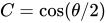
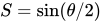
When used to represent rotation, unit quaternions are also called rotation quaternions as they represent the 3D rotation group. When used to represent an orientation (rotation relative to a reference coordinate system), they are called orientation quaternions or attitude quaternions. A spatial rotation around a fixed point of radians about a unit axis that denotes the Euler axis is given by the quaternion , where and .

View the full Wikipedia page for Quaternions and spatial rotation
↑ Return to Menu

Molecular dynamics in the context of Molecular physics

Molecular physics is the study of the physical properties of molecules and molecular dynamics. The field overlaps significantly with physical chemistry, chemical physics, and quantum chemistry. It is often considered as a sub-field of atomic, molecular, and optical physics. Research groups studying molecular physics are typically designated as one of these other fields. Molecular physics addresses phenomena due to both molecular structure and individual atomic processes within molecules. Like atomic physics, it relies on a combination of classical and quantum mechanics to describe interactions between electromagnetic radiation and matter. Experiments in the field often rely heavily on techniques borrowed from atomic physics, such as spectroscopy and scattering.

View the full Wikipedia page for Molecular physics
↑ Return to Menu

Molecular dynamics in the context of Molecular modeling on GPUs

Molecular modeling on GPU is the technique of using a graphics processing unit (GPU) for molecular simulations.

In 2007, Nvidia introduced video cards that could be used not only to show graphics but also for scientific calculations. These cards include many arithmetic units (as of 2022, up to 18,176 in the RTX 6000 Ada) working in parallel. Long before this event, the computational power of video cards was purely used to accelerate graphics calculations. The new features of these cards made it possible to develop parallel programs in a high-level application programming interface (API) named CUDA. This technology substantially simplified programming by enabling programs to be written in C/C++. More recently, OpenCL allows cross-platform GPU acceleration.

View the full Wikipedia page for Molecular modeling on GPUs
↑ Return to Menu