Isomorphism in the context of Riesz representation theorem


Isomorphism in the context of Riesz representation theorem

Isomorphism Study page number 1 of 1

Play TriviaQuestions Online!

or

Skip to study material about Isomorphism in the context of "Riesz representation theorem"


⭐ Core Definition: Isomorphism

In mathematics, an isomorphism is a structure-preserving mapping or morphism between two structures of the same type that can be reversed by an inverse mapping. Two mathematical structures are isomorphic if an isomorphism exists between them, and this is often denoted as . The word is derived from Ancient Greek ἴσος (isos) 'equal' and μορφή (morphe) 'form, shape'.

The interest in isomorphisms lies in the fact that two isomorphic objects have the same properties (excluding further information such as additional structure or names of objects). Thus isomorphic structures cannot be distinguished from the point of view of structure only, and may often be identified. In mathematical jargon, one says that two objects are the same up to an isomorphism. A common example where isomorphic structures cannot be identified is when the structures are substructures of a larger one. For example, all subspaces of dimension one of a vector space are isomorphic and cannot be identified.

↓ Menu
HINT:

👉 Isomorphism in the context of Riesz representation theorem

The Riesz representation theorem, sometimes called the Riesz–Fréchet representation theorem after Frigyes Riesz and Maurice René Fréchet, establishes an important connection between a Hilbert space and its continuous dual space. If the underlying field is the real numbers, the two are isometrically isomorphic; if the underlying field is the complex numbers, the two are isometrically anti-isomorphic. The (anti-) isomorphism is a particular natural isomorphism.

↓ Explore More Topics
In this Dossier

Isomorphism in the context of Mathematical space

In mathematics, a space is a set (sometimes known as a universe) endowed with a structure defining the relationships among the elements of the set.A subspace is a subset of the parent space which retains the same structure.While modern mathematics uses many types of spaces, such as Euclidean spaces, linear spaces, topological spaces, Hilbert spaces, or probability spaces, it does not define the notion of "space" itself.

A space consists of selected mathematical objects that are treated as points, and selected relationships between these points. The nature of the points can vary widely: for example, the points can represent numbers, functions on another space, or subspaces of another space. It is the relationships that define the nature of the space. More precisely, isomorphic spaces are considered identical, where an isomorphism between two spaces is a one-to-one correspondence between their points that preserves the relationships. For example, the relationships between the points of a three-dimensional Euclidean space are uniquely determined by Euclid's axioms, and all three-dimensional Euclidean spaces are considered identical.

View the full Wikipedia page for Mathematical space
↑ Return to Menu

Isomorphism in the context of Projective transformation

In projective geometry, a homography is an isomorphism of projective spaces, induced by an isomorphism of the vector spaces from which the projective spaces derive. It is a bijection that maps lines to lines, and thus a collineation. In general, some collineations are not homographies, but the fundamental theorem of projective geometry asserts that is not so in the case of real projective spaces of dimension at least two. Synonyms include projectivity, projective transformation, and projective collineation.

Historically, homographies (and projective spaces) have been introduced to study perspective and projections in Euclidean geometry, and the term homography, which, etymologically, roughly means "similar drawing", dates from this time. At the end of the 19th century, formal definitions of projective spaces were introduced, which extended Euclidean and affine spaces by the addition of new points called points at infinity. The term "projective transformation" originated in these abstract constructions. These constructions divide into two classes that have been shown to be equivalent. A projective space may be constructed as the set of the lines of a vector space over a given field (the above definition is based on this version); this construction facilitates the definition of projective coordinates and allows using the tools of linear algebra for the study of homographies. The alternative approach consists in defining the projective space through a set of axioms, which do not involve explicitly any field (incidence geometry, see also synthetic geometry); in this context, collineations are easier to define than homographies, and homographies are defined as specific collineations, thus called "projective collineations".

View the full Wikipedia page for Projective transformation
↑ Return to Menu

Isomorphism in the context of Automorphism

In mathematics, an automorphism is an isomorphism from a mathematical object to itself. It is, in some sense, a symmetry of the object, and a way of mapping the object to itself while preserving all of its structure. The set of all automorphisms of an object forms a group, called the automorphism group. It is, loosely speaking, the symmetry group of the object.

View the full Wikipedia page for Automorphism
↑ Return to Menu

Isomorphism in the context of Homeomorphism

In mathematics and more specifically in topology, a homeomorphism (from Greek roots meaning "similar shape", named by Henri Poincaré), also called topological isomorphism, or bicontinuous function, is a bijective and continuous function between topological spaces that has a continuous inverse function. Homeomorphisms are the isomorphisms in the category of topological spaces—that is, they are the mappings that preserve all the topological properties of a given space. Two spaces with a homeomorphism between them are called homeomorphic, and from a topological viewpoint they are the same.

Very roughly speaking, a topological space is a geometric object, and a homeomorphism results from a continuous deformation of the object into a new shape. Thus, a square and a circle are homeomorphic to each other, but a sphere and a torus are not. However, this description can be misleading. Some continuous deformations do not produce homeomorphisms, such as the deformation of a line into a point. Some homeomorphisms do not result from continuous deformations, such as the homeomorphism between a trefoil knot and a circle. Homotopy and isotopy are precise definitions for the informal concept of continuous deformation.

View the full Wikipedia page for Homeomorphism
↑ Return to Menu

Isomorphism in the context of Finite geometry

A finite geometry is any geometric system that has only a finite number of points.The familiar Euclidean geometry is not finite, because a Euclidean line contains infinitely many points. A geometry based on the graphics displayed on a computer screen, where the pixels are considered to be the points, would be a finite geometry. While there are many systems that could be called finite geometries, attention is mostly paid to the finite projective and affine spaces because of their regularity and simplicity. Other significant types of finite geometry are finite Möbius or inversive planes and Laguerre planes, which are examples of a general type called Benz planes, and their higher-dimensional analogs such as higher finite inversive geometries.

Finite geometries may be constructed via linear algebra, starting from vector spaces over a finite field; the affine and projective planes so constructed are called Galois geometries. Finite geometries can also be defined purely axiomatically. Most common finite geometries are Galois geometries, since any finite projective space of dimension three or greater is isomorphic to a projective space over a finite field (that is, the projectivization of a vector space over a finite field). However, dimension two has affine and projective planes that are not isomorphic to Galois geometries, namely the non-Desarguesian planes. Similar results hold for other kinds of finite geometries.

View the full Wikipedia page for Finite geometry
↑ Return to Menu

Isomorphism in the context of Finite field

In mathematics, a finite field or Galois field (so-named in honor of Évariste Galois) is a field that has a finite number of elements. As with any field, a finite field is a set on which the operations of multiplication, addition, subtraction and division are defined and satisfy certain basic rules. The most common examples of finite fields are the integers mod when is a prime number.

The order of a finite field is its number of elements, which is either a prime number or a prime power. For every prime number and every positive integer there are fields of order . All finite fields of a given order are isomorphic.

View the full Wikipedia page for Finite field
↑ Return to Menu

Isomorphism in the context of Zero ring

In ring theory, a branch of mathematics, the zero ring or trivial ring is the unique ring (up to isomorphism) consisting of one element. (Less commonly, the term "zero ring" is used to refer to any rng of square zero, i.e., a rng in which xy = 0 for all x and y. This article refers to the one-element ring.)

In the category of rings, the zero ring is the terminal object, whereas the ring of integers Z is the initial object.

View the full Wikipedia page for Zero ring
↑ Return to Menu

Isomorphism in the context of Collineation

In projective geometry, a collineation is a one-to-one and onto map (a bijection) from one projective space to another, or from a projective space to itself, such that the images of collinear points are themselves collinear. A collineation is thus an isomorphism between projective spaces, or an automorphism from a projective space to itself. Some authors restrict the definition of collineation to the case where it is an automorphism. The set of all collineations of a space to itself form a group, called the collineation group.

View the full Wikipedia page for Collineation
↑ Return to Menu

Isomorphism in the context of Non-degenerate bilinear form

In mathematics, specifically linear algebra, a degenerate bilinear form on a vector space is a bilinear form such that the map from to (the dual space of ) given by has a non-trivial kernel, i.e. there exist some non-zero in such that for all .

An equivalent definition when is finite-dimensional is that the previous map is not an isomorphism.

View the full Wikipedia page for Non-degenerate bilinear form
↑ Return to Menu

Isomorphism in the context of Unitary operator

In functional analysis, a unitary operator is a surjective bounded operator on a Hilbert space that preserves the inner product.Non-trivial examples include rotations, reflections, and the Fourier operator.Unitary operators generalize unitary matrices.Unitary operators are usually taken as operating on a Hilbert space, but the same notion serves to define the concept of isomorphism between Hilbert spaces.

View the full Wikipedia page for Unitary operator
↑ Return to Menu

Isomorphism in the context of Direct sum

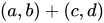
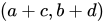
The direct sum is an operation between structures in abstract algebra, a branch of mathematics. It is defined differently but analogously for different kinds of structures. As an example, the direct sum of two abelian groups and is another abelian group consisting of the ordered pairs where and . To add ordered pairs, the sum is defined to be ; in other words, addition is defined coordinate-wise. For example, the direct sum , where is real coordinate space, is the Cartesian plane, . A similar process can be used to form the direct sum of two vector spaces or two modules.

Direct sums can also be formed with any finite number of summands; for example, , provided and are the same kinds of algebraic structures (e.g., all abelian groups, or all vector spaces). That relies on the fact that the direct sum is associative up to isomorphism. That is, for any algebraic structures , , and of the same kind. The direct sum is also commutative up to isomorphism, i.e. for any algebraic structures and of the same kind.

View the full Wikipedia page for Direct sum
↑ Return to Menu

Isomorphism in the context of Universal property

In mathematics, more specifically in category theory, a universal property is a property that characterizes up to an isomorphism the result of some constructions. Thus, universal properties can be used for defining some objects independently from the method chosen for constructing them. For example, the definitions of the integers from the natural numbers, of the rational numbers from the integers, of the real numbers from the rational numbers, and of polynomial rings from the field of their coefficients can all be done in terms of universal properties. In particular, the concept of universal property allows a simple proof that all constructions of real numbers are equivalent: it suffices to prove that they satisfy the same universal property.

Technically, a universal property is defined in terms of categories and functors by means of a universal morphism (see § Formal definition, below). Universal morphisms can also be thought more abstractly as initial or terminal objects of a comma category (see § Connection with comma categories, below).

View the full Wikipedia page for Universal property
↑ Return to Menu

Isomorphism in the context of Construction of the real numbers

In mathematics, there are several equivalent ways of defining the real numbers. One of them is that they form a complete ordered field that does not contain any smaller complete ordered field. Such a definition does not prove that such a complete ordered field exists, and the existence proof consists of constructing a mathematical structure that satisfies the definition.

The article presents several such constructions. They are equivalent in the sense that, given the result of any two such constructions, there is a unique isomorphism of ordered fields between them. This results from the above definition and is independent of particular constructions. These isomorphisms allow identifying the results of the constructions, and, in practice, to forget which construction has been chosen.

View the full Wikipedia page for Construction of the real numbers
↑ Return to Menu

Isomorphism in the context of Product ring

In mathematics, a product of rings or direct product of rings is a ring that is formed by the Cartesian product of the underlying sets of several rings (possibly an infinity), equipped with componentwise operations. It is a direct product in the category of rings.

Since direct products are defined up to an isomorphism, one says colloquially that a ring is the product of some rings if it is isomorphic to the direct product of these rings. For example, the Chinese remainder theorem may be stated as: if m and n are coprime integers, the quotient ring is the product of and

View the full Wikipedia page for Product ring
↑ Return to Menu

Isomorphism in the context of Algebraic closure

In mathematics, particularly abstract algebra, an algebraic closure of a field K is an algebraic extension of K that is algebraically closed. It is one of many closures in mathematics.

Using Zorn's lemma or the weaker ultrafilter lemma, it can be shown that every field has an algebraic closure, and that the algebraic closure of a field K is unique up to an isomorphism that fixes every member of K. Because of this essential uniqueness, we often speak of the algebraic closure of K, rather than an algebraic closure of K.

View the full Wikipedia page for Algebraic closure
↑ Return to Menu