Irregular moon in the context of "Jovian system"

Play Trivia Questions online!

or

Skip to study material about Irregular moon in the context of "Jovian system"

Ad spacer

⭐ Core Definition: Irregular moon

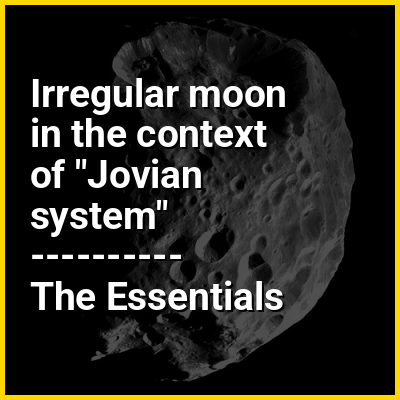
In astronomy, an irregular moon, irregular satellite, or irregular natural satellite is a natural satellite following an orbit that is irregular in some of the following ways: distant; inclined; highly elliptical; retrograde. They have often been captured by their parent planet, unlike regular satellites that formed in orbit around them. Irregular moons have a stable orbit, unlike temporary satellites which often have similarly irregular orbits but will eventually depart. The term does not refer to shape; Triton, for example, is a round moon but is considered irregular due to its orbit and origins.

As of April 2025, 358 irregular moons are known, orbiting all four of the outer planets (Jupiter, Saturn, Uranus, and Neptune). The largest of each planet are Himalia of Jupiter, Phoebe of Saturn, Sycorax of Uranus, and Triton of Neptune. Triton is rather unusual for an irregular moon; if it is excluded, then Nereid is the largest irregular moon around Neptune. It is currently thought that the irregular satellites were once independent objects orbiting the Sun before being captured by a nearby planet, early in the history of the Solar System. An alternative suggests that they originated further out in the Kuiper belt and were captured after the close flyby of another star.
↓ Menu

>>>PUT SHARE BUTTONS HERE<<<

👉 Irregular moon in the context of Jovian system

There are 97 known moons of the planet Jupiter. This number does not include a number of meter-sized moonlets thought to be shed from the inner moons, nor hundreds of possible kilometer-sized outer irregular moons that were only briefly captured by telescopes. All together, Jupiter's moons form a satellite system, colloquially referred to as the Jovian system. The most massive of the moons are the four Galilean moons: Io, Europa, Ganymede, and Callisto, all of which were independently discovered in 1610 by Galileo Galilei and Simon Marius and were the first objects found to orbit a body that was neither Earth nor the Sun. Much more recently, beginning in 1892, dozens of far smaller Jovian moons have been detected and have received the names of lovers (or other sexual partners) or daughters of the Roman god Jupiter or his Greek equivalent Zeus. The Galilean moons are by far the largest and most massive objects to orbit Jupiter, with the remaining 93 known moons and the rings together comprising just 0.003% of the total orbiting mass.

Of Jupiter's moons, eight are regular satellites with prograde and nearly circular orbits that are not greatly inclined with respect to Jupiter's equatorial plane. The Galilean satellites are nearly spherical in shape due to their planetary mass, and are just massive enough that they would be considered planets if they were in direct orbit around the Sun. The other four regular satellites, known as the inner moons, are much smaller and closer to Jupiter; these serve as sources of the dust that makes up Jupiter's rings. The remainder of Jupiter's moons are outer irregular satellites whose prograde and retrograde orbits are much farther from Jupiter and have high inclinations and eccentricities. The largest of these moons were likely asteroids that were captured from solar orbits by Jupiter before impacts with other small bodies shattered them into many kilometer-sized fragments, forming collisional families of moons sharing similar orbits. Jupiter is expected to have about 100 irregular moons larger than 1 km (0.6 mi) in diameter, plus around 500 more smaller retrograde moons down to diameters of 0.8 km (0.5 mi). Of the 89 known irregular moons of Jupiter, 40 of them have not yet been officially given names.

↓ Explore More Topics
In this Dossier

Irregular moon in the context of Moons of Saturn

There are 274 known moons of the planet Saturn, the most of any planet in the Solar System. Saturn's moons are diverse in size, ranging from tiny moonlets to Titan, which is larger than the planet Mercury. Three of these moons possess particularly notable features: Titan, Saturn's largest moon (and the second largest moon in the Solar System), has a nitrogen-rich, Earth-like atmosphere and a landscape featuring river networks and hydrocarbon lakes, Enceladus emits jets of ice from its south-polar region and is covered in a deep layer of snow, and Iapetus has contrasting black and white hemispheres as well as an extensive ridge of equatorial mountains which are among the tallest in the solar system.

Twenty-four of the known moons are regular satellites; they have prograde orbits not greatly inclined to Saturn's equatorial plane (except Iapetus, which has a prograde but highly inclined orbit). They include the seven major satellites, four small moons that exist in a trojan orbit with larger moons, and five that act as shepherd moons, of which two are mutually co-orbital. At least two tiny moons orbit inside of Saturn's B and G rings. The relatively large Hyperion is locked in an orbital resonance with Titan. The remaining regular moons orbit near the outer edges of the dense A Ring and the narrow F Ring, and between the major moons Mimas and Enceladus. The regular satellites are traditionally named after Titans and Titanesses or other figures associated with the mythological Saturn.

↑ Return to Menu

Irregular moon in the context of Moons of Uranus

There are 29 known moons of the planet Uranus. The 27 with names are named after characters that appear in, or are mentioned in William Shakespeare's plays and Alexander Pope's poem The Rape of the Lock. Uranus's moons are divided into three groups: fourteen inner moons, five major moons, and ten irregular moons. The inner and major moons all have prograde orbits and are cumulatively classified as regular moons. In contrast, the orbits of the irregular moons are distant, highly inclined, and mostly retrograde.

The inner moons are small dark bodies that share common properties and origins with Uranus's rings. The five major moons are ellipsoidal, indicating that they reached hydrostatic equilibrium at some point in their past (and may still be in equilibrium), and four of them show signs of internally driven processes such as canyon formation and volcanism on their surfaces. The largest of these five, Titania, is 1,578 km in diameter and the eighth-largest moon in the Solar System, about one-twentieth the mass of the Earth's Moon. The orbits of the regular moons are nearly coplanar with Uranus's equator, which is tilted 97.77° to its orbit. Uranus's irregular moons have elliptical and strongly inclined (mostly retrograde) orbits at large distances from the planet.

↑ Return to Menu

Irregular moon in the context of Regular satellite

In astronomy, a regular moon or a regular satellite is a natural satellite following a relatively close, stable, and circular orbit which is generally aligned to its primary's equator. They form within discs of debris and gas that once surrounded their primary, usually the aftermath of a large collision or leftover material accumulated from the protoplanetary disc. Young regular moons then begin to accumulate material within the circumplanetary disc in a process similar to planetary accretion, as opposed to irregular moons, which formed independently before being captured into orbit around the primary.

Regular moons are extremely diverse in their physical characteristics. The largest regular moons are massive enough to be gravitationally rounded, with two regular moons—Ganymede and Titan—being larger than the planet Mercury. Large regular moons also support varied and complex geology. Several are known to have atmospheres, although only one regular moon—Titan—hosts a significant atmosphere capable of supporting weather and climate. As a result of their complexity, the rounded regular moons are often considered planetary objects in their own right by planetary scientists. In contrast, the smallest regular moons lack active geology. Most are heavily cratered and irregular in shape, often resembling small asteroids and other minor bodies in appearance.

↑ Return to Menu

Irregular moon in the context of Asteroid capture

Asteroid capture is an orbital insertion of an asteroid around a larger planetary body. When asteroids, small rocky bodies in space, are captured, they become natural satellites, specifically either an irregular moon if permanently captured, or a temporary satellite.

All asteroids entering Earth's orbit or atmosphere so far have been natural phenomena; however, U.S. engineers have been working on methods for telerobotic spacecraft to retrieve asteroids using chemical or electrical propulsion. These two types of asteroid capture can be categorized as natural and artificial.

↑ Return to Menu