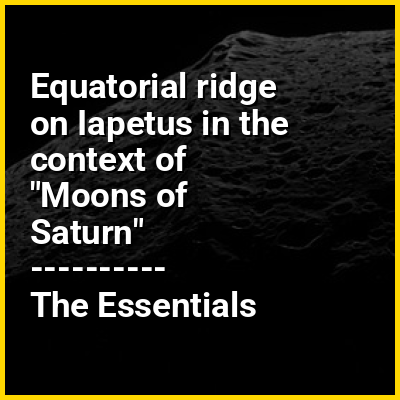
Iapetus, Saturn's third-largest moon, has a 20 kilometer (12 mi) equatorial ridge. The ridge runs along most of Iapetus's equator, and is the third tallest mountain structure in the Solar System. First discovered by the Cassini probe in 2004, the ridge's origin is unknown. There are bright areas on the sides of the equatorial ridge near Iapetus' bright trailing hemisphere, which were visible in Voyager 2 and were nicknamed the "Voyager Mountains".
>>>PUT SHARE BUTTONS HERE<<<
👉 Equatorial ridge on Iapetus in the context of Moons of Saturn
There are 274 known moons of the planet Saturn, the most of any planet in the Solar System. Saturn's moons are diverse in size, ranging from tiny moonlets to Titan, which is larger than the planet Mercury. Three of these moons possess particularly notable features: Titan, Saturn's largest moon (and the second largest moon in the Solar System), has a nitrogen-rich, Earth-like atmosphere and a landscape featuring river networks and hydrocarbon lakes, Enceladus emits jets of ice from its south-polar region and is covered in a deep layer of snow, and Iapetus has contrasting black and white hemispheres as well as an extensive ridge of equatorial mountains which are among the tallest in the solar system.
Twenty-four of the known moons are regular satellites; they have prograde orbits not greatly inclined to Saturn's equatorial plane (except Iapetus, which has a prograde but highly inclined orbit). They include the seven major satellites, four small moons that exist in a trojan orbit with larger moons, and five that act as shepherd moons, of which two are mutually co-orbital. At least two tiny moons orbit inside of Saturn's B and G rings. The relatively large Hyperion is locked in an orbital resonance with Titan. The remaining regular moons orbit near the outer edges of the dense A Ring and the narrow F Ring, and between the major moons Mimas and Enceladus. The regular satellites are traditionally named after Titans and Titanesses or other figures associated with the mythological Saturn.
In this Dossier
Equatorial ridge on Iapetus in the context of Iapetus (moon)
Iapetus (/aɪˈæpətəs/) is the outermost of Saturn's large moons. With an estimated diameter of 1,469 km (913 mi), it is the third-largest moon of Saturn and the eleventh-largest in the Solar System. Named after the Titan Iapetus from Greek mythology, the moon was discovered in 1671 by Giovanni Domenico Cassini.
A relatively low-density body composed mostly of ice, Iapetus is home to several distinctive and unusual features, such as a striking difference in coloration between its dark leading hemisphere and its bright trailing hemisphere, as well as a massive equatorial ridge that runs three-quarters of the way around the moon.