Algebra in the context of Polynomials


Algebra in the context of Polynomials

Algebra Study page number 1 of 6

Play TriviaQuestions Online!

or

Skip to study material about Algebra in the context of "Polynomials"


⭐ Core Definition: Algebra

Algebra is a branch of mathematics that deals with abstract systems, known as algebraic structures, and the manipulation of expressions within those systems. It is a generalization of arithmetic that introduces variables and algebraic operations other than the standard arithmetic operations, such as addition and multiplication.

Elementary algebra is the main form of algebra taught in schools. It examines mathematical statements using variables for unspecified values and seeks to determine for which values the statements are true. To do so, it uses different methods of transforming equations to isolate variables. Linear algebra is a closely related field that investigates linear equations and combinations of them called systems of linear equations. It provides methods to find the values that solve all equations in the system at the same time, and to study the set of these solutions.

↓ Menu
HINT:

In this Dossier

Algebra in the context of Mathematics

Mathematics is a field of study that discovers and organizes methods, theories, and theorems that are developed and proved for the needs of empirical sciences and mathematics itself. There are many areas of mathematics, which include number theory (the study of numbers), algebra (the study of formulas and related structures), geometry (the study of shapes and spaces that contain them), analysis (the study of continuous changes), and set theory (presently used as a foundation for all mathematics).

Mathematics involves the description and manipulation of abstract objects that consist of either abstractions from nature or—in modern mathematics—purely abstract entities that are stipulated to have certain properties, called axioms. Mathematics uses pure reason to prove the properties of objects through proofs, which consist of a succession of applications of deductive rules to already established results. These results, called theorems, include previously proved theorems, axioms, and—in case of abstraction from nature—some basic properties that are considered true starting points of the theory under consideration.

View the full Wikipedia page for Mathematics
↑ Return to Menu

Algebra in the context of Pythagorean theorem

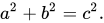
In mathematics, the Pythagorean theorem or Pythagoras's theorem is a fundamental relation in Euclidean geometry between the three sides of a right triangle. It states that the area of the square whose side is the hypotenuse (the side opposite the right angle) is equal to the sum of the areas of the squares on the other two sides.

The theorem can be written as an equation relating the lengths of the sides a, b and the hypotenuse c, sometimes called the Pythagorean equation:The theorem is named for the Greek philosopher Pythagoras, born around 570 BC. The theorem has been proved numerous times by many different methods – possibly the most for any mathematical theorem. The proofs are diverse, including both geometric proofs and algebraic proofs, with some dating back thousands of years.

View the full Wikipedia page for Pythagorean theorem
↑ Return to Menu

Algebra in the context of Diophantus

Diophantus of Alexandria (Ancient Greek: Διόφαντος, romanizedDiophantos) (/dˈfæntəs/; fl. 250 CE) was a Greek mathematician who was the author of the Arithmetica in thirteen books, ten of which are still extant, made up of arithmetical problems that are solved through algebraic equations.

Although Joseph-Louis Lagrange called Diophantus "the inventor of algebra" he did not invent it; however, his exposition became the standard within the Neoplatonic schools of Late antiquity, and its translation into Arabic in the 9th century AD and had influence in the development of later algebra: Diophantus' method of solution matches medieval Arabic algebra in its concepts and overall procedure. The 1621 edition of Arithmetica by Bachet gained fame after Pierre de Fermat wrote his famous "Last Theorem" in the margins of his copy.

View the full Wikipedia page for Diophantus
↑ Return to Menu

Algebra in the context of René Descartes

René Descartes (/dˈkɑːrt/ day-KART, also UK: /ˈdkɑːrt/ DAY-kart; 31 March 1596 – 11 February 1650) was a French philosopher, scientist, and mathematician, widely considered a seminal figure in the emergence of modern philosophy and science. Mathematics was paramount to his method of inquiry, and he connected the previously separate fields of geometry and algebra into analytic geometry.

Refusing to accept the authority of previous philosophers, Descartes frequently set his views apart from the philosophers who preceded him. In the opening section of the Passions of the Soul, an early modern treatise on emotions, Descartes goes so far as to assert that he will write on this topic "as if no one had written on these matters before." His best known philosophical statement is "cogito, ergo sum" ("I think, therefore I am," French: "Je pense, donc je suis").

View the full Wikipedia page for René Descartes
↑ Return to Menu

Algebra in the context of History of mathematics

The history of mathematics deals with the origin of discoveries in mathematics and the mathematical methods and notation of the past. Before the modern age and worldwide spread of knowledge, written examples of new mathematical developments have come to light only in a few locales. From 3000 BC the Mesopotamian states of Sumer, Akkad and Assyria, followed closely by Ancient Egypt and the Levantine state of Ebla began using arithmetic, algebra and geometry for taxation, commerce, trade, and in astronomy, to record time and formulate calendars.

The earliest mathematical texts available are from Mesopotamia and EgyptPlimpton 322 (Babylonian c. 2000 – 1900 BC), the Rhind Mathematical Papyrus (Egyptian c. 1800 BC) and the Moscow Mathematical Papyrus (Egyptian c. 1890 BC). All these texts mention the so-called Pythagorean triples, so, by inference, the Pythagorean theorem seems to be the most ancient and widespread mathematical development, after basic arithmetic and geometry.

View the full Wikipedia page for History of mathematics
↑ Return to Menu

Algebra in the context of Science in the medieval Islamic world

Science in the medieval Islamic world was the science developed and practised during the Islamic Golden Age under the Abbasid Caliphate of Baghdad, the Umayyads of Córdoba, the Abbadids of Seville, the Samanids, the Ziyarids and the Buyids in Persia and beyond, spanning the period roughly between 786 and 1258. Islamic scientific achievements encompassed a wide range of subject areas, especially astronomy, mathematics, and medicine. Other subjects of scientific inquiry included alchemy and chemistry, botany and agronomy, geography and cartography, ophthalmology, pharmacology, physics, and zoology.

Medieval Islamic science had practical purposes as well as the goal of understanding. For example, astronomy was useful for determining the Qibla, the direction in which to pray, botany had practical application in agriculture, as in the works of Ibn Bassal and Ibn al-'Awwam, and geography enabled Abu Zayd al-Balkhi to make accurate maps. Islamic mathematicians such as Al-Khwarizmi, Avicenna and Jamshīd al-Kāshī made advances in algebra, trigonometry, geometry and Arabic numerals. Islamic doctors described diseases like smallpox and measles, and challenged classical Greek medical theory. Al-Biruni, Avicenna and others described the preparation of hundreds of drugs made from medicinal plants and chemical compounds. Islamic physicists such as Ibn Al-Haytham, Al-Bīrūnī and others studied optics and mechanics as well as astronomy, and criticised Aristotle's view of motion.

View the full Wikipedia page for Science in the medieval Islamic world
↑ Return to Menu

Algebra in the context of Euclidean geometry

Euclidean geometry is a mathematical system attributed to Euclid, an ancient Greek mathematician, which he described in his textbook on geometry, Elements. Euclid's approach consists in assuming a small set of intuitively appealing axioms (postulates) and deducing many other propositions (theorems) from these. One of those is the parallel postulate which relates to parallel lines on a Euclidean plane. Although many of Euclid's results had been stated earlier, Euclid was the first to organize these propositions into a logical system in which each result is proved from axioms and previously proved theorems.

The Elements begins with plane geometry, still taught in secondary school (high school) as the first axiomatic system and the first examples of mathematical proofs. It goes on to the solid geometry of three dimensions. Much of the Elements states results of what are now called algebra and number theory, explained in geometrical language.

View the full Wikipedia page for Euclidean geometry
↑ Return to Menu

Algebra in the context of Mathematics in the medieval Islamic world

Mathematics during the Golden Age of Islam, especially during the 9th and 10th centuries, was built upon syntheses of Greek mathematics (Euclid, Archimedes, Apollonius) and Indian mathematics (Aryabhata, Brahmagupta). Important developments of the period include extension of the place-value system to include decimal fractions, the systematised study of algebra and advances in geometry and trigonometry.

The medieval Islamic world underwent significant developments in mathematics. Muhammad ibn Musa al-Khwārizmī played a key role in this transformation, introducing algebra as a distinct field in the 9th century. Al-Khwārizmī's approach, departing from earlier arithmetical traditions, laid the groundwork for the arithmetization of algebra, influencing mathematical thought for an extended period. Successors like Al-Karaji expanded on his work, contributing to advancements in various mathematical domains. The practicality and broad applicability of these mathematical methods facilitated the dissemination of Arabic mathematics to the West, contributing substantially to the evolution of Western mathematics.

View the full Wikipedia page for Mathematics in the medieval Islamic world
↑ Return to Menu

Algebra in the context of Calculus

Calculus is the mathematical study of continuous change, in the same way that geometry is the study of shape, and algebra is the study of generalizations of arithmetic operations.

Originally called infinitesimal calculus or "the calculus of infinitesimals", it has two major branches, differential calculus and integral calculus. The former concerns instantaneous rates of change, and the slopes of curves, while the latter concerns accumulation of quantities, and areas under or between curves. These two branches are related to each other by the fundamental theorem of calculus. They make use of the fundamental notions of convergence of infinite sequences and infinite series to a well-defined limit. It is the "mathematical backbone" for dealing with problems where variables change with time or another reference variable. It has also been called "the basic instrument of physical science".

View the full Wikipedia page for Calculus
↑ Return to Menu

Algebra in the context of Ellipse

In mathematics, an ellipse is a plane curve surrounding two focal points, such that for all points on the curve, the sum of both distances to the two focal points is a constant. It generalizes a circle, which is the special type of ellipse in which the two focal points are the same. The elongation of an ellipse is measured by its eccentricity , a number ranging from (the limiting case of a circle) to (the limiting case of infinite elongation, no longer an ellipse but a parabola).

An ellipse has a simple algebraic solution for its area, but for its perimeter (also known as circumference), integration is required to obtain an exact solution.

View the full Wikipedia page for Ellipse
↑ Return to Menu

Algebra in the context of Square

In geometry, a square is a regular quadrilateral. It has four straight sides of equal length and four equal angles. Squares are special cases of rectangles, which have four equal angles, and of rhombuses, which have four equal sides. As with all rectangles, a square's angles are right angles (90 degrees, or π/2 radians), making adjacent sides perpendicular. The area of a square is the side length multiplied by itself, and so in algebra, multiplying a number by itself is called squaring.

Equal squares can tile the plane edge-to-edge in the square tiling. Square tilings are ubiquitous in tiled floors and walls, graph paper, image pixels, and game boards. Square shapes are also often seen in building floor plans, origami paper, food servings, in graphic design and heraldry, and in instant photos and fine art.

View the full Wikipedia page for Square
↑ Return to Menu

Algebra in the context of Al-Khwārizmī

Muhammad ibn Musa al-Khwarizmi, or simply al-Khwarizmi (c. 780 – c. 850) was a mathematician active during the Islamic Golden Age, who produced Arabic-language works in mathematics, astronomy, and geography. Around 820, he worked at the House of Wisdom in Baghdad, the contemporary capital city of the Abbasid Caliphate. One of the most prominent scholars of the period, his works were widely influential on later authors, both in the Islamic world and Europe.

His popularizing treatise on algebra, compiled between 813 and 833 as Al-Jabr (The Compendious Book on Calculation by Completion and Balancing), presented the first systematic solution of linear and quadratic equations. One of his achievements in algebra was his demonstration of how to solve quadratic equations by completing the square, for which he provided geometric justifications. Because al-Khwarizmi was the first person to treat algebra as an independent discipline and introduced the methods of "reduction" and "balancing" (the transposition of subtracted terms to the other side of an equation, that is, the cancellation of like terms on opposite sides of the equation), he has been described as the father or founder of algebra. The English term algebra comes from the short-hand title of his aforementioned treatise (الجبر Al-Jabr, transl. "completion" or "rejoining"). His name gave rise to the English terms algorism and algorithm; the Spanish, Italian, and Portuguese terms algoritmo; and the Spanish term guarismo and Portuguese term algarismo, all meaning 'digit'.

View the full Wikipedia page for Al-Khwārizmī
↑ Return to Menu

Algebra in the context of Pattern theory

Pattern theory, formulated by Ulf Grenander, is a mathematical formalism to describe knowledge of the world as patterns. It differs from other approaches to artificial intelligence in that it does not begin by prescribing algorithms and machinery to recognize and classify patterns; rather, it prescribes a vocabulary to articulate and recast the pattern concepts in precise language. Broad in its mathematical coverage, Pattern Theory spans algebra and statistics, as well as local topological and global entropic properties.

In addition to the new algebraic vocabulary, its statistical approach is novel in its aim to:

View the full Wikipedia page for Pattern theory
↑ Return to Menu

Algebra in the context of Addition

Addition, usually denoted with the plus sign +, is one of the four basic operations of arithmetic, the other three being subtraction, multiplication, and division. The addition of two whole numbers results in the total or sum of those values combined. For example, the adjacent image shows two columns of apples, one with three apples and the other with two apples, totaling to five apples. This observation is expressed as "3 + 2 = 5", which is read as "three plus two equals five".

Besides counting items, addition can also be defined and executed without referring to concrete objects, using abstractions called numbers instead, such as integers, real numbers, and complex numbers. Addition belongs to arithmetic, a branch of mathematics. In algebra, another area of mathematics, addition can also be performed on abstract objects such as vectors, matrices, and elements of additive groups.

View the full Wikipedia page for Addition
↑ Return to Menu

Algebra in the context of Elementary algebra

Elementary algebra, also known as high school algebra or college algebra, encompasses the basic concepts of algebra. It is often contrasted with arithmetic: arithmetic deals with specified numbers, whilst algebra introduces numerical variables (quantities without fixed values).

This use of variables entails use of algebraic notation and an understanding of the general rules of the operations introduced in arithmetic: addition, subtraction, multiplication, division, etc. Unlike abstract algebra, elementary algebra is not concerned with algebraic structures outside the realm of real and complex numbers.

View the full Wikipedia page for Elementary algebra
↑ Return to Menu

Algebra in the context of Strange attractor

In the mathematical field of dynamical systems, an attractor is a set of states toward which a system tends to evolve, for a wide variety of starting conditions of the system. System values that get close enough to the attractor values remain close even if slightly disturbed.

In finite-dimensional systems, the evolving variable may be represented algebraically as an n-dimensional vector. The attractor is a region in n-dimensional space. In physical systems, the n dimensions may be, for example, two or three positional coordinates for each of one or more physical entities; in economic systems, they may be separate variables such as the inflation rate and the unemployment rate.

View the full Wikipedia page for Strange attractor
↑ Return to Menu