University of Strasbourg in the context of "Othmar Zeidler"

Play Trivia Questions online!

or

Skip to study material about University of Strasbourg in the context of "Othmar Zeidler"

Ad spacer

⭐ Core Definition: University of Strasbourg

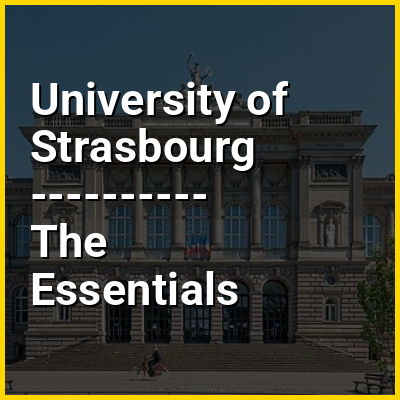
The University of Strasbourg (French: Université de Strasbourg, Unistra) is a public research university located in Strasbourg, France, with over 52,000 students and 3,300 researchers. Founded in the 16th century by Johannes Sturm, it was a center of intellectual life during the Age of Enlightenment.

In the 1970s, the old university was reorganized into three distinct institutions, which were consolidated in 2009. The current University of Strasbourg comprises 35 academic faculties, schools, and institutes, as well as 71 research laboratories spread across six campuses, including the historic site in the Neustadt.
↓ Menu

>>>PUT SHARE BUTTONS HERE<<<

👉 University of Strasbourg in the context of Othmar Zeidler

Othmar Zeidler (29 August 1850 – 17 June 1911) was an Austrian chemist credited with the first synthesis of DDT.

He was born on 29 August 1850 in Vienna a son of the Viennese pharmacist Franz Zeidler. Othmar's brother, Franz Zeidler Jr. (1851–1901), also became a chemist and would collaborate with him on several projects. As a doctoral student with Adolf von Baeyer at the University of Strasbourg, then in Germany, Zeidler is credited with the first synthesis of the insecticide dichlorodiphenyltrichloroethane, or DDT in 1874. Othmar returned to Austria before 1876 and, after working at the I. chemischen Universitätslaboratorium at the University of Vienna, became a pharmacist in the Fünfhaus district of the capital. He died in Mauer near Vienna on 17 June 1911.

↓ Explore More Topics
In this Dossier

University of Strasbourg in the context of Marc Bloch

Marc Léopold Benjamin Bloch (/blɒk/ BLOCK; French: [maʁk leɔpɔld bɛ̃ʒamɛ̃ blɔk]; 6 July 1886 – 16 June 1944) was a French historian. He was a founding member of the Annales School of French social history. Bloch specialised in medieval history and published widely on medieval France over the course of his career. As an academic, he worked at the University of Strasbourg (1920 to 1936 and 1940 to 1941), the University of Paris (1936 to 1939), and the University of Montpellier (1941 to 1944).

Born in Lyon to an Alsatian Jewish family, Bloch was raised in Paris, where his father—the classical historian Gustave Bloch—worked at Sorbonne University. Bloch was educated at various Parisian lycées and the École Normale Supérieure, and from an early age was affected by the antisemitism of the Dreyfus affair. During the First World War, he served in the French Army and fought at the First Battle of the Marne and the Somme. After the war, he was awarded his doctorate in 1918 and became a lecturer at the University of Strasbourg. There, he formed an intellectual partnership with modern historian Lucien Febvre. Together they founded the Annales School and began publishing the journal Annales d'histoire économique et sociale in 1929. Bloch was a modernist in his historiographical approach, and repeatedly emphasised the importance of a multidisciplinary engagement towards history, particularly blending his research with that on geography, sociology and economics, which was his subject when he was offered a post at the University of Paris in 1936.

↑ Return to Menu

University of Strasbourg in the context of Licentiate (degree)

A licentiate (abbreviated Lic.) is an academic degree awarded in many countries, by a variety of types of educational (usually tertiary) institutions, after a variety of courses of study. It can represent completion of study at different educational levels, but in many contexts is seen as broadly similar to a diploma; it is commonly for postgraduate studies shorter than a masters program.

The Licentiate (Pontifical Degree) is also a postgraduate degree preparatory to a doctoral degree when issued by pontifical universities and certain other universities in Europe, Latin America, and Asia.

↑ Return to Menu

University of Strasbourg in the context of Hrachia Adjarian

Hrachia Acharian (Armenian: Հրաչեայ Աճառեան, reformed spelling: Հրաչյա Աճառյան; pronounced [həɾɑt͡ʃʰˈjɑ ɑt͡ʃɑrˈjɑn]; 8 March 1876 – 16 April 1953) was an Armenian linguist, lexicographer, etymologist, and philologist.

An Istanbul Armenian, Acharian studied at local Armenian schools and at the Sorbonne, under Antoine Meillet, and the University of Strasbourg, under Heinrich Hübschmann. He then taught in various Armenian communities in the Russian Empire and Iran before settling in the Armenian Soviet Socialist Republic in 1923, working at Yerevan State University until his death.

↑ Return to Menu

University of Strasbourg in the context of Klemens von Metternich

Klemens Wenzel Nepomuk Lothar, Prince of Metternich-Winneburg zu Beilstein (15 May 1773 – 11 June 1859), known as Klemens von Metternich (/ˈmɛtərnɪx/ MET-ər-nikh, German: [ˈkleːmɛns fɔn ˈmɛtɐnɪç]) or Prince Metternich, was a German statesman and diplomat in the service of the Austrian Empire. A conservative, Metternich was at the center of the European balance of power known as the Concert of Europe for three decades as Austrian foreign minister from 1809 and chancellor from 1821 until the liberal Revolutions of 1848 forced his resignation.

Born into the House of Metternich in 1773 as the son of a diplomat, Metternich received a good education at the universities of Strasbourg and Mainz. Metternich rose through key diplomatic posts, including ambassadorial roles in the Kingdom of Saxony, the Kingdom of Prussia, and especially Napoleonic France. One of his first assignments as Foreign Minister was to engineer a détente with France that included the marriage of Napoleon to the Austrian archduchess Marie Louise. Soon after, he engineered Austria's entry into the War of the Sixth Coalition on the Allied side, signed the Treaty of Fontainebleau that sent Napoleon into exile and led the Austrian delegation at the Congress of Vienna that divided post-Napoleonic Europe amongst the major powers. For his service to the Austrian Empire, he was given the title of Prince in October 1813.

↑ Return to Menu

University of Strasbourg in the context of Jean-Pierre Sauvage

Jean-Pierre Sauvage (French pronunciation: [ʒɑ̃pjɛʁ sovaʒ]; born 21 October 1944) is a French coordination chemist working at Strasbourg University. He graduated from the National School of Chemistry of Strasbourg (now known as ECPM Strasbourg), in 1967. He has specialized in supramolecular chemistry for which he has been awarded the 2016 Nobel Prize in Chemistry along with Sir J. Fraser Stoddart and Bernard L. Feringa.

↑ Return to Menu

University of Strasbourg in the context of Hermann Dessau

Hermann Dessau (6 April 1856, Frankfurt am Main – 12 April 1931, Berlin) was a German ancient historian and epigrapher. He is noted for a key work of textual criticism published in 1889 on the Historia Augusta, which uncovered reasons to believe that this surviving text of ancient Roman imperial history had been written under circumstances very different from those previously believed.

He studied at the University of Berlin as a pupil of Theodor Mommsen, receiving his doctorate in 1877 from the University of Strasbourg. On behalf of the Corpus Inscriptionum Latinarum (CIL) he travelled to Italy and North Africa. In 1884 he was habilitated as a historian in Berlin, where he subsequently became an associate honorary professor (1912) and full honorary professor (1917). From 1900 to 1922 he served as a scientific officer for the Prussian Academy of Sciences.

↑ Return to Menu

University of Strasbourg in the context of Paul Uhlenhuth

Paul Theodor Uhlenhuth (7 January 1870 in Hanover – 13 December 1957 in Freiburg im Breisgau) was a German bacteriologist and immunologist, and Professor at the University of Strasbourg (1911–1918), at the University of Marburg (1918–1923) and at the University of Freiburg (1923–1936). He was a rector of the University of Freiburg from 1928 to 1929. After his retirement in 1936, he led his own research institute in Freiburg, known as the State Research Laboratory, until his death in 1957.

He is famous in the annals of forensic science for developing the species precipitin test, known as the Uhlenhuth test, which could distinguish human blood from animal blood in 1901, a discovery which had tremendous importance in criminal justice in the 20th century. In 1915, he discovered the pathogen of Weil's disease. He also invented the arsenic treatment of syphilis and the antimony treatment of many tropical diseases, and was an influential promoter of cancer research. He was a recipient of numerous honours, and was a member of the Academy of Sciences Leopoldina and the Royal Swedish Academy of Sciences. He was nominated for the Nobel Prize in Medicine 40 times between 1910 and 1952, notably by Nobel laureate Karl Landsteiner. At the time of his death, he was one of the most celebrated medical researchers in Germany, and one of the rare examples of someone who was equally celebrated in the west and east during the Cold War.

↑ Return to Menu