Uncertainty principle in the context of Quantum fluctuations


Uncertainty principle in the context of Quantum fluctuations

Uncertainty principle Study page number 1 of 2

Play TriviaQuestions Online!

or

Skip to study material about Uncertainty principle in the context of "Quantum fluctuations"


⭐ Core Definition: Uncertainty principle

The uncertainty principle, also known as Heisenberg's indeterminacy principle, is a fundamental concept in quantum mechanics. It states that there is a limit to the precision with which certain pairs of physical properties, such as position and momentum, can be simultaneously known. In other words, the more accurately one property is measured, the less accurately the other property can be known.

More formally, the uncertainty principle is any of a variety of mathematical inequalities asserting a fundamental limit to the product of the accuracy of certain related pairs of measurements on a quantum system, such as position, x, and momentum, p. Such paired-variables are known as complementary variables or canonically conjugate variables.

↓ Menu
HINT:

In this Dossier

Uncertainty principle in the context of Cold

Cold is the presence of low temperature, especially in the atmosphere. In common usage, cold is often a subjective perception. A lower bound to temperature is absolute zero, defined as 0.00 K on the Kelvin scale, an absolute thermodynamic temperature scale. This corresponds to −273.15 °C on the Celsius scale, −459.67 °F on the Fahrenheit scale, and 0.00 °R on the Rankine scale.

Since temperature relates to the thermal energy held by an object or a sample of matter, which is the kinetic energy of the random motion of the particle constituents of matter, an object will have less thermal energy when it is colder and more when it is hotter. If it were possible to cool a system to absolute zero, all motion of the particles in a sample of matter would cease and they would be at complete rest in the classical sense. The object could be described as having zero thermal energy. Microscopically in the description of quantum mechanics, however, matter still has zero-point energy even at absolute zero, because of the uncertainty principle.

View the full Wikipedia page for Cold
↑ Return to Menu

Uncertainty principle in the context of Point particle

A point particle, ideal particle or point-like particle (often spelled pointlike particle) is an idealization of particles heavily used in physics. Its defining feature is that it lacks spatial extension; being dimensionless, it does not take up space. A point particle is an appropriate representation of any object whenever its size, shape, and structure are irrelevant in a given context. For example, from far enough away, any finite-size object will look and behave as a point-like object. Point masses and point charges, discussed below, are two common cases. When a point particle has an additive property, such as mass or charge, it is often represented mathematically by a Dirac delta function. In classical mechanics there is usually no concept of rotation of point particles about their "center".

In quantum mechanics, the concept of a point particle is complicated by the Heisenberg uncertainty principle, because even an elementary particle, with no known internal structure, occupies a nonzero volume. There is nevertheless a distinction between elementary particles such as electrons or quarks, which have no known internal structure, and composite particles such as protons and neutrons, whose internal structures are made up of quarks.Elementary particles are sometimes called "point particles" in reference to their lack of known internal structure, but this is in a different sense than that discussed herein.

View the full Wikipedia page for Point particle
↑ Return to Menu

Uncertainty principle in the context of Logical disjunction

In logic, disjunction (also known as logical disjunction, logical or, logical addition, or inclusive disjunction) is a logical connective typically notated as and read aloud as "or". For instance, the English language sentence "it is sunny or it is warm" can be represented in logic using the disjunctive formula , assuming that abbreviates "it is sunny" and abbreviates "it is warm".

In classical logic, disjunction is given a truth functional semantics according to which a formula is true unless both and are false. Because this semantics allows a disjunctive formula to be true when both of its disjuncts are true, it is an inclusive interpretation of disjunction, in contrast with exclusive disjunction. Classical proof theoretical treatments are often given in terms of rules such as disjunction introduction and disjunction elimination. Disjunction has also been given numerous non-classical treatments, motivated by problems including Aristotle's sea battle argument, Heisenberg's uncertainty principle, as well as the numerous mismatches between classical disjunction and its nearest equivalents in natural languages.

View the full Wikipedia page for Logical disjunction
↑ Return to Menu

Uncertainty principle in the context of Absolute zero

Absolute zero is the lowest possible temperature, a state at which a system's internal energy, and in ideal cases entropy, reach their minimum values. The Kelvin scale is defined so that absolute zero is 0 K, equivalent to −273.15 °C on the Celsius scale, and −459.67 °F on the Fahrenheit scale. The Kelvin and Rankine temperature scales set their zero points at absolute zero by definition. This limit can be estimated by extrapolating the ideal gas law to the temperature at which the volume or pressure of a classical gas becomes zero.

Although absolute zero can be approached, it cannot be reached. Some isentropic processes, such as adiabatic expansion, can lower the system's temperature without relying on a colder medium. Nevertheless, the third law of thermodynamics implies that no physical process can reach absolute zero in a finite number of steps. As a system nears this limit, further reductions in temperature become increasingly difficult, regardless of the cooling method used. In the 21st century, scientists have achieved temperatures below 100 picokelvin (pK). At these low temperatures, matter displays exotic quantum mechanical phenomena such as superconductivity, superfluidity, and Bose–Einstein condensation. The particles still exhibit zero-point energy motion, as mandated by the Heisenberg uncertainty principle and, for a system of fermions, the Pauli exclusion principle.

View the full Wikipedia page for Absolute zero
↑ Return to Menu

Uncertainty principle in the context of Quantum fluctuation

In quantum physics, a quantum fluctuation (also known as a vacuum state fluctuation or vacuum fluctuation) is the temporary random change in the amount of energy in a point in space, as prescribed by Werner Heisenberg's uncertainty principle. They are minute random fluctuations in the values of the fields which represent elementary particles, such as electric and magnetic fields which represent the electromagnetic force carried by photons, W and Z fields which carry the weak force, and gluon fields which carry the strong force.

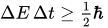
The uncertainty principle states the uncertainty in energy and time can be related by , where 1/2ħ5.27286×10 J⋅s. This means that pairs of virtual particles with energy and lifetime shorter than are continually created and annihilated in empty space. Although the particles are not directly detectable, the cumulative effects of these particles are measurable. For example, without quantum fluctuations, the "bare" mass and charge of elementary particles would be infinite; from renormalization theory the shielding effect of the cloud of virtual particles is responsible for the finite mass and charge of elementary particles.

View the full Wikipedia page for Quantum fluctuation
↑ Return to Menu

Uncertainty principle in the context of Werner Heisenberg

Werner Karl Heisenberg (/ˈh.zən.bɜːrɡ/; German: [ˈvɛʁnɐ ˈhaɪzn̩bɛʁk] ; 5 December 1901 – 1 February 1976) was a German theoretical physicist, one of the main pioneers of the theory of quantum mechanics and a principal scientist in the German nuclear program during World War II.

Heisenberg published his Umdeutung paper in 1925, a major reinterpretation of old quantum theory. In the subsequent series of papers with Max Born and Pascual Jordan, during the same year, his matrix formulation of quantum mechanics was substantially elaborated. He is known for the uncertainty principle, which he published in 1927. He received the Nobel Prize in Physics in 1932 "for the creation of quantum mechanics".

View the full Wikipedia page for Werner Heisenberg
↑ Return to Menu

Uncertainty principle in the context of Quantum noise

Quantum noise is a type of noise in a quantum system due to quantum mechanical phenomena such as quantized fields and the uncertainty principle. This principle says that some observables cannot simultaneously be known with arbitrary precision. This indeterminate state of matter introduces a fluctuation in the value of properties of a quantum system, even at zero temperature. These fluctuations in the absence of thermal noise are known as zero-point energy fluctuations.

Quantum noise can also come from the discrete nature of the small quantum constituents such as electrons and quantum effects, such as photocurrents. An example of this form of quantum noise is shot noise as coined by J. Verdeyen which comes from the discrete arrival of photons or electrons in a detector. Because these quanta arrive randomly in time, even a perfectly steady current or light beam exhibits fluctuations in the detected signal.

View the full Wikipedia page for Quantum noise
↑ Return to Menu

Uncertainty principle in the context of Complementarity (physics)

In physics, complementarity is a conceptual aspect of quantum mechanics that Niels Bohr regarded as an essential feature of the theory. The complementarity principle holds that certain pairs of complementary properties cannot all be observed or measured simultaneously. For example, position and momentum, frequency and lifetime, or optical phase and photon number. In contemporary terms, complementarity encompasses both the uncertainty principle and wave-particle duality.

Bohr considered one of the foundational truths of quantum mechanics to be the fact that setting up an experiment to measure one quantity of a pair, for instance the position of an electron, excludes the possibility of measuring the other, yet understanding both experiments is necessary to characterize the object under study. In Bohr's view, the behavior of atomic and subatomic objects cannot be separated from the measuring instruments that create the context in which the measured objects behave. Consequently, there is no "single picture" that unifies the results obtained in these different experimental contexts, and only the "totality of the phenomena" together can provide a completely informative description.

View the full Wikipedia page for Complementarity (physics)
↑ Return to Menu

Uncertainty principle in the context of Quantum measurement

In quantum physics, a measurement is the testing or manipulation of a physical system to yield a numerical result. A fundamental feature of quantum theory is that the predictions it makes are probabilistic.

The procedure for finding a probability involves combining a quantum state, which mathematically describes a quantum system, with a mathematical representation of the measurement to be performed on that system. The formula for this calculation is known as the Born rule. For example, a quantum particle like an electron can be described by a quantum state that associates to each point in space a complex number called a probability amplitude. Applying the Born rule to these amplitudes gives the probabilities that the electron will be found in one region or another when an experiment is performed to locate it. This is the best the theory can do; it cannot say for certain where the electron will be found. The same quantum state can also be used to make a prediction of how the electron will be moving, if an experiment is performed to measure its momentum instead of its position. The uncertainty principle implies that, whatever the quantum state, the range of predictions for the electron's position and the range of predictions for its momentum cannot both be narrow. Some quantum states imply a near-certain prediction of the result of a position measurement, but the result of a momentum measurement will be highly unpredictable, and vice versa. Furthermore, the fact that nature violates the statistical conditions known as Bell inequalities indicates that the unpredictability of quantum measurement results cannot be explained away as due to ignorance about local hidden variables within quantum systems.

View the full Wikipedia page for Quantum measurement
↑ Return to Menu

Uncertainty principle in the context of Virtual particle

A virtual particle is a theoretical transient particle that exhibits some of the characteristics of an ordinary particle, while having its existence limited by the uncertainty principle, which allows the virtual particles to spontaneously emerge from vacuum at short time and space ranges. The concept of virtual particles arises in the perturbation theory of quantum field theory (QFT) where interactions between ordinary particles are described in terms of exchanges of virtual particles. A process involving virtual particles can be described by a schematic representation known as a Feynman diagram, in which virtual particles are represented by internal lines.

Virtual particles do not necessarily carry the same mass as the corresponding ordinary particle, although they always conserve energy and momentum. The closer its characteristics come to those of ordinary particles, the longer the virtual particle exists. They are important in the physics of many processes, including particle scattering and Casimir forces. In quantum field theory, forces—such as the electromagnetic repulsion or attraction between two charges—can be thought of as resulting from the exchange of virtual photons between the charges. Virtual photons are the exchange particles for the electromagnetic interaction.

View the full Wikipedia page for Virtual particle
↑ Return to Menu

Uncertainty principle in the context of Electron density

Electron density or electronic density is the measure of the probability of an electron being present at an infinitesimal element of space surrounding any given point. It is a scalar quantity depending upon three spatial variables and is typically denoted as either or . The density is determined, through definition, by the normalised -electron wavefunction which itself depends upon variables ( spatial and spin coordinates). Conversely, the density determines the wave function modulo up to a phase factor, providing the formal foundation of density functional theory.

According to quantum mechanics, due to the uncertainty principle on an atomic scale the exact location of an electron cannot be predicted, only the probability of its being at a given position; therefore electrons in atoms and molecules act as if they are "smeared out" in space. For one-electron systems, the electron density at any point is proportional to the square magnitude of the wavefunction.

View the full Wikipedia page for Electron density
↑ Return to Menu

Uncertainty principle in the context of Particle collision

In particle physics, an event refers to the results just after a fundamental interaction takes place between subatomic particles, occurring in a very short time span, at a well-localized region of space. Because of the uncertainty principle, an event in particle physics does not have quite the same meaning as it does in the theory of relativity, in which an "event" is a point in spacetime which can be known exactly, i.e., a spacetime coordinate.

View the full Wikipedia page for Particle collision
↑ Return to Menu

Uncertainty principle in the context of Quantum information

Quantum information is the information of the state of a quantum system. It is the basic entity of study in quantum information science, and can be manipulated using quantum information processing techniques. Quantum information refers to both the technical definition in terms of von Neumann entropy and the general computational term.

It is an interdisciplinary field that involves quantum mechanics, computer science, information theory, philosophy and cryptography among other fields. Its study is also relevant to disciplines such as cognitive science, psychology and neuroscience. Its main focus is in extracting information from matter at the microscopic scale. Observation in science is one of the most important ways of acquiring information and measurement is required in order to quantify the observation, making this crucial to the scientific method. In quantum mechanics, due to the uncertainty principle, non-commuting observables cannot be precisely measured simultaneously, as an eigenstate in one basis is not an eigenstate in the other basis. According to the eigenstate–eigenvalue link, an observable is well-defined (definite) when the state of the system is an eigenstate of the observable. Since any two non-commuting observables are not simultaneously well-defined, a quantum state can never contain definitive information about both non-commuting observables.

View the full Wikipedia page for Quantum information
↑ Return to Menu