Von Neumann entropy in the context of Quantum information


Von Neumann entropy in the context of Quantum information

Von Neumann entropy Study page number 1 of 1

Play TriviaQuestions Online!

or

Skip to study material about Von Neumann entropy in the context of "Quantum information"


⭐ Core Definition: Von Neumann entropy

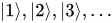
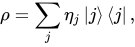
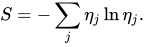
In physics, the von Neumann entropy, named after John von Neumann, is a measure of the statistical uncertainty within a description of a quantum system. It extends the concept of Gibbs entropy from classical statistical mechanics to quantum statistical mechanics, and it is the quantum counterpart of the Shannon entropy from classical information theory. For a quantum-mechanical system described by a density matrix ρ, the von Neumann entropy iswhere denotes the trace and denotes the matrix version of the natural logarithm. If the density matrix ρ is written in a basis of its eigenvectors asthen the von Neumann entropy is merelyIn this form, S can be seen as the Shannon entropy of the eigenvalues, reinterpreted as probabilities.

The von Neumann entropy and quantities based upon it are widely used in the study of quantum entanglement.

↓ Menu
HINT:

👉 Von Neumann entropy in the context of Quantum information

Quantum information is the information of the state of a quantum system. It is the basic entity of study in quantum information science, and can be manipulated using quantum information processing techniques. Quantum information refers to both the technical definition in terms of von Neumann entropy and the general computational term.

It is an interdisciplinary field that involves quantum mechanics, computer science, information theory, philosophy and cryptography among other fields. Its study is also relevant to disciplines such as cognitive science, psychology and neuroscience. Its main focus is in extracting information from matter at the microscopic scale. Observation in science is one of the most important ways of acquiring information and measurement is required in order to quantify the observation, making this crucial to the scientific method. In quantum mechanics, due to the uncertainty principle, non-commuting observables cannot be precisely measured simultaneously, as an eigenstate in one basis is not an eigenstate in the other basis. According to the eigenstate–eigenvalue link, an observable is well-defined (definite) when the state of the system is an eigenstate of the observable. Since any two non-commuting observables are not simultaneously well-defined, a quantum state can never contain definitive information about both non-commuting observables.

↓ Explore More Topics
In this Dossier

Von Neumann entropy in the context of Black hole information paradox

The black hole information paradox is an unsolved problem in physics and a paradox that appears when the predictions of quantum mechanics and general relativity are combined. The theory of general relativity predicts the existence of black holes that are regions of spacetime from which nothing—not even light—can escape. In the 1970s, Stephen Hawking applied the semiclassical approach of quantum field theory in curved spacetime to such systems and found that an isolated black hole would emit a form of radiation (now called Hawking radiation in his honor). He also argued that the detailed form of the radiation would be independent of the initial state of the black hole, and depend only on its mass, electric charge and angular momentum.

The information paradox appears when one considers a process in which a black hole is formed through a physical process and then evaporates away entirely through Hawking radiation. Hawking's calculation suggests that the final state of radiation would retain information only about the total mass, electric charge and angular momentum of the initial state. Since many different states can have the same mass, charge and angular momentum, this suggests that many initial physical states could evolve into the same final state. Therefore, information about the details of the initial state would be permanently lost; however, this violates a core precept of both classical and quantum physics: that, in principle only, the state of a system at one point in time should determine its state at any other time. Specifically, in quantum mechanics the state of the system is encoded by its wave function. The evolution of the wave function is determined by a unitary operator, and unitarity implies that the wave function at any instant of time can be used to determine the wave function either in the past or the future. In 1993, Don Page argued that if a black hole starts in a pure quantum state and evaporates completely by a unitary process, the von Neumann entropy of the Hawking radiation initially increases and then decreases back to zero when the black hole has disappeared. This is called the Page curve.

View the full Wikipedia page for Black hole information paradox
↑ Return to Menu