Uncertainty or incertitude refers to situations involving imperfect or unknown information. It applies to predictions of future events, to physical measurements that are already made, or to the unknown, and is particularly relevant for decision-making. Uncertainty arises in partially observable or stochastic or complex or dynamic environments, as well as due to ignorance, indolence, or both. It arises in any number of fields, including insurance, philosophy, physics, statistics, economics, entrepreneurship, finance, medicine, psychology, sociology, engineering, metrology, meteorology, ecology and information science.

HINT:
In this Dossier
- ⭐ Core Definition: Uncertainty
- Uncertainty in the context of Courage
- Uncertainty in the context of Prediction
- Uncertainty in the context of Risk
- Uncertainty in the context of Testable
- Uncertainty in the context of Expected utility hypothesis
- Uncertainty in the context of Choice under uncertainty
- Uncertainty in the context of Forecasting
- Uncertainty in the context of Expectation (epistemic)
- Uncertainty in the context of Doubt
- Uncertainty in the context of Ambiguity
- Uncertainty in the context of Strategy
- Uncertainty in the context of Estimation
- Uncertainty in the context of Suspense
- Uncertainty in the context of Von Neumann–Morgenstern utility theorem
Uncertainty in the context of Courage
Courage (also called bravery, valour (British and Commonwealth English), or valor (American English)) is the choice and willingness to confront agony, pain, danger, uncertainty, or intimidation. Valor is courage or bravery, especially in battle.
Physical courage is bravery in the face of physical pain, hardship, even death, or threat of death; while moral courage is the ability to act rightly in the face of popular opposition, shame, scandal, discouragement, or personal loss.
View the full Wikipedia page for CourageUncertainty in the context of Prediction
A prediction (Latin præ-, "before," and dictum, "something said") or forecast is a statement about a future event or about future data. Predictions are often, but not always, based upon experience or knowledge of forecasters. There is no universal agreement about the exact difference between "prediction" and "estimation"; different authors and disciplines ascribe different connotations.
Future events are necessarily uncertain, so guaranteed accurate information about the future is impossible. Prediction can be useful to assist in making plans about possible developments.
View the full Wikipedia page for PredictionUncertainty in the context of Risk
Risk is the possibility of something bad happening, comprising a level of uncertainty about the effects and implications of an activity, particularly negative and undesirable consequences.
Risk theory, assessment, and management are applied but substantially differ in different practice areas, such as business, economics, environment, finance, information technology, health, insurance, safety, security, and privacy. The international standard for risk management, ISO 31000, provides general guidelines and principles on managing risks faced by organizations.
View the full Wikipedia page for RiskUncertainty in the context of Testable
Testability is a primary aspect of science and the scientific method. There are two components to testability:
- Falsifiability or defeasibility, which means that counterexamples to the hypothesis are logically possible.
- The practical feasibility of observing a reproducible series of such counterexamples if they do exist.
In short, a hypothesis is testable if there is a possibility of deciding whether it is true or false based on experimentation by anyone. This allows anyone to decide whether a theory can be supported or refuted by data. However, the interpretation of experimental data may be also inconclusive or uncertain. Karl Popper introduced the concept that scientific knowledge had the property of falsifiability as published in The Logic of Scientific Discovery.
View the full Wikipedia page for TestableUncertainty in the context of Expected utility hypothesis
The expected utility hypothesis is a foundational assumption in mathematical economics concerning decision making under uncertainty. It postulates that rational agents maximize utility, meaning the subjective desirability of their actions. Rational choice theory, a cornerstone of microeconomics, builds this postulate to model aggregate social behaviour.
The expected utility hypothesis states an agent chooses between risky prospects by comparing expected utility values (i.e., the weighted sum of adding the respective utility values of payoffs multiplied by their probabilities). The summarised formula for expected utility is where is the probability that outcome indexed by with payoff is realized, and function u expresses the utility of each respective payoff. Graphically the curvature of the u function captures the agent's risk attitude.
View the full Wikipedia page for Expected utility hypothesis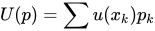


Uncertainty in the context of Choice under uncertainty
Decision theory or the theory of rational choice is a branch of probability, economics, and analytic philosophy that uses expected utility and probability to model how individuals would behave rationally under uncertainty. It differs from the cognitive and behavioral sciences in that it is mainly prescriptive and concerned with identifying optimal decisions for a rational agent, rather than describing how people actually make decisions. Despite this, the field is important to the study of real human behavior by social scientists, as it lays the foundations to mathematically model and analyze individuals in fields such as sociology, economics, criminology, cognitive science, moral philosophy and political science.
View the full Wikipedia page for Choice under uncertaintyUncertainty in the context of Forecasting
Forecasting is the process of making predictions based on past and present data. Later these can be compared with what actually happens. For example, a company might estimate their revenue in the next year, then compare it against the actual results creating a variance actual analysis. Prediction is a similar but more general term. Forecasting might refer to specific formal statistical methods employing time series, cross-sectional or longitudinal data, or alternatively to less formal judgmental methods or the process of prediction and assessment of its accuracy. Usage can vary between areas of application: for example, in hydrology the terms "forecast" and "forecasting" are sometimes reserved for estimates of values at certain specific future times, while the term "prediction" is used for more general estimates, such as the number of times floods will occur over a long period.
Risk and uncertainty are central to forecasting and prediction; it is generally considered a good practice to indicate the degree of uncertainty attaching to forecasts. In any case, the data must be up to date in order for the forecast to be as accurate as possible. In some cases the data used to predict the variable of interest is itself forecast. A forecast is not to be confused with a Budget; budgets are more specific, fixed-term financial plans used for resource allocation and control, while forecasts provide estimates of future financial performance, allowing for flexibility and adaptability to changing circumstances. Both tools are valuable in financial planning and decision-making, but they serve different functions.
Uncertainty in the context of Expectation (epistemic)
In the case of uncertainty, expectation is what is considered the most likely to happen. An expectation, which is a belief that is centered on the future, may or may not be realistic. A less advantageous result gives rise to the emotion of disappointment. If something happens that is not at all expected, it is a surprise. An expectation about the behavior or performance of another person, expressed to that person, may have the nature of a strong request, or an order; this kind of expectation is called a social norm. The degree to which something is expected to be true can be expressed using fuzzy logic. Anticipation is the emotion corresponding to expectation.
View the full Wikipedia page for Expectation (epistemic)Uncertainty in the context of Doubt
Doubt is a mental state in which the mind remains suspended between two or more contradictory propositions, and is uncertain about them. Doubt on an emotional level is indecision between belief and disbelief. It may involve uncertainty, distrust or lack of conviction on certain facts, actions, motives, or decisions. Doubt can result in delaying or rejecting relevant action out of concern for mistakes or missed opportunities.
View the full Wikipedia page for DoubtUncertainty in the context of Ambiguity
Ambiguity is the type of meaning in which a phrase, statement, or resolution is not explicitly defined, making for several interpretations; others describe it as a concept or statement that has no real reference. A common aspect of ambiguity is uncertainty. It is thus an attribute of any idea or statement whose intended meaning cannot be definitively resolved, according to a rule or process with a finite number of steps. The prefix ambi- reflects the idea of "two", as in "two meanings".
The concept of ambiguity is generally contrasted with vagueness. In ambiguity, specific and distinct interpretations are permitted (although some may not be immediately obvious), whereas with vague information it is difficult to form any interpretation at the desired level of specificity.
View the full Wikipedia page for AmbiguityUncertainty in the context of Strategy
Strategy (from Greek στρατηγία stratēgia, "troop leadership; office of general, command, generalship") is a general plan to achieve one or more long-term or overall goals under conditions of uncertainty. In the sense of the "art of the general", which included several subsets of skills including military tactics, siegecraft, logistics etc., the term came into use in the 6th century C.E. in Eastern Roman terminology, and was translated into Western vernacular languages only in the 18th century. From then until the 20th century, the word "strategy" came to denote "a comprehensive way to try to pursue political ends, including the threat or actual use of force, in a dialectic of wills" in a military conflict, in which both adversaries interact.
Strategy is important because the resources available to achieve goals are usually limited. Strategy generally involves setting goals and priorities, determining actions to achieve the goals, and mobilizing resources to execute the actions. A strategy describes how the ends (goals) will be achieved by the means (resources). Strategy can be intended or can emerge as a pattern of activity as the organization adapts to its environment or competes. It involves activities such as strategic planning and strategic thinking.
View the full Wikipedia page for StrategyUncertainty in the context of Estimation
Estimation (or estimating) is the process of finding an estimate or approximation, which is a value that is usable for some purpose even if input data may be incomplete, uncertain, or unstable. The value is nonetheless usable because it is derived from the best information available. Typically, estimation involves "using the value of a statistic derived from a sample to estimate the value of a corresponding population parameter". The sample provides information that can be projected, through various formal or informal processes, to determine a range most likely to describe the missing information. An estimate that turns out to be incorrect will be an overestimate if the estimate exceeds the actual result and an underestimate if the estimate falls short of the actual result.
The confidence in an estimate is quantified as a confidence interval, the likelihood that the estimate is in a certain range. Human estimators systematically suffer from overconfidence, believing that their estimates are more accurate than they actually are.
View the full Wikipedia page for EstimationUncertainty in the context of Suspense
Suspense is a state of anxiety or excitement caused by mysteriousness, uncertainty, doubt, or undecidedness. In a narrative work, suspense is the audience's excited anticipation about the plot or conflict (which may be heightened by a violent moment, stressful scene, puzzle, mystery, etc.), particularly as it affects a character for whom the audience feels sympathy. However, suspense is not exclusive to narratives.
View the full Wikipedia page for SuspenseUncertainty in the context of Von Neumann–Morgenstern utility theorem
In decision theory, the von Neumann–Morgenstern (VNM) utility theorem demonstrates that rational choice under uncertainty involves making decisions that take the form of maximizing the expected value of some cardinal utility function. The theorem forms the foundation of expected utility theory.
In 1947, John von Neumann and Oskar Morgenstern proved that any individual whose preferences satisfied four axioms has a utility function, where such an individual's preferences can be represented on an interval scale and the individual will always prefer actions that maximize expected utility. That is, they proved that an agent is (VNM-)rational if and only if there exists a real-valued function u defined by possible outcomes such that every preference of the agent is characterized by maximizing the expected value of u, which can then be defined as the agent's VNM-utility (it is unique up to affine transformations i.e. adding a constant and multiplying by a positive scalar). No claim is made that the agent has a "conscious desire" to maximize u, only that u exists.
View the full Wikipedia page for Von Neumann–Morgenstern utility theorem