Suspension bridge in the context of "List of longest suspension bridge spans"

Play Trivia Questions online!

or

Skip to study material about Suspension bridge in the context of "List of longest suspension bridge spans"

Ad spacer

⭐ Core Definition: Suspension bridge

A suspension bridge is a type of bridge in which the deck is hung below suspension cables on vertical suspenders. The first modern examples of this type of bridge were built in the early 1800s. Simple suspension bridges, which lack vertical suspenders, have a long history in many mountainous parts of the world.

Besides the bridge type most commonly called suspension bridges, covered in this article, there are other types of suspension bridges. The type covered here has cables suspended between towers, with vertical suspender cables that transfer the live and dead loads of the deck below, upon which traffic crosses. This arrangement allows the deck to be level or to arc upward for additional clearance. Like other suspension bridge types, this type often is constructed without the use of falsework.
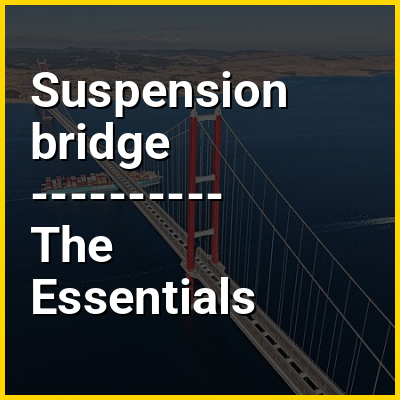
↓ Menu

>>>PUT SHARE BUTTONS HERE<<<

👉 Suspension bridge in the context of List of longest suspension bridge spans

The world's longest suspension bridges are listed according to the length of their main span (i.e., the length of suspended roadway between the bridge's towers). The length of the main span is the most common method of comparing the sizes of suspension bridges, often correlating with the height of the towers and the engineering complexity involved in designing and constructing the bridge. If one bridge has a longer span than another, it does not necessarily mean that the bridge is longer from shore to shore (or from abutment to abutment).

Suspension bridges have the longest spans of any type of bridge. Cable-stayed bridges, the next longest design, are practical for spans up to just over one kilometre (the longest cable-stayed bridge in the world has a 1,104 m span). Therefore, as of October 2025, the 28 longest bridges on this list are the 28 longest spans of all types of vehicular bridges (other than floating pontoon bridges).

↓ Explore More Topics
In this Dossier

Suspension bridge in the context of Bridge

A bridge is a structure that crosses an obstacle such as a river, lake, railroad, road, or ravine. Its primary function is to transport vehicles, trains, and pedestrians, but bridges may also accommodate pipelines, buildings, wildlife, and canals. Basic structures used in bridge design include arches, trusses, beams, cantilevers, suspension cables, and cable-stays. Bridges are configured in a variety of forms, such as viaducts, aqueducts, trestles, movable bridges, double-deckers, pontoons, and portable military bridges. They may also be categorized by their materials, which include wood, brick, stone, iron, steel, and concrete.

The history of bridges reflects the evolution of humankind's engineering technologies. The Romans and ancient Chinese built major bridges of stone and timber. During the Renaissance, advances in science and engineering led to wider bridge spans and more elegant designs. Concrete was perfected in the early 1800s, and proved to be superior to stone in many regards. With the Industrial Revolution came mass-produced steel, which enabled the creation of suspension and cable-stayed bridges that could span wide obstacles.

↑ Return to Menu

Suspension bridge in the context of 1915 Çanakkale Bridge

The 1915 Çanakkale Bridge (Turkish: 1915 Çanakkale Köprüsü) is a road suspension bridge in the province of Çanakkale in northwestern Turkey. Situated just south of the coastal towns of Lapseki and Gelibolu, the bridge spans the Dardanelles, about ten kilometres (six miles) south of the Sea of Marmara. The bridge is the longest suspension bridge in the world—with a main span of 2,023 m (2.023 km; 1.257 mi), the bridge surpasses the Akashi Kaikyo Bridge (1998) in Japan by 32 m (105 ft).

The bridge was officially opened by President Recep Tayyip Erdoğan on 18 March 2022 after roughly five years of construction. It is the centrepiece of the planned 321-kilometre-long (199 mi) US$2.8 billion O-6 motorway, which will connect the O-3 and O-7 motorways in East Thrace to the O-5 motorway in Anatolia. The year "1915" in the official Turkish name honours an important Ottoman victory in the Gallipoli campaign comprising an unsuccessful Entente naval attack followed by invasions of the Gallipoli peninsula by the forces of Australia, New Zealand, France, and Great Britain, on 25 April 1915 and a second in August; the Entente land forces failed to make significant progress and were evacuated at the end of that year.

↑ Return to Menu

Suspension bridge in the context of Golden Gate Bridge

The Golden Gate Bridge is a suspension bridge spanning the Golden Gate, the one-mile-wide (1.6 km) strait connecting San Francisco Bay and the Pacific Ocean in California, United States. The structure links San Francisco—the northern tip of the San Francisco Peninsula—to Marin County, carrying both U.S. Route 101 and California State Route 1 across the strait. It also carries pedestrian and bicycle traffic, and is designated as part of U.S. Bicycle Route 95. Recognized by the American Society of Civil Engineers as one of the Wonders of the Modern World, the bridge is one of the most internationally recognized symbols of San Francisco and California.

The idea of a fixed link between San Francisco and Marin had gained increasing popularity during the late 19th century, but it was not until the early 20th century that such a link became feasible. Joseph Strauss served as chief engineer for the project, with Leon Moisseiff, Irving Morrow and Charles Ellis making significant contributions to its design. The bridge opened to the public on May 27, 1937, and has undergone various retrofits and other improvement projects in the decades since.

↑ Return to Menu

Suspension bridge in the context of Cable-stayed bridge

A cable-stayed bridge is a type of bridge that has one or more towers (or pylons), from which cables support the bridge deck. A distinctive feature are the cables or stays, which run directly from the tower to the deck, normally forming a fan-like pattern or a series of parallel lines. This is in contrast to the modern suspension bridge, where the cables supporting the deck are suspended vertically from the main cables, which run between the towers and are anchored at both ends of the bridge. The cable-stayed bridge is optimal for spans longer than cantilever bridges and shorter than suspension bridges. This is the range within which cantilever bridges would rapidly grow heavier, and suspension bridge cabling would be more costly.

Cable-stayed bridges found wide use in the late 19th century. Early examples, including the Brooklyn Bridge, often combined features from both the cable-stayed and suspension designs. Cable-stayed designs fell from favor in the early 20th century as larger gaps were bridged using pure suspension designs, and shorter ones using various systems built of reinforced concrete. It returned to prominence in the later 20th century when the combination of new materials, larger construction machinery, and the need to replace older bridges all lowered the relative price of these designs.

↑ Return to Menu

Suspension bridge in the context of Akashi Kaikyo Bridge

The Akashi Kaikyo Bridge (Japanese: 明石海峡大橋, Hepburn: Akashi Kaikyō Ōhashi) is a suspension bridge that links the city of Kobe on the Japanese island of Honshu and Iwaya, Awaji [ja] on Awaji Island. It is part of the Kobe-Awaji-Naruto Expressway, and crosses the busy and turbulent Akashi Strait (Akashi Kaikyō in Japanese). It was completed in 1998, and at the time, was the longest central span of any suspension bridge in the world, at 1,991 metres (6,532 ft). Currently, it is the second-longest, behind the 1915 Çanakkale Bridge in Turkey that was opened in March 2022.

The Akashi Kaikyo Bridge is one of the key links of the Honshū–Shikoku Bridge Project, which created three routes across the Seto Inland Sea.

↑ Return to Menu

Suspension bridge in the context of Otoyol 7

The Otoyol 7 (O-7; English: Motorway 7), or Northern Marmara Motorway (Turkish: Kuzey Marmara Otoyolu), is a toll motorway in Turkey that bypasses Istanbul to the north. The motorway is 248 km in length between the Kınalı junction and the Akyazı junction, and is 8 lanes wide (4+4 lanes).Within the scope of the Build-Operate-Transfer Model Construction, Operation and Transfer of Kınalı-Odayeri (Including Connection Roads) Section (North Marmara Europan Motorway) and Kurtköy-Akyazı (Including Connection Roads) Section (North Marmara Anatolian Motorway) of the Northern Marmara Motorway (Including the 3rd Bosphorus Bridge) Project, it is composed of two separate authorized companies, namely "AVRUPA OTOYOLU YATIRIM VE İŞLETME AŞ". on the European side and "KMO ANADOLU OTOYOLU İŞLETME AŞ". on the Asian side.

The completed section of highway crosses the Bosphorus Strait via the Yavuz Sultan Selim Bridge, which was opened in August 2016. The route is intended to serve as the outermost beltway of Istanbul as well as being the third road crossing of the Bosphorus. The route stretches 250 km (160 mi) from Silivri, on the European side, to Akyazı on the Asian side. Connections to the O-4 as well as both the Bosphorus and Fatih Sultan Mehmet bridges will be built as the Northern Marmara Motorway and will bypass Istanbul to the north.

↑ Return to Menu

Suspension bridge in the context of George Washington Bridge

The George Washington Bridge is a double-decked suspension bridge spanning the Hudson River, connecting Fort Lee in Bergen County, New Jersey, with the Washington Heights neighborhood of Manhattan, New York City. It is named after George Washington, a Founding Father of the United States and the country's first president. The George Washington Bridge is the world's busiest motor vehicle bridge, carrying a traffic volume of over 104 million vehicles in 2019, and is the world's only suspension bridge with 14 vehicular lanes. The George Washington Bridge measures 4,760 feet (1,450 m) long, and its main span is 3,500 feet (1,100 m) long. It was the longest main bridge span in the world from its 1931 opening until the Golden Gate Bridge in San Francisco opened in 1937.

The bridge is informally known as the GW Bridge, the GWB, the GW, or the George, and was known as the Fort Lee Bridge or Hudson River Bridge during construction. It is owned by the Port Authority of New York and New Jersey, a bi-state government agency that operates infrastructure in the Port of New York and New Jersey. The George Washington Bridge is an important travel corridor within the New York metropolitan area. It has an upper level that carries four lanes in each direction and a lower level with three lanes in each direction, for a total of 14 lanes of travel. The speed limit on the bridge is 45 mph (72 km/h). The bridge's upper level also carries pedestrian and bicycle traffic. Interstate 95 (I-95) and U.S. Route 1/9 (US 1/9, composed of US 1 and US 9) cross the river via the bridge. U.S. Route 46 (US 46), which lies entirely within New Jersey, terminates halfway across the bridge at the state border with New York. At its eastern terminus in New York City, the bridge continues onto the Trans-Manhattan Expressway (part of I-95, connecting to the Cross Bronx Expressway).

↑ Return to Menu