Stochastic process in the context of Gaussian process


Stochastic process in the context of Gaussian process

Stochastic process Study page number 1 of 2

Play TriviaQuestions Online!

or

Skip to study material about Stochastic process in the context of "Gaussian process"


⭐ Core Definition: Stochastic process

In probability theory and related fields, a stochastic (/stəˈkæstɪk/) or random process is a mathematical object usually defined as a family of random variables in a probability space, where the index of the family often has the interpretation of time. Stochastic processes are widely used as mathematical models of systems and phenomena that appear to vary in a random manner. Examples include the growth of a bacterial population, an electrical current fluctuating due to thermal noise, or the movement of a gas molecule. Stochastic processes have applications in many disciplines such as biology, chemistry, ecology, neuroscience, physics, image processing, signal processing, control theory, information theory, computer science, and telecommunications. Furthermore, seemingly random changes in financial markets have motivated the extensive use of stochastic processes in finance.

Applications and the study of phenomena have in turn inspired the proposal of new stochastic processes. Examples of such stochastic processes include the Wiener process or Brownian motion process, used by Louis Bachelier to study price changes on the Paris Bourse, and the Poisson process, used by A. K. Erlang to study the number of phone calls occurring in a certain period of time. These two stochastic processes are considered the most important and central in the theory of stochastic processes, and were invented repeatedly and independently, both before and after Bachelier and Erlang, in different settings and countries.

↓ Menu
HINT:

👉 Stochastic process in the context of Gaussian process

In probability theory and statistics, a Gaussian process is a stochastic process (a collection of random variables indexed by time or space), such that every finite collection of those random variables has a multivariate normal distribution. The distribution of a Gaussian process is the joint distribution of all those (infinitely many) random variables, and as such, it is a distribution over functions with a continuous domain, e.g. time or space.

The concept of Gaussian processes is named after Carl Friedrich Gauss because it is based on the notion of the Gaussian distribution (normal distribution). Gaussian processes can be seen as an infinite-dimensional generalization of multivariate normal distributions.

↓ Explore More Topics
In this Dossier

Stochastic process in the context of Probability theory

Probability theory or probability calculus is the branch of mathematics concerned with probability. Although there are several different probability interpretations, probability theory treats the concept in a rigorous mathematical manner by expressing it through a set of axioms. Typically these axioms formalise probability in terms of a probability space, which assigns a measure taking values between 0 and 1, termed the probability measure, to a set of outcomes called the sample space. Any specified subset of the sample space is called an event.

Central subjects in probability theory include discrete and continuous random variables, probability distributions, and stochastic processes (which provide mathematical abstractions of non-deterministic or uncertain processes or measured quantities that may either be single occurrences or evolve over time in a random fashion).Although it is not possible to perfectly predict random events, much can be said about their behavior. Two major results in probability theory describing such behaviour are the law of large numbers and the central limit theorem.

View the full Wikipedia page for Probability theory
↑ Return to Menu

Stochastic process in the context of Spatial statistics

↑ Return to Menu

Stochastic process in the context of Equilibrium distribution

In probability theory and statistics, a Markov chain or Markov process is a stochastic process describing a sequence of possible events in which the probability of each event depends only on the state attained in the previous event. Informally, this may be thought of as, "What happens next depends only on the state of affairs now." A countably infinite sequence, in which the chain moves state at discrete time steps, gives a discrete-time Markov chain (DTMC). A continuous-time process is called a continuous-time Markov chain (CTMC). Markov processes are named in honor of the Russian mathematician Andrey Markov.

Markov chains have many applications as statistical models of real-world processes. They provide the basis for general stochastic simulation methods known as Markov chain Monte Carlo, which are used for simulating sampling from complex probability distributions, and have found application in areas including Bayesian statistics, biology, chemistry, economics, finance, information theory, physics, signal processing, and speech processing.

View the full Wikipedia page for Equilibrium distribution
↑ Return to Menu

Stochastic process in the context of Stochastic

Stochastic (/stəˈkæstɪk/; from Ancient Greek στόχος (stókhos) 'aim, guess') is the property of being well-described by a random probability distribution. Stochasticity and randomness are technically distinct concepts: the former refers to a modeling approach, while the latter describes phenomena; in everyday conversation these terms are often used interchangeably. In probability theory, the formal concept of a stochastic process is also referred to as a random process.

Stochasticity is used in many different fields, including image processing, signal processing, computer science, information theory, telecommunications, chemistry, ecology, neuroscience, physics, and cryptography. It is also used in finance (e.g., stochastic oscillator), due to seemingly random changes in the different markets within the financial sector and in medicine, linguistics, music, media, colour theory, botany, manufacturing and geomorphology.

View the full Wikipedia page for Stochastic
↑ Return to Menu

Stochastic process in the context of Ergodic

In mathematics, ergodicity expresses the idea that a point of a moving system, either a dynamical system or a stochastic process, will eventually visit all parts of the space in which the system moves, in a uniform and random sense. This implies that the average behavior of the system can be deduced from the trajectory of a "typical" point. Equivalently, a sufficiently large collection of random samples from a process can represent the average statistical properties of the entire process. Ergodicity is a property of the system; it is a statement that the system cannot be reduced or factored into smaller components. Ergodic theory is the study of systems possessing ergodicity.

Ergodic systems occur in a broad range of systems in physics and in geometry. This can be roughly understood to be due to a common phenomenon: the motions of particles, that is, geodesics, on a hyperbolic manifold are divergent; when that manifold is compact, that is, of finite size, those orbits return to the same general area, eventually filling the entire space.

View the full Wikipedia page for Ergodic
↑ Return to Menu

Stochastic process in the context of Stationary process

In mathematics and statistics, a stationary process (also called a strict/strictly stationary process or strong/strongly stationary process) is a stochastic process whose statistical properties, such as mean and variance, do not change over time. More formally, the joint probability distribution of the process remains the same when shifted in time. This implies that the process is statistically consistent across different time periods. Because many statistical procedures in time series analysis assume stationarity, non-stationary data are frequently transformed to achieve stationarity before analysis.

A common cause of non-stationarity is a trend in the mean, which can be due to either a unit root or a deterministic trend. In the case of a unit root, stochastic shocks have permanent effects, and the process is not mean-reverting. With a deterministic trend, the process is called trend-stationary, and shocks have only transitory effects, with the variable tending towards a deterministically evolving mean. A trend-stationary process is not strictly stationary but can be made stationary by removing the trend. Similarly, processes with unit roots can be made stationary through differencing.

View the full Wikipedia page for Stationary process
↑ Return to Menu

Stochastic process in the context of Diffusion

Diffusion is the net movement of anything (for example, atoms, ions, molecules, energy) generally from a region of higher concentration to a region of lower concentration. Diffusion is driven by a gradient in Gibbs free energy or chemical potential. It is possible to diffuse "uphill" from a region of lower concentration to a region of higher concentration, as in spinodal decomposition. Diffusion is a stochastic process due to the inherent randomness of the diffusing entity and can be used to model many real-life stochastic scenarios. Therefore, diffusion and the corresponding mathematical models are used in several fields beyond physics, such as statistics, probability theory, information theory, neural networks, finance, and marketing.

The concept of diffusion is widely used in many fields, including physics (particle diffusion), chemistry, biology, sociology, economics, statistics, data science, and finance (diffusion of people, ideas, data and price values). The central idea of diffusion, however, is common to all of these: a substance or collection undergoing diffusion spreads out from a point or location at which there is a higher concentration of that substance or collection.

View the full Wikipedia page for Diffusion
↑ Return to Menu

Stochastic process in the context of Randomization

Randomization is a statistical process in which a random mechanism is employed to select a sample from a population or assign subjects to different groups. The process is crucial in ensuring the random allocation of experimental units or treatment protocols, thereby minimizing selection bias and enhancing the statistical validity. It facilitates the objective comparison of treatment effects in experimental design, as it equates groups statistically by balancing both known and unknown factors at the outset of the study. In statistical terms, it underpins the principle of probabilistic equivalence among groups, allowing for the unbiased estimation of treatment effects and the generalizability of conclusions drawn from sample data to the broader population.

Randomization is not haphazard; instead, a random process is a sequence of random variables describing a process whose outcomes do not follow a deterministic pattern but follow an evolution described by probability distributions. For example, a random sample of individuals from a population refers to a sample where every individual has a known probability of being sampled. This would be contrasted with nonprobability sampling, where arbitrary individuals are selected. A runs test can be used to determine whether the occurrence of a set of measured values is random. Randomization is widely applied in various fields, especially in scientific research, statistical analysis, and resource allocation, to ensure fairness and validity in the outcomes.

View the full Wikipedia page for Randomization
↑ Return to Menu

Stochastic process in the context of Iannis Xenakis

Giannis Klearchou Xenakis (also spelled for professional purposes as Yannis or Iannis Xenakis; Greek: Γιάννης "Ιάννης" Κλέαρχου Ξενάκης, pronounced [ˈʝanis kseˈnacis]; 29 May 1922 – 4 February 2001) was a Romanian-born Greek-French avant-garde composer, music theorist, architect, performance director and engineer.

After 1947, he fled Greece, becoming a naturalised citizen of France eighteen years later. Xenakis pioneered the use of mathematical models in music such as applications of set theory, stochastic processes and game theory and was also an important influence on the development of electronic and computer music. He integrated music with architecture, designing music for pre-existing spaces, and designing spaces to be integrated with specific music compositions and performances.

View the full Wikipedia page for Iannis Xenakis
↑ Return to Menu

Stochastic process in the context of Subrahmanyan Chandrasekhar

Subrahmanyan Chandrasekhar (/ˌəndrəˈʃkər/ CHƏN-drə-SHAY-kər; Tamil: சுப்பிரமணியன் சந்திரசேகர், romanized: Cuppiramaṇiyaṉ Cantiracēkar; 19 October 1910 – 21 August 1995) was an Indian-American theoretical physicist who made significant contributions to the scientific knowledge about the structure of stars, stellar evolution and black holes. He also devoted some of his prime years to fluid dynamics, especially stability and turbulence, and made important contributions. He was awarded the 1983 Nobel Prize in Physics along with William A. Fowler for theoretical studies of the physical processes of importance to the structure and evolution of the stars. His mathematical treatment of stellar evolution yielded many of the current theoretical models of the later evolutionary stages of massive stars and black holes. Many concepts, institutions and inventions, including the Chandrasekhar limit and the Chandra X-Ray Observatory, are named after him.

Born in the late British Raj, Chandrasekhar worked on a wide variety of problems in physics during his lifetime, contributing to the contemporary understanding of stellar structure, white dwarfs, stellar dynamics, stochastic process, radiative transfer, the quantum theory of the hydrogen anion, hydrodynamic and hydromagnetic stability, turbulence, equilibrium and the stability of ellipsoidal figures of equilibrium, general relativity, mathematical theory of black holes and theory of colliding gravitational waves. At the University of Cambridge, he developed a theoretical model explaining the structure of white dwarf stars that took into account the relativistic variation of mass with the velocities of electrons that comprise their degenerate matter. He showed that the mass of a white dwarf could not exceed 1.44 times that of the Sun – the Chandrasekhar limit. Chandrasekhar revised the models of stellar dynamics first outlined by Jan Oort and others by considering the effects of fluctuating gravitational fields within the Milky Way on stars rotating about the galactic centre. His solution to this complex dynamical problem involved a set of twenty partial differential equations, describing a new quantity he termed "dynamical friction", which has the dual effects of decelerating the star and helping to stabilize clusters of stars. Chandrasekhar extended this analysis to the interstellar medium, showing that clouds of galactic gas and dust are distributed very unevenly.

View the full Wikipedia page for Subrahmanyan Chandrasekhar
↑ Return to Menu

Stochastic process in the context of Algorithmic information theory

Algorithmic information theory (AIT) is a branch of theoretical computer science that concerns itself with the relationship between computation and information of computably generated objects (as opposed to stochastically generated), such as strings or any other data structure. In other words, it is shown within algorithmic information theory that computational incompressibility "mimics" (except for a constant that only depends on the chosen universal programming language) the relations or inequalities found in information theory. According to Gregory Chaitin, it is "the result of putting Shannon's information theory and Turing's computability theory into a cocktail shaker and shaking vigorously."

Besides the formalization of a universal measure for irreducible information content of computably generated objects, some main achievements of AIT were to show that: in fact algorithmic complexity follows (in the self-delimited case) the same inequalities (except for a constant) that entropy does, as in classical information theory; randomness is incompressibility; and, within the realm of randomly generated software, the probability of occurrence of any data structure is of the order of the shortest program that generates it when running on a universal machine.

View the full Wikipedia page for Algorithmic information theory
↑ Return to Menu

Stochastic process in the context of Random field

In physics and mathematics, a random field is a random function over an arbitrary domain (usually a multi-dimensional space such as ). That is, it is a function that takes on a random value at each point (or some other domain). It is also sometimes thought of as a synonym for a stochastic process with some restriction on its index set. That is, by modern definitions, a random field is a generalization of a stochastic process where the underlying parameter need no longer be real or integer valued "time" but can instead take values that are multidimensional vectors or points on some manifold.

View the full Wikipedia page for Random field
↑ Return to Menu

Stochastic process in the context of Wildlife corridor

A wildlife corridor, also known as a habitat corridor, or green corridor, is a designated area that connects wildlife populations that have been separated by human activities or structures, such as development, roads, or land clearings. These corridors enable movement of individuals between populations, which helps to prevent negative effects of inbreeding and reduced genetic diversity, often caused by genetic drift, that can occur in isolated populations. Additionally, corridors support the re-establishment of populations that may have been reduced or wiped out due to random events like fires or disease. They can also mitigate some of the severe impacts of habitat fragmentation, a result of urbanization that divides habitat areas and restricts animal movement. Habitat fragmentation from human development poses an increasing threat to biodiversity, and habitat corridors help to reduce its harmful effects. Corridors aside from their benefit to vulnerable wildlife populations can conflict with communities surrounding them when human-wildlife conflicts are involved. In other communities the benefits of wildlife corridors to wildlife conservation are used and managed by indigenous communities.

View the full Wikipedia page for Wildlife corridor
↑ Return to Menu

Stochastic process in the context of Wiener process

In mathematics, the Wiener process (or Brownian motion, due to its historical connection with the physical process of the same name) is a real-valued continuous-time stochastic process named after Norbert Wiener. It is one of the best known Lévy processes (càdlàg stochastic processes with stationary independent increments). It occurs frequently in pure and applied mathematics, economics, quantitative finance, evolutionary biology, and physics.

The Wiener process plays an important role in both pure and applied mathematics. In pure mathematics, the Wiener process gave rise to the study of continuous time martingales. It is a key process in terms of which more complicated stochastic processes can be described. As such, it plays a vital role in stochastic calculus, diffusion processes and even potential theory. It is the driving process of Schramm–Loewner evolution. In applied mathematics, the Wiener process is used to represent the integral of a white noise Gaussian process, and so is useful as a model of noise in electronics engineering (see Brownian noise), instrument errors in filtering theory and disturbances in control theory.

View the full Wikipedia page for Wiener process
↑ Return to Menu

Stochastic process in the context of Louis Bachelier

Louis Jean-Baptiste Alphonse Bachelier (French: [baʃəlje]; 11 March 1870 – 28 April 1946) was a French mathematician at the turn of the 20th century. He is credited with being the first person to model the stochastic process now called Brownian motion, as part of his doctoral thesis The Theory of Speculation (Théorie de la spéculation, defended in 1900).

Bachelier's doctoral thesis, which introduced the first mathematical model of Brownian motion and its use for valuing stock options, was the first paper to use advanced mathematics in the study of finance. His Bachelier model has been influential in the development of other widely used models, including the Black-Scholes model.

View the full Wikipedia page for Louis Bachelier
↑ Return to Menu

Stochastic process in the context of Discrete-time Markov chain

In probability, a discrete-time Markov chain (DTMC) is a sequence of random variables, known as a stochastic process, in which the value of the next variable depends only on the value of the current variable, and not any variables in the past. For instance, a machine may have two states, A and E. When it is in state A, there is a 40% chance of it moving to state E and a 60% chance of it remaining in state A. When it is in state E, there is a 70% chance of it moving to A and a 30% chance of it staying in E. The sequence of states of the machine is a Markov chain. If we denote the chain by then is the state which the machine starts in and is the random variable describing its state after 10 transitions. The process continues forever, indexed by the natural numbers.

An example of a stochastic process which is not a Markov chain is the model of a machine which has states A and E and moves to A from either state with 50% chance if it has ever visited A before, and 20% chance if it has never visited A before (leaving a 50% or 80% chance that the machine moves to E). This is because the behavior of the machine depends on the whole history—if the machine is in E, it may have a 50% or 20% chance of moving to A, depending on its past values. Hence, it does not have the Markov property.

View the full Wikipedia page for Discrete-time Markov chain
↑ Return to Menu

Stochastic process in the context of Continuous-time Markov chain

A continuous-time Markov chain (CTMC) is a continuous stochastic process in which, for each state, the process will change state according to an exponential random variable and then move to a different state as specified by the probabilities of a stochastic matrix. An equivalent formulation describes the process as changing state according to the least value of a set of exponential random variables, one for each possible state it can move to, with the parameters determined by the current state.

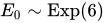
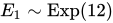
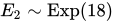
An example of a CTMC with three states is as follows: the process makes a transition after the amount of time specified by the holding time—an exponential random variable , where i is its current state. Each random variable is independent and such that , and . When a transition is to be made, the process moves according to the jump chain, a discrete-time Markov chain with stochastic matrix:

View the full Wikipedia page for Continuous-time Markov chain
↑ Return to Menu

Stochastic process in the context of Markov property

In probability theory and statistics, the term Markov property refers to the memoryless property of a stochastic process, which means that its future evolution is independent of its history. It is named after the Russian mathematician Andrey Markov. The term strong Markov property is similar to the Markov property, except that the meaning of "present" is defined in terms of a random variable known as a stopping time.

The term Markov assumption is used to describe a model where the Markov property is assumed to hold, such as a hidden Markov model.

View the full Wikipedia page for Markov property
↑ Return to Menu