Normal distribution in the context of Gaussian process


Normal distribution in the context of Gaussian process

Normal distribution Study page number 1 of 3

Play TriviaQuestions Online!

or

Skip to study material about Normal distribution in the context of "Gaussian process"


⭐ Core Definition: Normal distribution

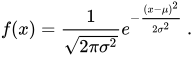
In probability theory and statistics, a normal distribution or Gaussian distribution is a type of continuous probability distribution for a real-valued random variable. The general form of its probability density function is

The parameter is the mean or expectation of the distribution (and also its median and mode), while the parameter is the variance. The standard deviation of the distribution is (sigma). A random variable with a Gaussian distribution is said to be normally distributed and is called a normal deviate.

↓ Menu
HINT:

In this Dossier

Normal distribution in the context of Statistics

Statistics (from German: Statistik, orig. "description of a state, a country") is the discipline that concerns the collection, organization, analysis, interpretation, and presentation of data. In applying statistics to a scientific, industrial, or social problem, it is conventional to begin with a statistical population or a statistical model to be studied. Populations can be diverse groups of people or objects such as "all people living in a country" or "every atom composing a crystal". Statistics deals with every aspect of data, including the planning of data collection in terms of the design of surveys and experiments.

When census data (comprising every member of the target population) cannot be collected, statisticians collect data by developing specific experiment designs and survey samples. Representative sampling assures that inferences and conclusions can reasonably extend from the sample to the population as a whole. An experimental study involves taking measurements of the system under study, manipulating the system, and then taking additional measurements using the same procedure to determine if the manipulation has modified the values of the measurements. In contrast, an observational study does not involve experimental manipulation.

View the full Wikipedia page for Statistics
↑ Return to Menu

Normal distribution in the context of Statistical parameter

In statistics, as opposed to its general use in mathematics, a parameter is any quantity of a statistical population that summarizes or describes an aspect of the population, such as a mean or a standard deviation. If a population exactly follows a known and defined distribution, for example the normal distribution, then a small set of parameters can be measured which provide a comprehensive description of the population and can be considered to define a probability distribution for the purposes of extracting samples from this population.

A "parameter" is to a population as a "statistic" is to a sample; that is to say, a parameter describes the true value calculated from the full population (such as the population mean), whereas a statistic is an estimated measurement of the parameter based on a sample (such as the sample mean, which is the mean of gathered data per sampling, called sample). Thus a "statistical parameter" can be more specifically referred to as a population parameter.

View the full Wikipedia page for Statistical parameter
↑ Return to Menu

Normal distribution in the context of Human variability

Human variability, or human variation, is the range of possible values for any characteristic, physical or mental, of human beings.

Frequently debated areas of variability include cognitive ability, personality, physical appearance (body shape, skin color, etc.) and immunology.Variability is partly heritable and partly acquired (nature vs. nurture debate).As the human species exhibits sexual dimorphism, many traits show significant variation not just between populations but also between the sexes.

View the full Wikipedia page for Human variability
↑ Return to Menu

Normal distribution in the context of Intelligence quotient

An intelligence quotient (IQ) is a total score derived from a set of standardized tests or subtests designed to assess human intelligence. Originally, IQ was a score obtained by dividing a person's estimated mental age, obtained by administering an intelligence test, by the person's chronological age. The resulting fraction (quotient) was multiplied by 100 to obtain the IQ score. For modern IQ tests, the raw score is transformed to a normal distribution with mean 100 and standard deviation 15. This results in approximately two-thirds of the population scoring between IQ 85 and IQ 115 and about 2 percent each above 130 and below 70.

Scores from intelligence tests are estimates of intelligence. Unlike quantities such as distance and mass, a concrete measure of intelligence cannot be achieved given the abstract nature of the concept of "intelligence". IQ scores have been shown to be associated with factors such as nutrition, parental socioeconomic status, morbidity and mortality, parental social status, and perinatal environment. While the heritability of IQ has been studied for nearly a century, there is still debate over the significance of heritability estimates and the mechanisms of inheritance. The best estimates for heritability range from 40 to 60% of the variance between individuals in IQ being explained by genetics.

View the full Wikipedia page for Intelligence quotient
↑ Return to Menu

Normal distribution in the context of Robust statistics

Robust statistics are statistics that maintain their properties even if the underlying distributional assumptions are incorrect. Robust statistical methods have been developed for many common problems, such as estimating location, scale, and regression parameters. One motivation is to produce statistical methods that are not unduly affected by outliers. Another motivation is to provide methods with good performance when there are small departures from a parametric distribution. For example, robust methods work well for mixtures of two normal distributions with different standard deviations; under this model, non-robust methods like a t-test work poorly.

View the full Wikipedia page for Robust statistics
↑ Return to Menu

Normal distribution in the context of Quantile

In statistics and probability, quantiles are cut points dividing the range of a probability distribution into continuous intervals with equal probabilities or dividing the observations in a sample in the same way. There is one fewer quantile than the number of groups created. Common quantiles have special names, such as quartiles (four groups), deciles (ten groups), and percentiles (100 groups). The groups created are termed halves, thirds, quarters, etc., though sometimes the terms for the quantile are used for the groups created, rather than for the cut points.

q-quantiles are values that partition a finite set of values into q subsets of (nearly) equal sizes. There are q − 1 partitions of the q-quantiles, one for each integer k satisfying 0 < k < q. In some cases the value of a quantile may not be uniquely determined, as can be the case for the median (2-quantile) of a uniform probability distribution on a set of even size. Quantiles can also be applied to continuous distributions, providing a way to generalize rank statistics to continuous variables (see percentile rank). When the cumulative distribution function of a random variable is known, the q-quantiles are the application of the quantile function (the inverse function of the cumulative distribution function) to the values {1/q, 2/q, …, (q − 1)/q}.

View the full Wikipedia page for Quantile
↑ Return to Menu

Normal distribution in the context of Probability density function

In probability theory, a probability density function (PDF), density function, or density of an absolutely continuous random variable, is a function whose value at any given sample (or point) in the sample space (the set of possible values taken by the random variable) can be interpreted as providing a relative likelihood that the value of the random variable would be equal to that sample. Probability density is the probability per unit length, in other words. While the absolute likelihood for a continuous random variable to take on any particular value is zero, given there is an infinite set of possible values to begin with. Therefore, the value of the PDF at two different samples can be used to infer, in any particular draw of the random variable, how much more likely it is that the random variable would be close to one sample compared to the other sample.

More precisely, the PDF is used to specify the probability of the random variable falling within a particular range of values, as opposed to taking on any one value. This probability is given by the integral of a continuous variable's PDF over that range, where the integral is the nonnegative area under the density function between the lowest and greatest values of the range. The PDF is nonnegative everywhere, and the area under the entire curve is equal to one, such that the probability of the random variable falling within the set of possible values is 100%.

View the full Wikipedia page for Probability density function
↑ Return to Menu

Normal distribution in the context of Standard deviation

In statistics, the standard deviation is a measure of the amount of variation of the values of a variable about its mean. A low standard deviation indicates that the values tend to be close to the mean (also called the expected value) of the set, while a high standard deviation indicates that the values are spread out over a wider range. The standard deviation is commonly used in the determination of what constitutes an outlier and what does not. Standard deviation may be abbreviated SD or std dev, and is most commonly represented in mathematical texts and equations by the lowercase Greek letter σ (sigma), for the population standard deviation, or the Latin letter s, for the sample standard deviation.

The standard deviation of a random variable, sample, statistical population, data set, or probability distribution is the square root of its variance. (For a finite population, variance is the average of the squared deviations from the mean.) A useful property of the standard deviation is that, unlike the variance, it is expressed in the same unit as the data. Standard deviation can also be used to calculate standard error for a finite sample, and to determine statistical significance.

View the full Wikipedia page for Standard deviation
↑ Return to Menu

Normal distribution in the context of Oil depletion

Oil depletion is the decline in oil production of a well, oil field, or geographic area. The Hubbert peak theory makes predictions of production rates based on prior discovery rates and anticipated production rates. Hubbert curves predict that the production curves of non-renewing resources approximate a bell curve. Thus, according to this theory, when the peak of production is passed, production rates enter an irreversible decline.

View the full Wikipedia page for Oil depletion
↑ Return to Menu

Normal distribution in the context of Bimodal

In statistics, a multimodal distribution is a probability distribution with more than one mode (i.e., more than one local peak of the distribution). These appear as distinct peaks (local maxima) in the probability density function, as shown in Figures 1 and 2. Categorical, continuous, and discrete data can all form multimodal distributions. Among univariate analyses, multimodal distributions are commonly bimodal.

View the full Wikipedia page for Bimodal
↑ Return to Menu

Normal distribution in the context of Outlier

In statistics, an outlier is a data point that differs significantly from other observations. An outlier may be due to a variability in the measurement, an indication of novel data, or it may be the result of experimental error; the latter are sometimes excluded from the data set. An outlier can be an indication of exciting possibility, but can also cause serious problems in statistical analyses.

Outliers can occur by chance in any distribution, but they can indicate novel behaviour or structures in the data-set, measurement error, or that the population has a heavy-tailed distribution. In the case of measurement error, one wishes to discard them or use statistics that are robust to outliers, while in the case of heavy-tailed distributions, they indicate that the distribution has high skewness and that one should be very cautious in using tools or intuitions that assume a normal distribution. A frequent cause of outliers is a mixture of two distributions, which may be two distinct sub-populations, or may indicate 'correct trial' versus 'measurement error'; this is modeled by a mixture model.

View the full Wikipedia page for Outlier
↑ Return to Menu

Normal distribution in the context of IQ classification

IQ classification is the practice of categorizing human intelligence, as measured by intelligence quotient (IQ) tests, into categories such as "superior" and "average".

With the usual IQ scoring methods, an IQ score of 100 means that the test-taker's performance on the test is of average performance in the sample of test-takers of about the same age as was used to norm the test. An IQ score of 115 means performance one standard deviation above the mean, while a score of 85 means performance one standard deviation below the mean, and so on. This "deviation IQ" method is used for standard scoring of all IQ tests in large part because they allow a consistent definition of IQ for both children and adults. By the existing "deviation IQ" definition of IQ test standard scores, about two-thirds of all test-takers obtain scores from 85 to 115, and about 5 percent of the population scores above 125 (i.e. normal distribution).

View the full Wikipedia page for IQ classification
↑ Return to Menu

Normal distribution in the context of Fourier transform

In mathematics, the Fourier transform (FT) is an integral transform that takes a function as input, and outputs another function that describes the extent to which various frequencies are present in the original function. The output of the transform is a complex valued function of frequency. The term Fourier transform refers to both the mathematical operation and to this complex-valued function. When a distinction needs to be made, the output of the operation is sometimes called the frequency domain representation of the original function. The Fourier transform is analogous to decomposing the sound of a musical chord into the intensities of its constituent pitches.

Functions that are localized in the time domain have Fourier transforms that are spread out across the frequency domain and vice versa, a phenomenon known as the uncertainty principle. The critical case for this principle is the Gaussian function, of substantial importance in probability theory and statistics as well as in the study of physical phenomena exhibiting normal distribution (e.g., diffusion). The Fourier transform of a Gaussian function is another Gaussian function. Joseph Fourier introduced sine and cosine transforms (which correspond to the imaginary and real components of the modern Fourier transform) in his study of heat transfer, where Gaussian functions appear as solutions of the heat equation.

View the full Wikipedia page for Fourier transform
↑ Return to Menu

Normal distribution in the context of Thermal noise

Johnson–Nyquist noise (thermal noise, Johnson noise, or Nyquist noise) is the voltage or current noise generated by the thermal agitation of the charge carriers (usually the electrons) inside an electrical conductor at equilibrium, which happens regardless of any applied voltage. Thermal noise is present in all electrical circuits, and in sensitive electronic equipment (such as radio receivers) can drown out weak signals, and can be the limiting factor on sensitivity of electrical measuring instruments. Thermal noise is proportional to absolute temperature, so some sensitive electronic equipment such as radio telescope receivers are cooled to cryogenic temperatures to improve their signal-to-noise ratio. The generic, statistical physical derivation of this noise is called the fluctuation-dissipation theorem, where generalized impedance or generalized susceptibility is used to characterize the medium.

Thermal noise in an ideal resistor is approximately white, meaning that its power spectral density is nearly constant throughout the frequency spectrum (Figure 2). When limited to a finite bandwidth and viewed in the time domain (as sketched in Figure 1), thermal noise has a nearly Gaussian amplitude distribution.

View the full Wikipedia page for Thermal noise
↑ Return to Menu

Normal distribution in the context of Openness to experience

Openness to experience is one of the domains which are used to describe human personality in the Five Factor Model. Openness involves six facets, or dimensions: active imagination (fantasy), aesthetic sensitivity, attentiveness to inner feelings, preference for variety (adventurousness), intellectual curiosity, and challenging authority (psychological liberalism). A great deal of psychometric research has demonstrated that these facets or qualities are significantly correlated. Thus, openness can be viewed as a global personality trait consisting of a set of specific traits, habits, and tendencies that cluster together.

Openness tends to be normally distributed, with a small number of people scoring extremely high or low on the trait and most people scoring moderately. People who score low on openness are considered to be closed to experience. They tend to be conventional and traditional in their outlook and behavior. They prefer familiar routines to new experiences, and generally have a narrower range of interests.

View the full Wikipedia page for Openness to experience
↑ Return to Menu

Normal distribution in the context of Dirac delta function

In mathematical analysis, the Dirac delta function (or δ distribution), also known as the unit impulse, is a generalized function on the real numbers, whose value is zero everywhere except at zero, and whose integral over the entire real line is equal to one. Thus it can be represented heuristically as

View the full Wikipedia page for Dirac delta function
↑ Return to Menu

Normal distribution in the context of Maximum likelihood estimation

In statistics, maximum likelihood estimation (MLE) is a method of estimating the parameters of an assumed probability distribution, given some observed data. This is achieved by maximizing a likelihood function so that, under the assumed statistical model, the observed data is most probable. The point in the parameter space that maximizes the likelihood function is called the maximum likelihood estimate. The logic of maximum likelihood is both intuitive and flexible, and as such the method has become a dominant means of statistical inference.

If the likelihood function is differentiable, the derivative test for finding maxima can be applied. In some cases, the first-order conditions of the likelihood function can be solved analytically; for instance, the ordinary least squares estimator for a linear regression model maximizes the likelihood when the random errors are assumed to have normal distributions with the same variance.

View the full Wikipedia page for Maximum likelihood estimation
↑ Return to Menu