Protocol stack in the context of Packet-switched


Protocol stack in the context of Packet-switched

Protocol stack Study page number 1 of 1

Play TriviaQuestions Online!

or

Skip to study material about Protocol stack in the context of "Packet-switched"


⭐ Core Definition: Protocol stack

The protocol stack or network stack is an implementation of a computer networking protocol suite or protocol family. Some of these terms are used interchangeably but strictly speaking, the suite is the definition of the communication protocols, and the stack is the software implementation of them.

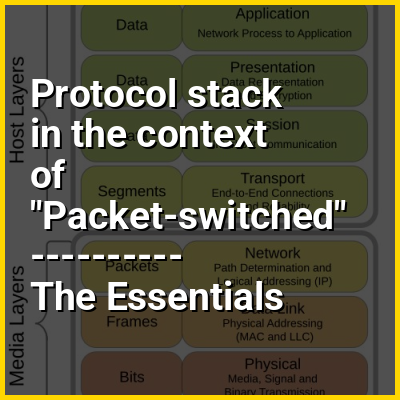
Individual protocols within a suite are often designed with a single purpose in mind. This modularization simplifies design and evaluation. Because each protocol module usually communicates with two others, they are commonly imagined as layers in a stack of protocols. The lowest protocol always deals with low-level interaction with the communications hardware. Each higher layer adds additional capabilities. User applications usually deal only with the topmost layers.

↓ Menu
HINT:

👉 Protocol stack in the context of Packet-switched

In telecommunications, packet switching is a method of grouping data into short messages in fixed format, i.e., packets, that are transmitted over a telecommunications network. Packets consist of a header and a payload. The header directs the packet to its destination, where the payload is extracted and used by an operating system, application software, or higher-layer protocols. Packet switching is the primary basis for data communications in computer networks worldwide.

During the early 1960s, American engineer Paul Baran developed a concept he called distributed adaptive message block switching as part of a research program at the RAND Corporation, funded by the United States Department of Defense. His proposal was to provide a fault-tolerant, efficient method for communication of voice messages using low-cost hardware to route the message blocks across a distributed network. His ideas contradicted then-established principles of pre-allocation of network bandwidth, exemplified by the development of telecommunications in the Bell System. The new concept found little resonance among network implementers until the independent work of British computer scientist Donald Davies at the National Physical Laboratory beginning in 1965. Davies developed the concept for data communication using software switches in a high-speed computer network and coined the term packet switching. His work inspired numerous packet switching networks in the decade following, including the incorporation of the concept into the design of the ARPANET in the United States and the CYCLADES network in France. The ARPANET and CYCLADES were the primary precursor networks of the modern Internet.
↓ Explore More Topics
In this Dossier

Protocol stack in the context of Internet protocol suite

The Internet protocol suite, commonly known as TCP/IP, is a framework for organizing the communication protocols used in the Internet and similar computer networks according to functional criteria. The foundational protocols in the suite are the Transmission Control Protocol (TCP), the User Datagram Protocol (UDP), and the Internet Protocol (IP). Early versions of this networking model were known as the Department of Defense (DoD) Internet Architecture Model because the research and development were funded by the Defense Advanced Research Projects Agency (DARPA) of the United States Department of Defense.

The Internet protocol suite provides end-to-end data communication specifying how data should be packetized, addressed, transmitted, routed, and received. This functionality is organized into four abstraction layers, which classify all related protocols according to each protocol's scope of networking. An implementation of the layers for a particular application forms a protocol stack. From lowest to highest, the layers are the link layer, containing communication methods for data that remains within a single network segment (link); the internet layer, providing internetworking between independent networks; the transport layer, handling host-to-host communication; and the application layer, providing process-to-process data exchange for applications.

View the full Wikipedia page for Internet protocol suite
↑ Return to Menu

Protocol stack in the context of Packet switching

In telecommunications, packet switching is a method of grouping data into short messages in fixed format, i.e., packets, that are transmitted over a telecommunications network. Packets consist of a header and a payload. Data in the header is used by networking hardware to direct the packet to its destination, where the payload is extracted and used by an operating system, application software, or higher layer protocols. Packet switching is the primary basis for data communications in computer networks worldwide.

During the early 1960s, American engineer Paul Baran developed a concept he called distributed adaptive message block switching as part of a research program at the RAND Corporation, funded by the United States Department of Defense. His proposal was to provide a fault-tolerant, efficient method for communication of voice messages using low-cost hardware to route the message blocks across a distributed network. His ideas contradicted then-established principles of pre-allocation of network bandwidth, exemplified by the development of telecommunications in the Bell System. The new concept found little resonance among network implementers until the independent work of Welsh computer scientist Donald Davies at the National Physical Laboratory beginning in 1965. Davies developed the concept for data communication using software switches in a high-speed computer network and coined the term packet switching. His work inspired numerous packet switching networks in the decade following, including the incorporation of the concept into the design of the ARPANET in the United States and the CYCLADES network in France. The ARPANET and CYCLADES were the primary precursor networks of the modern Internet.

View the full Wikipedia page for Packet switching
↑ Return to Menu

Protocol stack in the context of C (programming language)

C is a general-purpose programming language. It was created in the 1970s by Dennis Ritchie and remains widely used and influential. By design, C gives the programmer relatively direct access to the features of the typical CPU architecture, customized for the target instruction set. It has been and continues to be used to implement operating systems (especially kernels), device drivers, and protocol stacks, but its use in application software has been decreasing. C is used on computers that range from the largest supercomputers to the smallest microcontrollers and embedded systems.

A successor to the programming language B, C was originally developed at Bell Labs by Ritchie between 1972 and 1973 to construct utilities running on Unix. It was applied to re-implementing the kernel of the Unix operating system. During the 1980s, C gradually gained popularity. It has become one of the most widely used programming languages, with C compilers available for practically all modern computer architectures and operating systems. The book The C Programming Language, co-authored by the original language designer, served for many years as the de facto standard for the language. C has been standardized since 1989 by the American National Standards Institute (ANSI) and, subsequently, jointly by the International Organization for Standardization (ISO) and the International Electrotechnical Commission (IEC).

View the full Wikipedia page for C (programming language)
↑ Return to Menu

Protocol stack in the context of Packet-switched network

In telecommunications, packet switching is a method of grouping data into short messages in fixed format, i.e., packets, that are transmitted over a telecommunications network. Packets consist of a header and a payload. Data in the header is used by networking hardware to direct the packet to its destination, where the payload is extracted and used by an operating system, application software, or higher layer protocols. Packet switching is the primary basis for data communications in computer networks worldwide.

During the early 1960s, American engineer Paul Baran developed a concept he called distributed adaptive message block switching as part of a research program at the RAND Corporation, funded by the United States Department of Defense. His proposal was to provide a fault-tolerant, efficient method for communication of voice messages using low-cost hardware to route the message blocks across a distributed network. His ideas contradicted then-established principles of pre-allocation of network bandwidth, exemplified by the development of telecommunications in the Bell System. The new concept found little resonance among network implementers until the independent work of British computer scientist Donald Davies at the National Physical Laboratory beginning in 1965. Davies developed the concept for data communication using software switches in a high-speed computer network and coined the term packet switching. His work inspired numerous packet switching networks in the decade following, including the incorporation of the concept into the design of the ARPANET in the United States and the CYCLADES network in France. The ARPANET and CYCLADES were the primary precursor networks of the modern Internet.

View the full Wikipedia page for Packet-switched network
↑ Return to Menu

Protocol stack in the context of Ethernet physical layer

The physical-layer specifications of the Ethernet family of computer network standards are published by the Institute of Electrical and Electronics Engineers (IEEE), which defines the electrical or optical properties and the transfer speed of the physical connection between a device and the network or between network devices. It is complemented by the MAC layer and the logical link layer. An implementation of a specific physical layer is commonly referred to as PHY.

The Ethernet physical layer has evolved over its existence starting in 1980 and encompasses multiple physical media interfaces and several orders of magnitude of speed from Mbit/s to 800 Gbit/s. The physical medium ranges from bulky coaxial cable to twisted pair and optical fiber with a standardized reach of up to 80 km. In general, network protocol stack software will work similarly on all physical layers.

View the full Wikipedia page for Ethernet physical layer
↑ Return to Menu

Protocol stack in the context of Dynamic Host Configuration Protocol

The Dynamic Host Configuration Protocol (DHCP) is a network management protocol used on Internet Protocol (IP) networks for automatically assigning IP addresses and other communication parameters to devices connected to the network using a client–server architecture.

The technology eliminates the need for individually configuring network devices manually, and consists of two network components, a centrally installed network DHCP server and client instances of the protocol stack on each computer or device. When connected to the network, and periodically thereafter, a client requests a set of parameters from the server using DHCP.

View the full Wikipedia page for Dynamic Host Configuration Protocol
↑ Return to Menu

Protocol stack in the context of TCP congestion control

Transmission Control Protocol (TCP) uses a congestion control algorithm that includes various aspects of an additive increase/multiplicative decrease (AIMD) scheme, along with other schemes including slow start and a congestion window (CWND), to achieve congestion avoidance. The TCP congestion-avoidance algorithm is the primary basis for congestion control in the Internet. Per the end-to-end principle, congestion control is largely a function of internet hosts, not the network itself. There are several variations and versions of the algorithm implemented in protocol stacks of operating systems of computers that connect to the Internet.

To avoid congestive collapse, TCP uses a multi-faceted congestion-control strategy. For each connection, TCP maintains a CWND, limiting the total number of unacknowledged packets that may be in transit end-to-end. This is somewhat analogous to TCP's sliding window used for flow control.

View the full Wikipedia page for TCP congestion control
↑ Return to Menu