Pentaquark in the context of "Baryon number"

Play Trivia Questions online!

or

Skip to study material about Pentaquark in the context of "Baryon number"

Ad spacer

⭐ Core Definition: Pentaquark

A pentaquark is a subatomic particle, consisting of four quarks and one antiquark bound together. Evidence for the existence of pentaquarks has been found in decays of the Bottom lambda baryon.

As quarks have a baryon number of ⁠++1/3, and antiquarks of ⁠−+1/3, the pentaquark would have a total baryon number of 1, and thus would be a baryon. Further, because it has five quarks instead of the usual three found in regular baryons (a.k.a. "triquarks"), it is classified as an exotic baryon. The name pentaquark was coined by Claude Gignoux et al. (1987) and Harry J. Lipkin in 1987; however, the possibility of five-quark particles was identified as early as 1964 when Murray Gell-Mann first postulated the existence of quarks. Although predicted for decades, pentaquarks proved surprisingly difficult to discover and some physicists were beginning to suspect that an unknown law of nature prevented their production.

↓ Menu

>>>PUT SHARE BUTTONS HERE<<<

👉 Pentaquark in the context of Baryon number

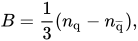
In particle physics, the baryon number (B) is an additive quantum number of a system. It is defined aswhere is the number of quarks, and is the number of antiquarks. Baryons (three quarks) have B = +1, mesons (one quark, one antiquark) have B = 0, and antibaryons (three antiquarks) have B = −1. Exotic hadrons like pentaquarks (four quarks, one antiquark) and tetraquarks (two quarks, two antiquarks) are also classified as baryons and mesons depending on their baryon number. In the Standard Model B conservation is an accidental symmetry which means that it appears in the Standard Model but is often violated when going beyond it. Physics beyond the Standard Model theories that contain baryon number violation are, for example, Standard Model with extra dimensions, Supersymmetry, Grand Unified Theory and String theory.

↓ Explore More Topics
In this Dossier

Pentaquark in the context of Hadron

In particle physics, a hadron is a composite subatomic particle made of two or more quarks held together by the strong nuclear force. Pronounced /ˈhædrɒn/ , the name is derived from Ancient Greek ἁδρός (hadrós) 'stout, thick'. They are analogous to molecules, which are held together by the electric force. Most of the mass of ordinary matter comes from two hadrons: the proton and the neutron, while most of the mass of the protons and neutrons is in turn due to the binding energy of their constituent quarks, due to the strong force.

Hadrons are categorized into two broad families: baryons, made of an odd number of quarks (usually three), and mesons, made of an even number of quarks (usually two: one quark and one antiquark). Protons and neutrons (which make the majority of the mass of an atom) are examples of baryons; pions are an example of a meson. A tetraquark state (an exotic meson), named the Z(4430), was discovered in 2007 by the Belle Collaboration and confirmed as a resonance in 2014 by the LHCb collaboration. Two pentaquark states (exotic baryons), named P
c
(4380)
and P
c
(4450)
, were discovered in 2015 by the LHCb collaboration. There are several other "Exotic" hadron candidates and other colour-singlet quark combinations that may also exist.

↑ Return to Menu

Pentaquark in the context of Exotic hadron

Exotic hadrons are subatomic particles composed of quarks and gluons, but which – unlike "well-known" hadrons such as protons, neutrons and mesons – consist of more than three valence quarks. By contrast, "ordinary" hadrons contain just two or three quarks. Hadrons with explicit valence gluon content would also be considered exotic. In theory, there is no limit on the number of quarks in a hadron, as long as the hadron's color charge is white, or color-neutral.

Consistent with ordinary hadrons, exotic hadrons are classified as being either fermions, like ordinary baryons, or bosons, like ordinary mesons. According to this classification scheme, pentaquarks, containing five valence quarks, are exotic baryons, while tetraquarks (four valence quarks) and hexaquarks (six quarks, consisting of either a dibaryon or three quark-antiquark pairs) would be considered exotic mesons. Tetraquark and pentaquark particles are believed to have been observed and are being investigated; hexaquarks have not yet been confirmed as observed.

↑ Return to Menu

Pentaquark in the context of Exotic baryon

In particle physics, exotic baryons are a type of hadron (bound states of quarks and gluons) with half-integer spin, but with a quark content different from the three quarks (qqq) present in conventional baryons. An example would be pentaquarks, consisting of four quarks and one antiquark (qqqqq̅).

So far, the only observed exotic baryons are the pentaquarks Pc(4380), Pc(4450) discovered in 2015, Pc(4312) in 2019 and P
ψs
(4338)
in 2022 by the LHCb collaboration.

↑ Return to Menu