Numerical analysis in the context of MATLAB


Numerical analysis in the context of MATLAB

Numerical analysis Study page number 1 of 2

Play TriviaQuestions Online!

or

Skip to study material about Numerical analysis in the context of "MATLAB"


⭐ Core Definition: Numerical analysis

Numerical analysis is the study of algorithms that use numerical approximation (as opposed to symbolic manipulations) for the problems of mathematical analysis (as distinguished from discrete mathematics). It is the study of numerical methods that attempt to find approximate solutions of problems rather than the exact ones. Numerical analysis finds application in all fields of engineering and the physical sciences, and in the 21st century also the life and social sciences like economics, medicine, business and even the arts. Current growth in computing power has enabled the use of more complex numerical analysis, providing detailed and realistic mathematical models in science and engineering. Examples of numerical analysis include: ordinary differential equations as found in celestial mechanics (predicting the motions of planets, stars and galaxies), numerical linear algebra in data analysis, and stochastic differential equations and Markov chains for simulating living cells in medicine and biology.

Before modern computers, numerical methods often relied on hand interpolation formulas, using data from large printed tables. Since the mid-20th century, computers calculate the required functions instead, but many of the same formulas continue to be used in software algorithms.

↓ Menu
HINT:

👉 Numerical analysis in the context of MATLAB

MATLAB (Matrix Laboratory) is a proprietary multi-paradigm programming language and numeric computing environment developed by MathWorks. MATLAB allows matrix manipulations, plotting of functions and data, implementation of algorithms, creation of user interfaces, and interfacing with programs written in other languages.

Although MATLAB is intended primarily for numeric computing, an optional toolbox uses the MuPAD symbolic engine allowing access to symbolic computing abilities. An additional package, Simulink, adds graphical multi-domain simulation and model-based design for dynamic and embedded systems.

↓ Explore More Topics
In this Dossier

Numerical analysis in the context of Computer scientist

A computer scientist is a scientist who specializes in the academic study of computer science and technology.

Computer scientists typically work on the theoretical side of computation. Although computer scientists can also focus their work and research on specific areas (such as algorithm and data structure development and design, software engineering, information theory, database theory, theoretical computer science, numerical analysis, programming language theory, compiler, computer graphics, computer vision, robotics, computer architecture, operating system), their foundation is the theoretical study of computing from which these other fields derive.

View the full Wikipedia page for Computer scientist
↑ Return to Menu

Numerical analysis in the context of Polynomial

In mathematics, a polynomial is a mathematical expression consisting of indeterminates (also called variables) and coefficients, that involves only the operations of addition, subtraction, multiplication and exponentiation to nonnegative integer powers, and has a finite number of terms. An example of a polynomial of a single indeterminate is . An example with three indeterminates is .

Polynomials appear in many areas of mathematics and science. For example, they are used to form polynomial equations, which encode a wide range of problems, from elementary word problems to complicated scientific problems; they are used to define polynomial functions, which appear in settings ranging from basic chemistry and physics to economics and social science; and they are used in calculus and numerical analysis to approximate other functions. In advanced mathematics, polynomials are used to construct polynomial rings and algebraic varieties, which are central concepts in algebra and algebraic geometry.

View the full Wikipedia page for Polynomial
↑ Return to Menu

Numerical analysis in the context of Molecular dynamics

Molecular dynamics (MD) is a computer simulation method for analyzing the physical movements of atoms and molecules. The atoms and molecules are allowed to interact for a fixed period of time, giving a view of the dynamic "evolution" of the system. In the most common version, the trajectories of atoms and molecules are determined by numerically solving Newton's equations of motion for a system of interacting particles, where forces between the particles and their potential energies are often calculated using interatomic potentials or molecular mechanical force fields. MD simulations are widely applied in chemical physics, materials science, and biophysics.

Because molecular systems typically consist of a vast number of particles, it is impossible to determine the properties of such complex systems analytically; MD simulation circumvents this problem by using numerical methods. However, long MD simulations are mathematically ill-conditioned, generating cumulative errors in numerical integration that can be minimized with proper selection of algorithms and parameters, but not eliminated.

View the full Wikipedia page for Molecular dynamics
↑ Return to Menu

Numerical analysis in the context of Continued fraction

A continued fraction is a mathematical expression written as a fraction whose denominator contains a sum involving another fraction, which may itself be a simple or a continued fraction. If this iteration (repetitive process) terminates with a simple fraction, the result is a finite continued fraction; if it continues indefinitely, the result is an infinite continued fraction. The special case in which all numerators are equal to one is referred to as a simple (or regular) continued fraction. Any rational number can be expressed as a finite simple continued fraction, and any irrational number can be expressed as an infinite simple continued fraction.

Different areas of mathematics use different terminology and notation for continued fractions. In number theory, the unqualified term continued fraction usually refers to simple continued fractions, whereas the general case is referred to as generalized continued fractions. In complex analysis and numerical analysis, the general case is usually referred to by the unqualified term continued fraction.

View the full Wikipedia page for Continued fraction
↑ Return to Menu

Numerical analysis in the context of Chaos theory

Chaos theory is an interdisciplinary area of scientific study and branch of mathematics. It focuses on underlying patterns and deterministic laws of dynamical systems that are highly sensitive to initial conditions. These were once thought to have completely random states of disorder and irregularities. Chaos theory states that within the apparent randomness of chaotic complex systems, there are underlying patterns, interconnection, constant feedback loops, repetition, self-similarity, fractals and self-organization. The butterfly effect, an underlying principle of chaos, describes how a small change in one state of a deterministic nonlinear system can result in large differences in a later state (meaning there is sensitive dependence on initial conditions). A metaphor for this behavior is that a butterfly flapping its wings in Brazil can cause or prevent a tornado in Texas.

Small differences in initial conditions, such as those due to errors in measurements or due to rounding errors in numerical computation, can yield widely diverging outcomes for such dynamical systems, rendering long-term prediction of their behavior impossible in general. This can happen even though these systems are deterministic, meaning that their future behavior follows a unique evolution and is fully determined by their initial conditions, with no random elements involved. In other words, despite the deterministic nature of these systems, this does not make them predictable. This behavior is known as deterministic chaos, or simply chaos. The theory was summarized by Edward Lorenz as:

View the full Wikipedia page for Chaos theory
↑ Return to Menu

Numerical analysis in the context of Quincunx

A quincunx (/ˈkwɪn.kʌŋks/ KWIN-kunks) is a geometric pattern consisting of five points arranged in a cross, with four of them forming a square or rectangle and a fifth at its center. The same pattern has other names, including "in saltire" or "in cross" in heraldry (depending on the orientation of the outer square), the five-point stencil in numerical analysis, and the five dots tattoo. It forms the arrangement of five units in the pattern corresponding to the five-spot on six-sided dice, playing cards, and dominoes. It is represented in Unicode as U+2059 FIVE DOT PUNCTUATION or (for the die pattern) U+2684 DIE FACE-5.

View the full Wikipedia page for Quincunx
↑ Return to Menu

Numerical analysis in the context of Color index

In astronomy, the color index is a simple numerical expression that determines the color of an object, which in the case of a star gives its temperature. The lower the color index, the more blue (or hotter) the object is. Conversely, the larger the color index, the more red (or cooler) the object is. This is a consequence of the inverse logarithmic magnitude scale, in which brighter objects have smaller (more negative) magnitudes than dimmer ones. For comparison, the whitish Sun has a B−V index of 0.656 ± 0.005, whereas the bluish Rigel has a B−V of −0.03 (its B magnitude is 0.09 and its V magnitude is 0.12, B−V = −0.03). Traditionally, the color index uses Vega as a zero point. The blue supergiant Theta Muscae has one of the lowest B−V indices at −0.41, while the red giant and carbon star R Leporis has one of the largest, at +5.74.

To measure the index, one observes the magnitude of an object successively through two different filters, such as U and B, or B and V, where U is sensitive to ultraviolet rays, B is sensitive to blue light, and V is sensitive to visible (green-yellow) light (see also: UBV system). The set of passbands or filters is called a photometric system. The difference in magnitudes found with these filters is called the U−B or B−V color index respectively.

View the full Wikipedia page for Color index
↑ Return to Menu

Numerical analysis in the context of Numerical method

In numerical analysis, a numerical method is a mathematical tool designed to solve numerical problems. The implementation of a numerical method with an appropriate convergence check in a programming language is called a numerical algorithm.

View the full Wikipedia page for Numerical method
↑ Return to Menu

Numerical analysis in the context of Adriaan van Wijngaarden

Adriaan "Aad" van Wijngaarden (2 November 1916 – 7 February 1987) was a Dutch mathematician and computer scientist. Trained as a mechanical engineer, Van Wijngaarden emphasized and promoted the mathematical aspects of computing, first in numerical analysis, then in programming languages and finally in design principles of such languages.

View the full Wikipedia page for Adriaan van Wijngaarden
↑ Return to Menu

Numerical analysis in the context of Computational science

Computational science, also known as scientific computing, technical computing or scientific computation (SC), is a division of science, and more specifically the computer sciences, which uses advanced computing capabilities to understand and solve complex physical problems in science. While this typically extends into computational specializations, this field of study includes:

In practical use, it is typically the application of computer simulation and other forms of computation from numerical analysis and theoretical computer science to solve problems in various scientific disciplines. The field is different from theory and laboratory experiments, which are the traditional forms of science and engineering. The scientific computing approach is to gain understanding through the analysis of mathematical models implemented on computers. Scientists and engineers develop computer programs and application software that model systems being studied and run these programs with various sets of input parameters. The essence of computational science is the application of numerical algorithms and computational mathematics. In some cases, these models require massive amounts of calculations (usually floating-point) and are often executed on supercomputers or distributed computing platforms.

View the full Wikipedia page for Computational science
↑ Return to Menu

Numerical analysis in the context of Interpolation

In the mathematical field of numerical analysis, interpolation is a type of estimation, a method of constructing (finding) new data points based on the range of a discrete set of known data points.

In engineering and science, one often has a number of data points, obtained by sampling or experimentation, which represent the values of a function for a limited number of values of the independent variable. It is often required to interpolate; that is, estimate the value of that function for an intermediate value of the independent variable.

View the full Wikipedia page for Interpolation
↑ Return to Menu

Numerical analysis in the context of Triangular matrix

In mathematics, a triangular matrix is a special kind of square matrix. A square matrix is called lower triangular if all the entries above the main diagonal are zero. Similarly, a square matrix is called upper triangular if all the entries below the main diagonal are zero.

Because matrix equations with triangular matrices are easier to solve, they are very important in numerical analysis. By the LU decomposition algorithm, an invertible matrix may be written as the product of a lower triangular matrix L and an upper triangular matrix U if and only if all its leading principal minors are non-zero.

View the full Wikipedia page for Triangular matrix
↑ Return to Menu

Numerical analysis in the context of Numerical integration

In analysis, numerical integration comprises a broad family of algorithms for calculating the numerical value of a definite integral.The term numerical quadrature (often abbreviated to quadrature) is more or less a synonym for "numerical integration", especially as applied to one-dimensional integrals. Some authors refer to numerical integration over more than one dimension as cubature; others take "quadrature" to include higher-dimensional integration.

The basic problem in numerical integration is to compute an approximate solution to a definite integral

View the full Wikipedia page for Numerical integration
↑ Return to Menu

Numerical analysis in the context of Condition number

In numerical analysis, the condition number of a function measures how much the output value of the function can change for a small change in the input argument. This is used to measure how sensitive a function is to changes or errors in the input, and how much error in the output results from an error in the input. Very frequently, one is solving the inverse problem: given one is solving for x, and thus the condition number of the (local) inverse must be used.

The condition number is derived from the theory of propagation of uncertainty, and is formally defined as the value of the asymptotic worst-case relative change in output for a relative change in input. The "function" is the solution of a problem and the "arguments" are the data in the problem. The condition number is frequently applied to questions in linear algebra, in which case the derivative is straightforward but the error could be in many different directions, and is thus computed from the geometry of the matrix. More generally, condition numbers can be defined for non-linear functions in several variables.

View the full Wikipedia page for Condition number
↑ Return to Menu

Numerical analysis in the context of Newton–Raphson method

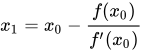
In numerical analysis, the Newton–Raphson method, also known simply as Newton's method, named after Isaac Newton and Joseph Raphson, is a root-finding algorithm which produces successively better approximations to the roots (or zeroes) of a real-valued function. The most basic version starts with a real-valued function f, its derivative f, and an initial guess x0 for a root of f. If f satisfies certain assumptions and the initial guess is close, then

View the full Wikipedia page for Newton–Raphson method
↑ Return to Menu