Numerator in the context of Rational function


Numerator in the context of Rational function

Numerator Study page number 1 of 1

Play TriviaQuestions Online!

or

Skip to study material about Numerator in the context of "Rational function"


⭐ Core Definition: Numerator

A fraction (from Latin: fractus, "broken") represents a part of a whole or, more generally, any number of equal parts. When spoken in everyday English, a fraction describes how many parts of a certain size there are, for example, one-half, eight-fifths, three-quarters. A common, vulgar, or simple fraction (examples: 1/2 and 17/3) consists of an integer numerator, displayed above a line (or before a slash like 12), and a non-zero integer denominator, displayed below (or after) that line. If these integers are positive, then the numerator represents a number of equal parts, and the denominator indicates how many of those parts make up a unit or a whole. For example, in the fraction 3/4, the numerator 3 indicates that the fraction represents 3 equal parts, and the denominator 4 indicates that 4 parts make up a whole. The picture to the right illustrates 3/4 of a cake.

Fractions can be used to represent ratios and division. Thus the fraction 3/4 can be used to represent the ratio 3:4 (the ratio of the part to the whole), and the division 3 ÷ 4 (three divided by four).

↓ Menu
HINT:

👉 Numerator in the context of Rational function

In mathematics, a rational function is any function that can be defined by a rational fraction, which is an algebraic fraction such that both the numerator and the denominator are polynomials. The coefficients of the polynomials need not be rational numbers; they may be taken in any field K. In this case, one speaks of a rational function and a rational fraction over K. The values of the variables may be taken in any field L containing K. Then the domain of the function is the set of the values of the variables for which the denominator is not zero, and the codomain is L.

The set of rational functions over a field K is a field, the field of fractions of the ring of the polynomial functions over K.

↓ Explore More Topics
In this Dossier

Numerator in the context of Rational number

In mathematics, a rational number is a number that can be expressed as the quotient or fraction of two integers, a numerator p and a non-zero denominator q. For example, is a rational number, as is every integer (for example, ). The set of all rational numbers is often referred to as "the rationals", and is closed under addition, subtraction, multiplication, and division by a nonzero rational number. It is a field under these operations and therefore also calledthe field of rationals or the field of rational numbers. It is usually denoted by boldface Q, or blackboard bold

A rational number is a real number. The real numbers that are rational are those whose decimal expansion either terminates after a finite number of digits (example: 3/4 = 0.75), or eventually begins to repeat the same finite sequence of digits over and over (example: 9/44 = 0.20454545...). This statement is true not only in base 10, but also in every other integer base, such as the binary and hexadecimal ones (see Repeating decimal § Extension to other bases).

View the full Wikipedia page for Rational number
↑ Return to Menu

Numerator in the context of Egyptian fractions

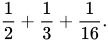
An Egyptian fraction is a finite sum of distinct unit fractions, such asThat is, each fraction in the expression has a numerator equal to 1 and a denominator that is a positive integer, and all the denominators differ from each other. The value of an expression of this type is a positive rational number ; for instance the Egyptian fraction above sums to . Every positive rational number can be represented by an Egyptian fraction. Sums of this type, and similar sums also including and as summands, were used as a serious notation for rational numbers by the ancient Egyptians, and continued to be used by other civilizations into medieval times. In modern mathematical notation, Egyptian fractions have been superseded by vulgar fractions and decimal notation. However, Egyptian fractions continue to be an object of study in modern number theory and recreational mathematics, as well as in modern historical studies of ancient mathematics.

View the full Wikipedia page for Egyptian fractions
↑ Return to Menu

Numerator in the context of Unit fraction

A unit fraction is a positive fraction with one as its numerator, 1/n. It is the multiplicative inverse (reciprocal) of the denominator of the fraction, which must be a positive natural number. Examples are 1/1, 1/2, 1/3, 1/4, 1/5, etc. When an object is divided into equal parts, each part is a unit fraction of the whole.

Multiplying two unit fractions produces another unit fraction, but other arithmetic operations do not preserve unit fractions. In modular arithmetic, unit fractions can be converted into equivalent whole numbers, allowing modular division to be transformed into multiplication. Every rational number can be represented as a sum of distinct unit fractions; these representations are called Egyptian fractions based on their use in ancient Egyptian mathematics. Many infinite sums of unit fractions are meaningful mathematically.

View the full Wikipedia page for Unit fraction
↑ Return to Menu