Denominator in the context of "Egyptian fractions"

Play Trivia Questions online!

or

Skip to study material about Denominator in the context of "Egyptian fractions"

Ad spacer

⭐ Core Definition: Denominator

A fraction (from Latin: fractus, "broken") represents a part of a whole or, more generally, any number of equal parts. When spoken in everyday English, a fraction describes how many parts of a certain size there are, for example, one-half, eight-fifths, three-quarters. A common, vulgar, or simple fraction (examples: 1/2 and 17/3) consists of an integer numerator, displayed above a line (or before a slash like 12), and a non-zero integer denominator, displayed below (or after) that line. If these integers are positive, then the numerator represents a number of equal parts, and the denominator indicates how many of those parts make up a unit or a whole. For example, in the fraction 3/4, the numerator 3 indicates that the fraction represents 3 equal parts, and the denominator 4 indicates that 4 parts make up a whole. The picture to the right illustrates 3/4 of a cake.

Fractions can be used to represent ratios and division. Thus the fraction 3/4 can be used to represent the ratio 3:4 (the ratio of the part to the whole), and the division 3 ÷ 4 (three divided by four).

↓ Menu

>>>PUT SHARE BUTTONS HERE<<<

👉 Denominator in the context of Egyptian fractions

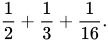
An Egyptian fraction is a finite sum of distinct unit fractions, such asThat is, each fraction in the expression has a numerator equal to 1 and a denominator that is a positive integer, and all the denominators differ from each other. The value of an expression of this type is a positive rational number ; for instance the Egyptian fraction above sums to . Every positive rational number can be represented by an Egyptian fraction. Sums of this type, and similar sums also including and as summands, were used as a serious notation for rational numbers by the ancient Egyptians, and continued to be used by other civilizations into medieval times. In modern mathematical notation, Egyptian fractions have been superseded by vulgar fractions and decimal notation. However, Egyptian fractions continue to be an object of study in modern number theory and recreational mathematics, as well as in modern historical studies of ancient mathematics.

↓ Explore More Topics
In this Dossier

Denominator in the context of Rational number

In mathematics, a rational number is a number that can be expressed as the quotient or fraction of two integers, a numerator p and a non-zero denominator q. For example, is a rational number, as is every integer (for example, ). The set of all rational numbers is often referred to as "the rationals", and is closed under addition, subtraction, multiplication, and division by a nonzero rational number. It is a field under these operations and therefore also calledthe field of rationals or the field of rational numbers. It is usually denoted by boldface Q, or blackboard bold

A rational number is a real number. The real numbers that are rational are those whose decimal expansion either terminates after a finite number of digits (example: 3/4 = 0.75), or eventually begins to repeat the same finite sequence of digits over and over (example: 9/44 = 0.20454545...). This statement is true not only in base 10, but also in every other integer base, such as the binary and hexadecimal ones (see Repeating decimal § Extension to other bases).

↑ Return to Menu

Denominator in the context of Square root of 2

The square root of 2 (approximately 1.4142) is the positive real number that, when multiplied by itself or squared, equals the number 2. It may be written as or . It is an algebraic number, and therefore not a transcendental number. Technically, it should be called the principal square root of 2, to distinguish it from the negative number with the same property.

Geometrically, the square root of 2 is the length of a diagonal across a square with sides of one unit of length; this follows from the Pythagorean theorem. It was probably the first number known to be irrational. The fraction 99/70 (≈ 1.4142857) is sometimes used as a good rational approximation with a reasonably small denominator.

↑ Return to Menu

Denominator in the context of V/v

In chemistry and fluid mechanics, the volume fraction is defined as the volume of a constituent Vi divided by the volume of all constituents of the mixture V prior to mixing:

Being dimensionless, its unit is 1; it is expressed as a number, e.g., 0.18. It is the same concept as volume percent (vol%) except that the latter is expressed with a denominator of 100, e.g., 18%.

↑ Return to Menu

Denominator in the context of Continued fraction

A continued fraction is a mathematical expression written as a fraction whose denominator contains a sum involving another fraction, which may itself be a simple or a continued fraction. If this iteration (repetitive process) terminates with a simple fraction, the result is a finite continued fraction; if it continues indefinitely, the result is an infinite continued fraction. The special case in which all numerators are equal to one is referred to as a simple (or regular) continued fraction. Any rational number can be expressed as a finite simple continued fraction, and any irrational number can be expressed as an infinite simple continued fraction.

Different areas of mathematics use different terminology and notation for continued fractions. In number theory, the unqualified term continued fraction usually refers to simple continued fractions, whereas the general case is referred to as generalized continued fractions. In complex analysis and numerical analysis, the general case is usually referred to by the unqualified term continued fraction.

↑ Return to Menu

Denominator in the context of Highest averages method

The highest averages, divisor, or divide-and-round methods are a family of apportionment rules, i.e. algorithms for fair division of seats in a legislature between several groups (like political parties or states). More generally, divisor methods are used to round shares of a total to a fraction with a fixed denominator (e.g. percentage points, which must add up to 100).

The methods aim to treat voters equally by ensuring legislators represent an equal number of voters by ensuring every party has the same seats-to-votes ratio (or divisor). Such methods divide the number of votes by the number of votes per seat to get the final apportionment. By doing so, the method maintains proportional representation, as a party with e.g. twice as many votes will win about twice as many seats.

↑ Return to Menu