Novum Instrumentum omne in the context of "Erasmus"

Play Trivia Questions online!

or

Skip to study material about Novum Instrumentum omne in the context of "Erasmus"

Ad spacer

⭐ Core Definition: Novum Instrumentum omne

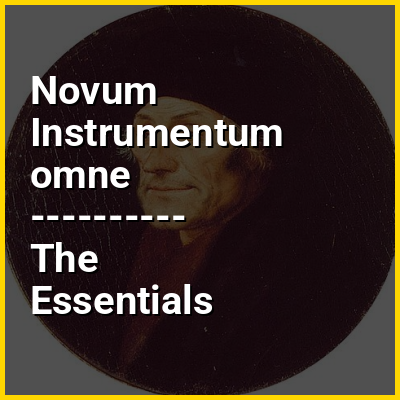
Novum Instrumentum Omne, later titled Novum Testamentum Omne, was a series of bilingual Latin-Greek New Testaments with substantial scholarly annotations, and the first printed New Testament of the Greek to be published. They were prepared by Desiderius Erasmus (1466–1536) in consultation with leading scholars, and printed by Johann Froben (1460–1527) of Basel. All five editions included Erasmus' collated and corrected Vulgate Latin version side-by-side with the Greek version, and the fourth edition also included his de novo rendition of the Greek into more refined Latin to bring out the similarities and difference from the Vulgate, for scholars not expert in Greek.

An estimate of up to 300,000 copies were printed in Erasmus' lifetime. After Erasmus' death, his New Testament work was republished and revised notably by Robert Stephanus: the corrected Latin Vulgate, shorn of mentions of Erasmus, soon became a reference text for the Leuven Vulgate which was ultimately the basis of the official Catholic Sixto-Clementine Vulgate Bible and subsequent Catholic vernacular translations; the Greek text was the basis for the majority of Protestant Textus Receptus translations of the New Testament in the 16th–19th centuries, including those of Martin Luther, William Tyndale and the King James Version.
↓ Menu

>>>PUT SHARE BUTTONS HERE<<<
In this Dossier

Novum Instrumentum omne in the context of Erasmus of Rotterdam

Desiderius Erasmus Roterodamus (/ˌdɛzɪˈdɪəriəs ɪˈræzməs/ DEZ-i-DEER-ee-əs irr-AZ-məs; Dutch: [ˌdeːziˈdeːrijʏs eːˈrɑsmʏs]; 28 October c. 1466 – 12 July 1536), commonly known in English as Erasmus of Rotterdam or simply Erasmus, was a Dutch humanist, Christian theologian, and philosopher. He was, through his writings, one of the most influential scholars of the Northern Renaissance and a major figure of Western culture.

Erasmus was an important figure in classical scholarship who wrote in a spontaneous, copious and natural Latin style. As a Catholic priest developing humanist techniques for working on texts, he prepared pioneering new Latin and Greek scholarly editions of the New Testament and of the Church Fathers, with annotations and commentary that were immediately and vitally influential in both the Protestant Reformation and the Catholic Reformation. He also wrote On Free Will, The Praise of Folly, The Complaint of Peace, Handbook of a Christian Knight, On Civility in Children, Copia: Foundations of the Abundant Style and many other popular and pedagogical works.

↑ Return to Menu

Novum Instrumentum omne in the context of Textus Receptus

The Textus Receptus (Latin for 'received text') is the succession of printed Greek New Testament texts starting with Erasmus' Novum Instrumentum omne (1516) and including the editions of Stephanus, Beza, the Elzevir house, Colinaeus and Scrivener.

Erasmus' Latin/Greek New Testament editions and annotations were a major influence for the original German Luther Bible and the translations of the New Testament into English by William Tyndale. Subsequent Textus Receptus editions constituted the main Greek translation-base for the King James Version, the Spanish Reina-Valera translation, the Czech Bible of Kralice, the Portuguese Almeida Recebida, the Dutch Statenvertaling, the Russian Synodal Bible and many other Reformation-era New Testament translations throughout Western, Northern and Central Europe.

↑ Return to Menu

Novum Instrumentum omne in the context of Works of Erasmus

Desiderius Erasmus was the most popular, most printed and arguably most influential author of the early Sixteenth Century, read in all nations in the West and frequently translated. By the 1530s, the writings of Erasmus accounted for 10 to 20 percent of all book sales in Europe. "Undoubtedly he was the most read author of his age."

His vast number of Latin and Greek publications included translations, paraphrases, letters, textbooks, plays for schoolboys, commentary, poems, liturgies, satires, sermons, and prayers. He is noted for his extensive scholarly editions of the New Testament and the complete works of numerous Church Fathers. A large number of his later works were defences of his earlier work from attacks by Catholic and Protestant theological and literary opponents.

↑ Return to Menu

Novum Instrumentum omne in the context of Luther Bible

The Luther Bible (German: Lutherbibel) is a German language Bible translation by the Protestant reformer Martin Luther. A New Testament translation by Luther was first published in September 1522; the completed Bible contained 75 books, including the Old Testament, Apocrypha and New Testament, which was printed in 1534. Luther continued to make improvements to the text until 1545. It was one of the first full translations of the Bible into German that used not only the Latin Vulgate but the original Hebrew and Greek.

Luther did not translate the entire Bible by himself; he relied on a team of translators and helpers that included Philip Melanchthon, a scholar of Koine Greek who motivated and assisted Luther's New Testament translation from Greek, and Matthäus Aurogallus, a linguist and scholar of Hebrew. One of the textual bases of the New Testament translation was the bilingual Latin and Greek version, with its philological annotations, recently published by the Dutch Catholic humanist Erasmus of Rotterdam and called the Novum Testamentum omne (1519).

↑ Return to Menu

Novum Instrumentum omne in the context of Desiderius Erasmus

Desiderius Erasmus Roterodamus (/ˌdɛzɪˈdɪəriəs ɪˈræzməs/ DEZ-i-DEER-ee-əs irr-AZ-məs; Dutch: [ˌdeːziˈdeːrijʏs eːˈrɑsmʏs]; 28 October c. 1466 – 12 July 1536), commonly known in English as Erasmus of Rotterdam or simply Erasmus, was a Dutch humanist, Christian theologian, and pioneering philologist and educationalist. He was, through his writings and translations, one of the most influential scholars of the Northern Renaissance and a major figure of Western culture.

Erasmus was an important figure in Renaissance classical scholarship who wrote in a spontaneous, copious and correct but natural Latin style. As a Catholic priest developing humanist techniques for working on texts, he prepared pioneering new Latin and Greek scholarly editions of the New Testament and of the Church Fathers, with annotations and commentary that were immediately and vitally influential in both the Protestant Reformation and the Catholic Reformation. He also wrote On Free Will, The Praise of Folly, The Complaint of Peace, Handbook of a Christian Knight, On Civility in Children, Copia: Foundations of the Abundant Style and many other academic, popular and pedagogical works.

↑ Return to Menu