Neo-classicism in the context of "Jugendstil"

Play Trivia Questions online!

or

Skip to study material about Neo-classicism in the context of "Jugendstil"

Ad spacer

⭐ Core Definition: Neo-classicism

Neoclassicism, also spelled Neo-classicism, emerged as a Western cultural movement in the decorative and visual arts, literature, theatre, music, and architecture that drew inspiration from the art and culture of classical antiquity. Neoclassicism was born in Rome, largely due to the writings of Johann Joachim Winckelmann during the rediscovery of Pompeii and Herculaneum. Its popularity expanded throughout Europe as a generation of European art students finished their Grand Tour and returned from Italy to their home countries with newly rediscovered Greco-Roman ideals. The main Neoclassical movement emerged from the 18th-century Age of Enlightenment, and reached its peak in the early-to-mid-19th century, eventually competing with Romanticism. In architecture, the style endured throughout the 19th, 20th, and into the 21st century.

European Neoclassicism in the visual arts began c. 1760 in opposition to the then-dominant Rococo style. Rococo architecture emphasizes grace, ornamentation and asymmetry; Neoclassical architecture is based on the principles of simplicity and symmetry, which were seen as virtues of the arts of Ancient Rome and Ancient Greece, and drawn directly from 16th-century Renaissance Classicism. Each "neo"-classicism movement selects some models among the range of possible classics that are available to it, and ignores others. Between 1765 and 1830, Neoclassical proponents—writers, speakers, patrons, collectors, artists and sculptors—paid homage to an idea of the artistic generation associated with Phidias, but sculpture examples they actually embraced were more likely to be Roman copies of Hellenistic sculptures. They ignored both Archaic Greek art and the works of late antiquity. The discovery of ancient Palmyra's "Rococo" art through engravings in Robert Wood's The Ruins of Palmyra came as a revelation. With Greece largely unexplored and considered a dangerous territory of the Ottoman Empire, Neoclassicists' appreciation of Greek architecture was predominantly mediated through drawings and engravings which were subtly smoothed and regularized, "corrected" and "restored" monuments of Greece, not always consciously.
↓ Menu

>>>PUT SHARE BUTTONS HERE<<<

👉 Neo-classicism in the context of Jugendstil

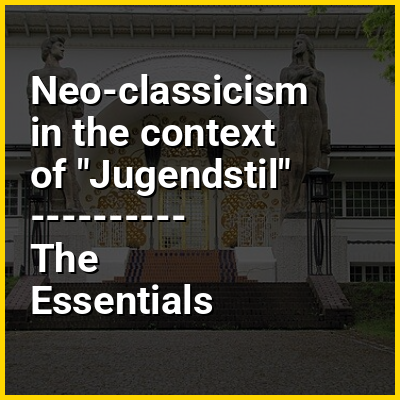
Jugendstil (German pronunciation: [ˈjuːɡn̩tˌstiːl] ; "Youth Style") was an artistic movement, particularly in the decorative arts, that was influential primarily in Germany, Austria, and elsewhere in Europe to a lesser extent from about 1895 until about 1910. It was the German and Austrian counterpart of Art Nouveau. The members of the movement were reacting against the historicism and neo-classicism of the official art and architecture academies. It took its name from the art journal Jugend, founded by the German artist Georg Hirth. It was especially active in the graphic arts and interior decoration.

Its major centers of activity were Munich, Vienna and Weimar and the Darmstadt Artists' Colony founded in Darmstadt in 1901. Important figures of the movement included the Swiss graphic artist Hermann Obrist, Otto Eckmann, the Belgian architect and decorator Henry van de Velde, as well as the Austrians Otto Wagner, Joseph Maria Olbrich, Gustav Klimt, and Koloman Moser, among others. In its earlier years, the style was influenced by the British Modern Style. It was also influenced by Japanese prints. Later, under the Secessionists' influence, it tended toward abstraction and more geometrical forms.

↓ Explore More Topics
In this Dossier

Neo-classicism in the context of Joseph-Benoît Suvée

Joseph-Benoît Suvée (3 January 1743 – 9 February 1807) was a Flemish painter strongly influenced by French neo-classicism.

↑ Return to Menu

Neo-classicism in the context of François Rude

François Rude (French pronunciation: [fʁɑ̃swa ʁyd]; 4 January 1784 – 3 November 1855) was a French sculptor, best known for the Departure of the Volunteers, also known as La Marseillaise on the Arc de Triomphe in Paris. (1835–36). His work often expressed patriotic themes, as well as the transition from neo-classicism to romanticism.

↑ Return to Menu

Neo-classicism in the context of Return to Order

The Return to Order (French: retour à l'ordre) was a European art movement following the First World War that rejected the extreme avant-garde art of the years up to 1918 and emphasized the classical ideals of order and rationality. The movement is often thought to be a reaction to the war, though strands of the Return to Order began before its outbreak, such as the Noucentista movement in Spain. Futurism, which had praised machinery, dynamism, violence and war, was rejected by most of its adherents. The return to order was associated with a revival of classicism and representational painting. Among the many artists who participated in the movement were notable figures in modernism such as Picasso and Braque, Matisse, Cezanne, Renoir, and much of the Italian Futurists.

Artists of the Return to Order placed high emphasis on the classical ideals of rationality, quality of line, illusionism and order, in opposition to the preceding decades of irrationality and emotional turbulence which characterised the artworks of the avant-garde. Although taking classicism as its foundational inspiration, artists were keen to re-interpret the essence of classical art through the lens of modernism, and a link was often made between the idealism of the classical period and the “Plastic-like” art of the modern era. Many of the works made during the period display modernist tendencies alongside classical subjects and techniques.

↑ Return to Menu

Neo-classicism in the context of Hemistich

A hemistich (/ˈhɛmɪstɪk/; via Latin from Greek ἡμιστίχιον, from ἡμι- "half" and στίχος "verse") is a half-line of verse, followed and preceded by a caesura, that makes up a single overall prosodic or verse unit. In Latin and Greek poetry, the hemistich is generally confined to drama. In Greek tragedy, characters exchanging clipped dialogue to suggest rapidity and drama would speak in hemistichs (in hemistichomythia). The Roman poet Virgil employed hemistichs in the Aeneid to indicate great duress in his characters, where they were incapable of forming complete lines due to emotional or physical pain.

In neo-classicism, the hemistich was frowned upon (e.g. by John Dryden), but Germanic alliterative verse employed the hemistich as a basic component of verse. In Old English and Old Norse poetry, each line of alliterative verse was divided into an "a-verse" and "b-verse" hemistich with a strong caesura between. In Beowulf, there are only five basic types of hemistich, with some used only as initial hemistichs and some only as secondary hemistichs. Furthermore, Middle English poetry also employed the hemistich as a coherent unit of verse, with both the Pearl Poet and Layamon using a regularized set of principles for which metrical (as well as alliterative) forms were allowed in which hemistich position.

↑ Return to Menu