Mini in the context of "Rover Company"

Play Trivia Questions online!

or

Skip to study material about Mini in the context of "Rover Company"

Ad spacer

⭐ Core Definition: Mini

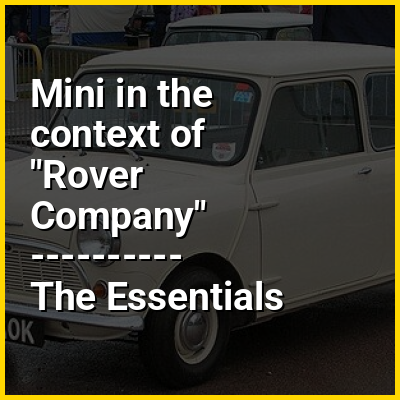
The Mini is a two-door, four-seat small car produced for four decades over a single generation, with many names and variants, by the British Motor Corporation (BMC) and its successors British Leyland and the Rover Group, and finally (briefly) under BMW ownership. Minis were built as fastbacks, estates, convertibles, and various other body styles. Minus a brief 1990s hiatus, from 1959 into 2000, an estimated 5.38 million of all variations combined were built, and the Mini's engines also powered another 2 million Mini Metros, though the Mini eventually outlasted its successor.

Initially, the Mini was marketed under the Austin and Morris names, as the Austin Seven and Morris Mini-Minor; the Austin Seven was renamed Austin Mini in 1962 and Mini became a marque in its own right in 1969. Retrospectively, the car is known as the "Classic Mini" to distinguish it from the modern MINI family of vehicles produced since 2001 by German carmaker BMW, who took ownership of the Mini name following the sale of Rover Group in 2000.
↓ Menu

>>>PUT SHARE BUTTONS HERE<<<

👉 Mini in the context of Rover Company

The Rover Company Limited was a British car manufacturing company in independent operation between 1878 and 1967, beginning car manufacturing in 1904. It primarily operated from its base in Solihull, Warwickshire. Rover also manufactured the Land Rover series from 1948 onwards, and created the Range Rover in 1970, which went on to become its most successful and profitable product. Land Rover eventually became a separate company and brand in its own right.

Rover was bought by Leyland Motors in 1967, which had already acquired Standard-Triumph seven years earlier. Initially, Rover maintained a level of autonomy within the Leyland conglomerate, but by 1978, Leyland – by then British Leyland (BL) – had run into severe financial difficulties and had been nationalized by the British Government. Most of the assets of the former Rover Company were moved into a new BL subsidiary named Land Rover Ltd whilst the Rover marque itself continued to be used on other BL products which relied largely on Honda engineering. Nevertheless, Rover ultimately became the most prolific brand within BL and gave its name to the entire conglomerate in the form of the Rover Group in 1986, of which MG, Mini and Land Rover remained a part until the Rover Group was broken up by BMW in 2000.

↓ Explore More Topics
In this Dossier

Mini in the context of Ford Model T

The Ford Model T is an automobile that was produced by the Ford Motor Company from October 1, 1908, to May 26, 1927. It is generally regarded as the first mass-affordable automobile, which made car travel available to middle-class Americans. The relatively low price was partly the result of Ford's efficient fabrication, including assembly line production instead of individual handcrafting. The savings from mass production allowed the price to decline from $780 in 1910 (equivalent to $26,322 in 2024) to $290 in 1924 ($5,321 in 2024 dollars). It was mainly designed by three engineers, Joseph A. Galamb (the main engineer), Eugene Farkas, and Childe Harold Wills. The Model T was colloquially known as the "Tin Lizzie".

The Ford Model T was named the most influential car of the 20th century in the 1999 Car of the Century competition, ahead of the BMC Mini, Citroën DS, and Volkswagen Beetle. Ford's Model T was successful not only because it provided inexpensive transportation on a massive scale, but also because the car signified innovation for the rising middle class and became a powerful symbol of the United States' age of modernization. With over 15 million sold, it was the most sold car in history before being surpassed by the Volkswagen Beetle in 1972.

↑ Return to Menu

Mini in the context of Mini Hatch

The Mini is a supermini car which has been made since July 2001. Colloquially known as the New Mini, all four generations have been produced as three-door hatchbacks and two-door convertibles, with a five-door hatchback body style added from the third generation. Introduced following the acquisition of the Mini marque by German carmaker BMW, it is a family of retro-styled cars with a front-engine, front-wheel-drive layout. The range has been marketed under various names, such as the Mini Cooper, Mini Hatch, Mini Hardtop, Mini One, and Mini John Cooper Works.

The Rover Group (which was then owned by BMW) first unveiled the Mini hatch concept car at the 1997 Frankfurt International Motor Show. Developed as a successor to the original Mini, the styling of the concept car was well received by the public and further developed. BMW sold the other parts of the Rover Group in May 2000, but retained the rights to Mini, although MG Rover were allowed to continue production of the original until October of that year. The new Mini entered production on 26 April 2001 and went on sale in July of that year, initially only as a three-door hatchback, in contrast to the original Mini which is predominantly a two-door saloon car.

↑ Return to Menu

Mini in the context of Mini moke

The Mini Moke is a small, front-wheel-drive utility and recreational convertible, conceived and manufactured as a lightweight military vehicle by British Motor Corporation (BMC), and subsequently marketed for civilian use under the Austin, Morris, Leyland, and Moke brands. The name "Mini Moke" combines mini with moke, an archaic term for a mule. The Moke is known for its simple, straightforward, doorless design and for its adaptability.

BMC's Cowley plant started building Mokes in January 1964, with 14,518 produced in the UK between 1964 and 1968; 26,000 were manufactured in Australia between 1966 and 1981; and 10,000 in Portugal between 1980 and 1993 when, after a nearly 30-year run, production ended.

↑ Return to Menu