Meditations on First Philosophy in the context of Louis Charles d'Albert de Luynes


Meditations on First Philosophy in the context of Louis Charles d'Albert de Luynes

⭐ Core Definition: Meditations on First Philosophy

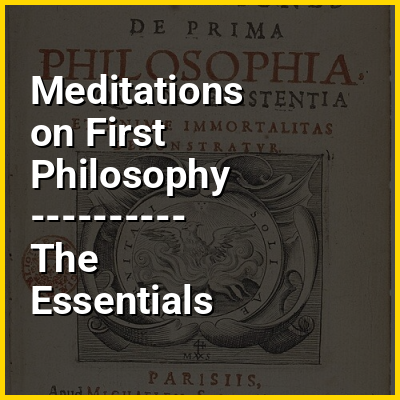
Meditations on First Philosophy, in which the existence of God and the immortality of the soul are demonstrated (Latin: Meditationes de Prima Philosophia, in qua Dei existentia et animæ immortalitas demonstratur), often called simply the Meditations, is a philosophical treatise by René Descartes first published in Latin in 1641. The French translation (by the Duke of Luynes with Descartes' supervision) was published in 1647 as Méditations Métaphysiques. The title may contain a misreading by the printer, mistaking animae immortalitas for animae immaterialitas, as suspected by A. Baillet.

The book is made up of six meditations, in which Descartes first discards all belief in things that are not absolutely certain, and then tries to establish what can be known for sure. He wrote the meditations as if he had meditated for six days: each meditation refers to the last one as "yesterday". (In fact, Descartes began work on the Meditations in 1639.) One of the most influential philosophical texts ever written, it is widely read to this day.
↓ Menu
HINT:

In this Dossier

Meditations on First Philosophy in the context of Discourse on the Method

Discourse on the Method of Rightly Conducting One's Reason and of Seeking Truth in the Sciences (French: Discours de la Méthode pour bien conduire sa raison, et chercher la vérité dans les sciences) is a philosophical and autobiographical treatise published by René Descartes in 1637. It is best known as the source of the famous quotation "Je pense, donc je suis" ("I think, therefore I am", or "I am thinking, therefore I exist"), which occurs in Part IV of the work. A similar argument without this precise wording is found in Meditations on First Philosophy (1641), and a Latin version of the same statement, "Cogito, ergo sum", is found in Principles of Philosophy (1644).

Discourse on the Method is one of the most influential works in the history of modern philosophy, and important to the development of natural sciences. In this work, Descartes tackles the problem of skepticism, which had previously been studied by other philosophers. While addressing some of his predecessors and contemporaries, Descartes modified their approach to account for a truth he found to be incontrovertible; he started his line of reasoning by doubting everything, so as to assess the world from a fresh perspective, clear of any preconceived notions.

View the full Wikipedia page for Discourse on the Method
↑ Return to Menu

Meditations on First Philosophy in the context of Cogito, ergo sum

The Latin cogito, ergo sum, usually translated into English as "I think, therefore I am", is the "first principle" of René Descartes' philosophy. He originally published it in French as je pense, donc je suis in his 1637 Discourse on the Method, so as to reach a wider audience than Latin would have allowed. It later appeared in Latin in his Principles of Philosophy, and a similar phrase (Ego sum, ego existo, 'I am, I exist') also featured prominently in his Meditations on First Philosophy. The dictum is also sometimes referred to as the cogito. As Descartes explained in a margin note, "we cannot doubt of our existence while we doubt." In the posthumously published The Search for Truth by Natural Light, he expressed this insight as dubito, ergo sum, vel, quod idem est, cogito, ergo sum ("I doubt, therefore I am—or what is the same—I think, therefore I am."). Antoine Léonard Thomas, in a 1765 essay in honor of Descartes, presented it as dubito, ergo cogito, ergo sum ("I doubt, therefore I think, therefore I am.").

Descartes's statement became a fundamental element of Western philosophy, as it purported to provide a certain foundation for knowledge in the face of radical doubt. While other knowledge could be a figment of imagination, deception, or mistake, Descartes asserted that the very act of doubting one's own existence served—at minimum—as proof of the reality of one's own mind; there must be a thinking entity—in this case the self—for there to be a thought.

View the full Wikipedia page for Cogito, ergo sum
↑ Return to Menu

Meditations on First Philosophy in the context of Principles of Philosophy

Principles of Philosophy (Latin: Principia Philosophiae) is a book by the French philosopher and scientist René Descartes. In essence, it is a synthesis of the Discourse on Method and Meditations on First Philosophy. It was written in Latin, published in 1644 and dedicated to Elisabeth of Bohemia, with whom Descartes had a long-standing friendship. A French version (Les Principes de la Philosophie) followed in 1647.

The book sets forth the principles of nature—the laws of physics—as Descartes viewed them. Most notably, it set forth the principle that in the absence of external forces, an object's motion will be uniform and in a straight line. Isaac Newton borrowed this principle from Descartes and included it in his own Principia; to this day, it is still generally referred to as Newton's first law of motion. The book was primarily intended to replace the Aristotelian curriculum then used in French and British universities. The work provides a systematic statement of his metaphysics and natural philosophy, and represents the first truly comprehensive, mechanistic account of the universe.

View the full Wikipedia page for Principles of Philosophy
↑ Return to Menu

Meditations on First Philosophy in the context of The Search for Truth by Natural Light

The Search for Truth by Natural Light (La recherche de la vérité par la lumière naturelle) is an unfinished philosophical dialogue by René Descartes “set in the courtly culture of the ‘honnête homme’ and ‘curiosité’.” It was written in French (presumably after the Meditations was completed) but that was lost around 1700 and remained lost until a partial copy was discovered in G.W. Leibniz's papers in Hanover in 1908 and published in the Adam-Tannery edition of Descartes's works and correspondence (vol. X, pp. 495-532). A Latin translation, Inquisitio Veritatis per Lumen Naturale, was published in 1683 as part of Renati Des-Cartes Musicae compendium (Blaviana printing house, Amsterdam) and again in 1701 as part of R. Des-Cartes Opuscula posthuma, physica et mathematica (Apud Janssonio-Waesbergios, Boom et Goethals, Amsterdam); it was also included in a Dutch translation of a collection of letters from Descartes published in 1684 by J.H. Glazemaker.

A definitive edition, containing the partial French text plus the fuller Dutch and Latin translations on facing pages was published in 2002. The opening passage (translated by Norman Kemp Smith to English in 1957) "is a helpful commentary on the argument of Articles 74-78" of The Passions of the Soul.

View the full Wikipedia page for The Search for Truth by Natural Light
↑ Return to Menu