Leopold von Ranke in the context of "Historical narrative"

Play Trivia Questions online!

or

Skip to study material about Leopold von Ranke in the context of "Historical narrative"

Ad spacer

⭐ Core Definition: Leopold von Ranke

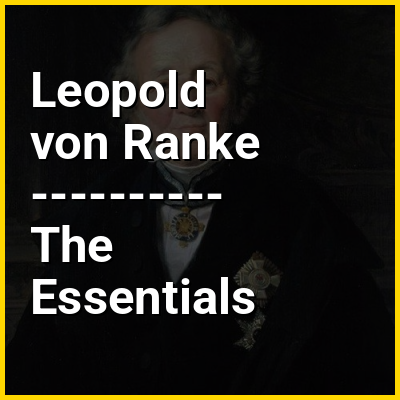
Leopold von Ranke (21 December 1795 – 23 May 1886) was a German historian and a founder of modern source-based history. He was able to implement the seminar teaching method in his classroom and focused on archival research and the analysis of historical documents. Building on the methods of the Göttingen school of history, he was the first to establish a historical seminar. Ranke set the standards for much of later historical writing, introducing such ideas as reliance on primary sources (empiricism), an emphasis on narrative history and especially international politics (Außenpolitik). He was ennobled in 1865, with the addition of a "von" to his name.

Ranke also had a great influence on Western historiography and is considered a symbol of the quality of 19th century German historical studies. Ranke, influenced by Barthold Georg Niebuhr, was very talented in constructing narratives without exceeding the limits of historical evidence. His critics have noted the influence of Lutheranism in guiding his work, especially his belief that God's actions were manifest in the lives of men and history, a viewpoint that shaped his ideas that the German Empire was a manifestation of God's intent.
↓ Menu

>>>PUT SHARE BUTTONS HERE<<<

👉 Leopold von Ranke in the context of Historical narrative

Narrative history is the practice of writing history in a story-based form. It tends to entail history-writing based on reconstructing series of short-term events, and ever since the influential work of Leopold von Ranke on professionalising history-writing in the nineteenth century, it has been associated with empiricism. The term narrative history thus overlaps with the term histoire événementielle ('event-history') coined by Fernand Braudel in the early twentieth century, as he promoted forms of history-writing analysing much longer-term trends (what he called the longue durée).

Though history is considered a social science, the story-based nature of history allows for the inclusion of a greater or lesser degree of narration in addition to an analytical or interpretative exposition of historical knowledge. It can be divided into two subgenres: the traditional narrative and the modern narrative.

↓ Explore More Topics
In this Dossier

Leopold von Ranke in the context of Auxiliary sciences of history

Auxiliary (or ancillary) sciences of history are scholarly disciplines which help evaluate and use historical sources and are seen as auxiliary for historical research. Many of these areas of study, classification and analysis were originally developed between the 16th and 19th centuries by antiquaries, and would then have been regarded as falling under the broad heading of antiquarianism. "History" was at that time regarded as a largely literary skill. However, with the spread of the principles of empirical source-based history championed by the Göttingen school of history in the late 18th century and later by Leopold von Ranke from the mid-19th century onwards, they have been increasingly regarded as falling within the skill-set of the trained historian.

↑ Return to Menu

Leopold von Ranke in the context of Vuk Karadžić

Vuk Stefanović Karadžić (Serbian Cyrillic: Вук Стефановић Караџић, pronounced [ʋûːk stefǎːnoʋitɕ kâradʒitɕ]; 6 November 1787 (26 October OS) – 7 February 1864) was a Serbian philologist, anthropologist and linguist. He was one of the most important reformers of the modern Serbian language. Vuk Karadžić was a versatile scholar and the founder of several Serbian academic disciplines, with a significant contribution to historiography. For his collection and preservation of Serbian folktales, Encyclopædia Britannica labelled Karadžić "the father of Serbian folk-literature scholarship." He was also the author of the first Serbian dictionary in the new reformed language. In addition, he translated the New Testament into the reformed form of the Serbian spelling and language.

He was well known abroad and familiar to Jacob Grimm, Johann Wolfgang von Goethe and historian Leopold von Ranke. Karadžić was the primary source for Ranke's Die serbische Revolution ("The Serbian Revolution"), written in 1829.

↑ Return to Menu

Leopold von Ranke in the context of Popular crusades

The popular crusades were several movements "animated by crusading enthusiasm" but unsanctioned by the Church. They contrast with the "official crusades" authorised by the Papacy. While the latter consisted of professional armies led by apostolic legates, the popular crusades were generally disorganized and consisted of peasants, artisans and only the occasional knight. The term "popular crusade" is a modern scholarly convention. The distinction between the "hierarchical" (or official) and the popular impulse in crusading was first made by historian Leopold von Ranke in the nineteenth century.

These events demonstrate the power of crusading ideas and the engagement of non-noble believers with the great events of Latin Christendom. All crusades that were not preached officially were illicit and unaccompanied by papal representation. But it was not until the 1320s that the papacy criticised a popular crusade. The objectives were traditional, such as regaining Jerusalem or liberating the captive King Louis IX of France. Victories in the Smyrniote crusade of 1344 aroused mass enthusiasm in Tuscany and Lombardy. Those who took part in popular crusades perceived themselves as authentic crusaders, evident in the use of pilgrimage and crusade emblems, including the cross.

↑ Return to Menu

Leopold von Ranke in the context of Leipzig University

Leipzig University (German: Universität Leipzig), in Leipzig in Saxony, Germany, is one of the world's oldest universities and the second-oldest university (by consecutive years of existence) in Germany. The university was founded on 2 December 1409 by Frederick I, Elector of Saxony and his brother William II, Margrave of Meissen, and originally comprised the four scholastic faculties. Since its inception, the university has engaged in teaching and research for over 600 years without interruption.

Famous alumni include Angela Merkel, Gottfried Wilhelm von Leibniz, Johann Wolfgang von Goethe, Leopold von Ranke, Friedrich Nietzsche, Robert Schumann, Richard Wagner, Tycho Brahe, Georgius Agricola. The university is associated with ten Nobel laureates, most recently with Svante Pääbo who won the Nobel Prize for Medicine in 2022.

↑ Return to Menu

Leopold von Ranke in the context of Georg Waitz

Georg Waitz (9 October 1813 – 24 May 1886) was a German medieval historian and politician. Waitz is often spoken of as the leading disciple of Leopold von Ranke, though perhaps he had more affinity with Georg Heinrich Pertz or Friedrich Christoph Dahlmann. He concentrated on medieval German history.

↑ Return to Menu