Hoplites in the context of "Psiloi"

Play Trivia Questions online!

or

Skip to study material about Hoplites in the context of "Psiloi"

Ad spacer

⭐ Core Definition: Hoplites

Hoplites (/ˈhɒplts/ HOP-lytes) (Ancient Greek: ὁπλῖται, romanizedhoplîtai [hoplîːtai̯]) were citizen-soldiers of Ancient Greek city-states who were primarily armed with spears and shields. Hoplite soldiers used the phalanx formation to be effective in war with fewer soldiers. The formation discouraged the soldiers from acting alone, for this would compromise the formation and minimize its strengths. The hoplites were primarily represented by free citizens – propertied farmers and artisans – who were able to afford a linen or bronze armour suit and weapons (estimated at a third to a half of its able-bodied adult male population). Some states maintained a small elite professional unit, known as the epilektoi or logades ('the chosen') because they were picked from the regular citizen infantry. These existed at times in Athens, Sparta, Argos, Thebes, and Syracuse, among other places. Hoplite soldiers made up the bulk of ancient Greek armies.

In the 8th century BC, Greek armies started to adopt the phalanx formation. The formation proved successful in defeating the Persians when employed by the Athenians at the Battle of Marathon in 490 BC during the First Greco-Persian War. The Persian archers and light troops who fought in the Battle of Marathon failed because their bows were too weak for their arrows to penetrate the wall of Greek shields of the phalanx formation. The phalanx was also employed by the Greeks at the Battle of Thermopylae in 480 BC and at the Battle of Plataea in 479 BC during the Second Greco-Persian War.
↓ Menu

>>>PUT SHARE BUTTONS HERE<<<

👉 Hoplites in the context of Psiloi

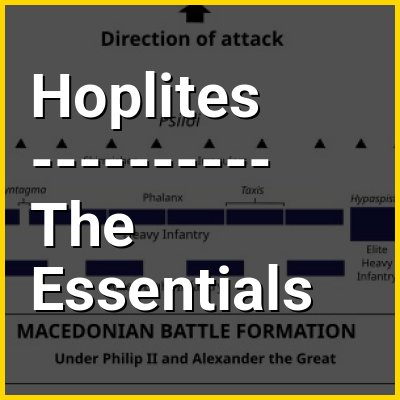
In Ancient Greek armies, the psiloi (Ancient Greek ψιλοί, singular ψιλός, psilos, literally "bare, stripped") were light infantry who typically served as skirmishers and missile troops. They were distinguished from the armored hoplitai (heavy infantry) by their light weaponry and lack of armor.

In Classical Antiquity and Late Antiquity and throughout the existence of the Byzantine Empire, the lightest-armed troops, typically equipped with ranged weapons, and which fought irregularly in a loose formation, were deemed 'the psiloi'. Numbered among the psiloi were archers, the toxotai armed with a bow (toxa), and slingers, the (sphendonetai) who hurled stones or metal bullets with slings (sfendonai). Others, the akontistai, used the throwing javelin (akontia). Some psiloi simply threw stones at the enemy and were referred to as lithoboloi.

↓ Explore More Topics
In this Dossier

Hoplites in the context of Giants (Greek mythology)

In Greek and Roman mythology, the Giants, also called Gigantes (Greek: Γίγαντες, Gígantes, singular: Γίγας, Gígas), were a race of great strength and aggression, though not necessarily of great size, known for the Gigantomachy (also spelled Gigantomachia), their battle with the Olympian gods. According to Hesiod, the Giants were the offspring of Gaia (Earth), born from the blood that fell when Uranus (Sky) was castrated by his Titan son Cronus.

Archaic and Classical representations show Gigantes as man-sized hoplites (heavily armed ancient Greek foot soldiers) fully human in form. Later representations (after c. 380 BC) show Gigantes with snakes for legs. In later traditions, the Giants were often confused with other opponents of the Olympians, particularly the Titans, an earlier generation of large and powerful children of Gaia and Uranus.

↑ Return to Menu

Hoplites in the context of Heavy infantry

Heavy infantry consisted of heavily armed and armoured infantrymen who were trained to mount frontal assaults and/or anchor the defensive center of a battle line. This differentiated them from light infantry who were relatively mobile and lightly armoured skirmisher troops intended for screening, scouting, and other tactical roles unsuited to soldiers carrying heavier loads. Heavy infantry typically made use of dense battlefield formations, such as shield wall or phalanx, multiplying their effective weight of arms with force concentration.

Heavy infantry were critical to many ancient armies, which first attested by the Sumerians in the Stele of the Vultures. It was also used by rival Assyrian and Persian Sparabara, then by Greek hoplites, Macedonian phalangites, and Roman legionaries. After the fall of Rome, heavy infantry declined in Europe but returned to dominance in the Late Middle Ages with Swiss pikemen and German Landsknechts. With the rise of firearms during early modern warfare, dense formations became increasingly infeasible, and heavy armours were either ineffective or too cumbersome to be tactically useful. By the early 18th century, heavy infantry were replaced by line infantry armed with muskets and bayonets and wearing little to no armour.

↑ Return to Menu

Hoplites in the context of Tagus (title)

Tagus (Ancient Greek: τᾱγός, τάγης) was a Thessalian title for a leader or general, especially the military leader of the Thessalian League. When occasion required, a chief magistrate was elected under the name of Tagus, whose commands were obeyed by all the four districts of Thessaly (Phthiotis, Thessaliotis, Histiaeotis, Pelasgiotis). He is sometimes called king ("basileus", Herodotus, V.63), and sometimes "archon" (Dionysius. V.74).

Accordingly, Pollux (I.128), in his list of military designations, classes together the Boeotarchs of the Thebans, the Kings of Sparta, the Polemarchs of the Athenians, (in reference to their original duties), and the Tagoi of the Thessalians. When Jason of Pherae was Tagus, he had an army of more than 8,000 cavalry and not less than 20,000 hoplites. When Thessaly was not united under a Tagus, the subject towns possessed more independence. Philip II of Macedon and his son Alexander the Great exercised control over Thessaly as elected Tagoi. In later times some states called their ordinary magistrates "Tagoi".

↑ Return to Menu