Eos in the context of "Theia"

Play Trivia Questions online!

or

Skip to study material about Eos in the context of "Theia"

Ad spacer

⭐ Core Definition: Eos

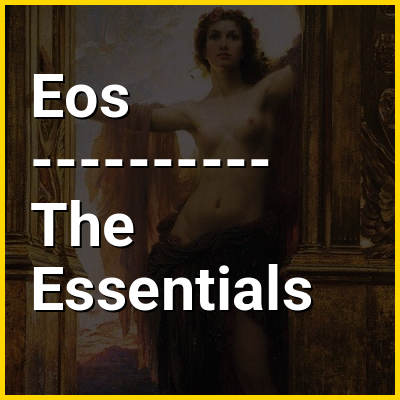
In ancient Greek mythology and religion, Eos (/ˈɒs/; Ionic and Homeric Greek Ἠώς Ēṓs, Attic Ἕως Héōs, "dawn", pronounced [ɛːɔ̌ːs] or [héɔːs]; Aeolic Αὔως Aúōs, Doric Ἀώς Āṓs) is the goddess and personification of the dawn, who rose each morning from her home at the edge of the river Oceanus to deliver light and disperse the night. In Greek tradition and poetry, she is characterized as a goddess with a great sexual appetite, who took numerous human lovers for her own satisfaction and bore them several children. Like her Roman counterpart Aurora and Rigvedic Ushas, Eos continues the name of an earlier Indo-European dawn goddess, Hausos. Eos, or her earlier Proto-Indo-European (PIE) ancestor, also shares several elements with the love goddess Aphrodite, perhaps signifying Eos's influence on her or otherwise a common origin for the two goddesses. In surviving tradition, Aphrodite is the culprit behind Eos's numerous love affairs, having cursed the goddess with insatiable lust for mortal men.

In Greek literature, Eos is presented as a daughter of the Titans Hyperion and Theia, the sister of the sun god Helios and the moon goddess Selene. In rarer traditions, she is the daughter of the Titan Pallas. Each day she drives her two-horse chariot, heralding the breaking of the new day and her brother's arrival. Thus, her most common epithet of the goddess in the Homeric epics is Rhododactylos, or "rosy-fingered", a reference to the sky's colours at dawn, and Erigeneia, "early-born". Although primarily associated with the dawn and early morning, sometimes Eos would accompany Helios for the entire duration of his journey, and thus she is even seen during dusk.
↓ Menu

>>>PUT SHARE BUTTONS HERE<<<

👉 Eos in the context of Theia

In Greek mythology, Theia (/ˈθə/; Ancient Greek: Θεία, romanizedTheía, lit.'divine') also called Thea, Thia, Euryphaessa, Aethra or Basileia, was one of the Titans, the children of Uranus (Sky) and Gaia (Earth). She is the goddess of minerals and gemstones.

Her brother-husband is Hyperion, a god of the light, and together they are the parents of Helios (the Sun), Selene (the Moon), and Eos (the Dawn). She seems to be the same figure as Aethra, who is the wife of Hyperion and mother of his children in some accounts. Like her husband, Theia features scarcely in myth, being mostly important for the children she bore, though she appears in some texts and rare traditions.

↓ Explore More Topics
In this Dossier

Eos in the context of Helios

In ancient Greek religion and mythology, Helios (/ˈhliəs, -ɒs/; Ancient Greek: Ἥλιος pronounced [hɛ̌ːlios], lit.'Sun'; Homeric Greek: Ἠέλιος) is the god who personifies the Sun. His name is also Latinized as Helius, and he is often given the epithets Hyperion ("the one above") and Phaethon ("the shining"). Helios is often depicted in art with a radiant crown and driving a horse-drawn chariot through the sky. He was a guardian of oaths and also the god of sight. Though Helios was a relatively minor deity in Classical Greece, his worship grew more prominent in late antiquity thanks to his identification with several major solar divinities of the Roman period, particularly Apollo and Sol. The Roman Emperor Julian made Helios the central divinity of his short-lived revival of traditional Roman religious practices in the 4th century AD.

Helios figures prominently in several works of Greek mythology, poetry, and literature, in which he is often described as the son of the Titans Hyperion and Theia and brother of the goddesses Selene (the Moon) and Eos (the Dawn). Helios's most notable role in Greek mythology is the story of his mortal son Phaethon. In the Homeric epics, his most notable role is the one he plays in the Odyssey, where Odysseus's men despite his warnings impiously kill and eat Helios's sacred cattle that the god kept at Thrinacia, his sacred island. Once informed of their misdeed, Helios, in wrath, asks Zeus to punish those who wronged him, and Zeus, agreeing, strikes their ship with a thunderbolt, killing everyone except Odysseus himself, the only one who had not harmed the cattle and was allowed to live.

↑ Return to Menu

Eos in the context of Selene

In ancient Greek mythology and religion, Selene (/sɪˈln/; Ancient Greek: Σελήνη pronounced [selɛ̌ːnɛː] seh-LEH-neh) is the goddess and personification of the Moon. Also known as Mene (/ˈmn/; Ancient Greek: μήνη pronounced [mɛ̌ː.nɛː] MEH-neh), she is traditionally the daughter of the Titans Hyperion and Theia, and sister of the sun god Helios and the dawn goddess Eos. She drives her moon chariot across the heavens. Several lovers are attributed to her in various myths, including Zeus, Pan, her brother Helios and the mortal Endymion. In post-classical times, Selene was often identified with Artemis, much as her brother, Helios, was identified with Apollo. Selene and Artemis were also associated with Hecate and all three were regarded as moon and lunar goddesses, but only Selene was regarded as the personification of the Moon itself.

Her equivalent in Roman religion and mythology is the goddess Luna.

↑ Return to Menu

Eos in the context of Hesperus

In Greek mythology, Hesperus (/ˈhɛspərəs/; Ancient Greek: Ἕσπερος, romanizedHésperos) is the Evening Star, the planet Venus in the evening. A son of the dawn goddess Eos (Roman Aurora), he is the half-brother of her other son, Phosphorus (also called Eosphorus; the "Morning Star"). Hesperus' Roman equivalent is Vesper (cf. "evening", "supper", "evening star", "west"). By one account, Hesperus' father was Cephalus, a mortal, while Phosphorus was the star god Astraeus. Other sources, however, state that Hesperus was the brother of Atlas, and thus the son of Iapetus.

↑ Return to Menu

Eos in the context of Hyperion (Titan)

In Greek mythology, Hyperion (/hˈpɪəriən/; Ancient Greek: Ὑπερίων) was one of the Titans, the children of Uranus (Sky) and Gaia (Earth). With his sister, the Titaness Theia, Hyperion fathered Helios (Sun), Selene (Moon) and Eos (Dawn).

Hyperion was, along with his son Helios, a personification of the sun, with the two sometimes identified. John Keats's abandoned epic poem Hyperion is among the literary works that feature the figure.

↑ Return to Menu

Eos in the context of Astraeus

In Greek mythology, Astraeus (/əˈstrəs/) or Astraios (Ancient Greek: Ἀστραῖος, romanizedAstraîos, lit.'starry') is the son of Crius and Eurybia, and the consort of Eos. He is said to be the father of the winds.

↑ Return to Menu

Eos in the context of Anemoi

In ancient Greek religion and myth, the Anemoi (Ancient Greek: Ἄνεμοι, lit.'Winds') were wind gods who were each ascribed a cardinal direction from which their respective winds came (see Classical compass winds), and were each associated with various nature, seasons and weather conditions. They were the progeny of the goddess of the dawn Eos and her husband, the god of the dusk, Astraeus.

↑ Return to Menu

Eos in the context of Tithonus (poem)

"Tithonus" is a poem by the Victorian poet Alfred, Lord Tennyson (1809–92), originally written in 1833 as "Tithon" and completed in 1859. It first appeared in the February edition of the Cornhill Magazine in 1860. Faced with old age, Tithonus, weary of his immortality, yearns for death. The poem is a dramatic monologue with Tithonus addressing his consort Eos, the goddess of the dawn.

↑ Return to Menu

Eos in the context of Cephalus (son of Deione/Deioneus)

In Greek mythology, Cephalus (/ˈsɛfələs/; Ancient Greek: Κέφαλος Kephalos) was an Aeolian prince, the son of Deion/Deioneos, ruler of Phocis, and Diomede, and grandson of Aeolus. He was one of the lovers of the dawn goddess Eos.

↑ Return to Menu