Elevation in the context of Clinometer


Elevation in the context of Clinometer

Elevation Study page number 1 of 10

Play TriviaQuestions Online!

or

Skip to study material about Elevation in the context of "Clinometer"


⭐ Core Definition: Elevation

The elevation of a geographic location is its height above or below a fixed reference point, most commonly a reference geoid, a mathematical model of the Earth's sea level as an equipotential gravitational surface (see Geodetic datum § Vertical datum).The term elevation is mainly used when referring to points on the Earth's surface, while altitude or geopotential height is used for points above the surface, such as an aircraft in flight or a spacecraft in orbit, and depth is used for points below the surface.

Elevation is not to be confused with the distance from the center of the Earth. Due to the equatorial bulge, the summits of Mount Everest and Chimborazo have, respectively, the largest elevation and the largest geocentric distance.

↓ Menu
HINT:

In this Dossier

Elevation in the context of Biogeography

Biogeography is the study of the distribution of species and ecosystems in geographic space and through geological time. Organisms and biological communities often vary in a regular fashion along geographic gradients of latitude, elevation, isolation and habitat area. Phytogeography is the branch of biogeography that studies the distribution of plants, Zoogeography is the branch that studies distribution of animals, while Mycogeography is the branch that studies distribution of fungi, such as mushrooms.

Knowledge of spatial variation in the numbers and types of organisms is as vital to us today as it was to our early human ancestors, as we adapt to heterogeneous but geographically predictable environments. Biogeography is an integrative field of inquiry that unites concepts and information from ecology, evolutionary biology, taxonomy, geology, physical geography, palaeontology, and climatology.

View the full Wikipedia page for Biogeography
↑ Return to Menu

Elevation in the context of Antarctica

Antarctica (/ænˈtɑːrktɪkə/ ) is Earth's southernmost and least-populated continent. Situated almost entirely south of the Antarctic Circle and surrounded by the Southern Ocean (also known as the Antarctic Ocean), it contains the geographic South Pole. Antarctica is the fifth-largest continent, being about 40% larger than Europe, and has an area of 14,200,000 km (5,500,000 sq mi). Most of Antarctica is covered by the Antarctic ice sheet, with an average thickness of 1.9 km (1.2 mi).

Antarctica is, on average, the coldest, driest, and windiest of the continents, and has the highest average elevation. It is mainly a polar desert, with annual precipitation of over 200 mm (8 in) along the coast and far less inland. About 70% of the world's freshwater reserves are frozen in Antarctica, which, if melted, would raise global sea levels by almost 60 metres (200 ft). Antarctica holds the record for the lowest measured temperature on Earth, −89.2 °C (−128.6 °F). The coastal regions can reach temperatures over 10 °C (50 °F) in the summer. Native species of animals include mites, nematodes, penguins, seals and tardigrades. Where vegetation occurs, it is mostly in the form of lichen or moss.

View the full Wikipedia page for Antarctica
↑ Return to Menu

Elevation in the context of Plain

In geography, a plain, commonly known as flatland, is a flat expanse of land that generally has few rapid or steep changes in elevation. Natural vegetation in plains can include prairies/grasslands, forests, savanah, tundra, and desert biomes, among others. Plains occur as lowlands along valleys or at the base of mountains, as coastal plains, and as plateaus or uplands. Plains are one of the major landforms on earth, being present on all continents and covering more than one-third of the world's land area. Plains in many areas are important for agriculture. There are various types of plains, and biomes on them.

View the full Wikipedia page for Plain
↑ Return to Menu

Elevation in the context of Terrain

Terrain (from Latin terra 'earth'), alternatively relief or topographical relief, is the dimension and shape of a given surface of a land. In physical geography, terrain is the lay of the land. This is usually expressed in terms of the elevation, slope, and orientation of terrain features. Terrain affects surface water flow and distribution. Over a large area, it can affect weather and climate patterns. Bathymetry is the study of underwater relief, while hypsometry studies terrain relative to sea level.

View the full Wikipedia page for Terrain
↑ Return to Menu

Elevation in the context of Above sea level

Height above mean sea level is a measure of a location's vertical distance (height, elevation or altitude) in reference to a vertical datum based on a historic mean sea level. In geodesy, it is formalized as orthometric height. The zero level varies in different countries due to different reference points and historic measurement periods. Climate change and other forces can cause sea levels and elevations to vary over time.

View the full Wikipedia page for Above sea level
↑ Return to Menu

Elevation in the context of River

A river is a natural stream of fresh water that flows on land or inside caves towards another body of water at a lower elevation, such as an ocean, lake, or another river. A river may run dry before reaching the end of its course if it runs out of water, or only flow during certain seasons. Rivers are regulated by the water cycle, the processes by which water moves around the Earth. Water first enters rivers through precipitation, whether from rainfall, the runoff of water down a slope, the melting of glaciers or snow, or seepage from aquifers beneath the surface of the Earth.

Rivers flow in channeled watercourses and merge in confluences to form drainage basins, areas where surface water eventually flows to a common outlet. Drainage divides keep rivers separated from other courses of water and causes upstream water within the confines of the divide to fall into the downhill stream. Rivers have a great effect on the landscape around them. They may regularly overflow their banks and flood the surrounding area, spreading nutrients to the surrounding area. Sediment or alluvium carried by rivers shapes the landscape around it, forming deltas and islands where the flow slows down. Rivers rarely run in a straight line, instead, they bend or meander; the locations of a river's banks can change frequently. Rivers get their alluvium from erosion, which carves rock into canyons and valleys.

View the full Wikipedia page for River
↑ Return to Menu

Elevation in the context of Black Forest

The Black Forest (German: Schwarzwald [ˈʃvaʁtsvalt] ) is a large forested mountain range in the state of Baden-Württemberg in southwest Germany, bounded by the Rhine Valley to the west and south and close to the borders with France and Switzerland. It is the source of the Danube and Neckar rivers.

Its highest peak is the Feldberg with an elevation of 1,493 metres (4,898 ft) above sea level. Roughly oblong in shape, with a length of 160 kilometres (100 miles) and breadth of up to 50 km (30 mi), it has an area of about 6,009 km (2,320 sq mi).

View the full Wikipedia page for Black Forest
↑ Return to Menu

Elevation in the context of Topography

Topography is the study of forms and features of land surfaces. The topography of an area may refer to landforms and features themselves, or a description or depiction in maps.

Topography is a field of geoscience and planetary science, and is concerned with local detail in general, including not only relief, but also natural, artificial, and cultural features such as roads, land boundaries, and buildings. In the United States, topography often means specifically relief, even though the USGS topographic maps record not just elevation contours, but also roads, populated places, structures, land boundaries, and so on.

View the full Wikipedia page for Topography
↑ Return to Menu

Elevation in the context of Krasnaya Polyana, Sochi, Krasnodar Krai

Krasnaya Polyana (Russian: Кра́сная Поля́на, IPA: [ˈkrasnəjə pɐˈlʲanə]; Abkhaz: Гәбаадәы, Gwbaadwy; Adyghe: Ӏаткъуадж, ‘atquaj, Greek: Κράσναγια Πολιάνα) is an urban locality (an urban-type settlement) in Krasnopolyansky Settlement Okrug, which is under the administrative jurisdiction of Adlersky City District of the City of Sochi in Krasnodar Krai, Russia. Population: 4,598 (2010 census); 3,969 (2002 census); 3,300 (1989 Soviet census).

Located in the Western Caucasus, it is home to the new Rosa Khutor alpine ski resort, with a base elevation of 560 meters (1,840 ft) along the Mzymta River, 39 kilometers (24 mi) from its influx into the Black Sea in Adlersky City District of Sochi. The lift-served summit climbs to 2,320 meters (7,610 ft), giving a vertical drop of over a mile at 1,760 meters (5,770 ft). The resort hosted the Alpine and Nordic events of the 2014 Winter Olympics in Sochi, having previously hosted World Cup alpine events from February 2012, two years earlier.

View the full Wikipedia page for Krasnaya Polyana, Sochi, Krasnodar Krai
↑ Return to Menu

Elevation in the context of Cross-sectional area

In geometry and science, a cross section is the non-empty intersection of a solid body in three-dimensional space with a plane, or the analog in higher-dimensional spaces. Cutting an object into slices creates many parallel cross-sections. The boundary of a cross-section in three-dimensional space that is parallel to two of the axes, that is, parallel to the plane determined by these axes, is sometimes referred to as a contour line; for example, if a plane cuts through mountains of a raised-relief map parallel to the ground, the result is a contour line in two-dimensional space showing points on the surface of the mountains of equal elevation.

In technical drawing a cross-section, being a projection of an object onto a plane that intersects it, is a common tool used to depict the internal arrangement of a 3-dimensional object in two dimensions. It is traditionally crosshatched with the style of crosshatching often indicating the types of materials being used.

View the full Wikipedia page for Cross-sectional area
↑ Return to Menu

Elevation in the context of List of elevation extremes by region

The following three sortable tables list land surface elevation extremes by region.

Elevation is the vertical distance above the reference geoid, an equipotential gravitational surface model of the Earth's sea level.

View the full Wikipedia page for List of elevation extremes by region
↑ Return to Menu

Elevation in the context of Circle of latitude

A circle of latitude or line of latitude on Earth is an abstract eastwest small circle connecting all locations around Earth (ignoring elevation) at a given latitude coordinate line.

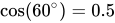
Circles of latitude are often called parallels because they are parallel to each other; that is, planes that contain any of these circles never intersect each other. A location's position along a circle of latitude is given by its longitude. Circles of latitude are unlike circles of longitude, which are all great circles with the centre of Earth in the middle, as the circles of latitude get smaller as the distance from the Equator increases. Their length can be calculated by a common sine or cosine function. For example, the 60th parallel north or south is half as long as the Equator (disregarding Earth's minor flattening by 0.335%), stemming from . On the Mercator projection or on the Gall-Peters projection, a circle of latitude is perpendicular to all meridians. On the ellipsoid or on spherical projection, all circles of latitude are rhumb lines, except the Equator.

View the full Wikipedia page for Circle of latitude
↑ Return to Menu

Elevation in the context of Sea level

Mean sea level (MSL, often shortened to sea level) is an average surface level of one or more among Earth's coastal bodies of water from which heights such as elevation may be measured. The global MSL is a type of vertical datum – a standardised geodetic datum – that is used, for example, as a chart datum in cartography and marine navigation, or, in aviation, as the standard sea level at which atmospheric pressure is measured to calibrate altitude and, consequently, aircraft flight levels. A common and relatively straightforward mean sea-level standard is instead a long-term average of tide gauge readings at a particular reference location.

The term above sea level generally refers to the height above mean sea level (AMSL). The term APSL means above present sea level, comparing sea levels in the past with the level today.

View the full Wikipedia page for Sea level
↑ Return to Menu

Elevation in the context of Summit

A summit is a point on a surface that is higher in elevation than all points immediately adjacent to it. The topographic terms acme, apex, peak (mountain peak), and zenith are synonymous.

The term top (mountain top) is generally used only for a mountain peak that is located at some distance from the nearest point of higher elevation. For example, a big, massive rock next to the main summit of a mountain is not considered a summit. Summits near a higher peak, with some prominence or isolation, but not reaching a certain cutoff value for the quantities, are often considered subsummits (or subpeaks) of the higher peak, and are considered part of the same mountain. A pyramidal peak is an exaggerated form produced by ice erosion of a mountain top. For summits that are permanently covered in significant layers of ice, the height may be measured by the highest point of rock (rock height) or the highest point of permanent solid ice (snow height).

View the full Wikipedia page for Summit
↑ Return to Menu

Elevation in the context of Antarctic ice sheet

The Antarctic ice sheet is a continental glacier covering 98% of the Antarctic continent, with an area of 14 million square kilometres (5.4 million square miles) and an average thickness of over 2 kilometres (1.2 mi). It is the largest of Earth's two current ice sheets, containing 26.5 million cubic kilometres (6,400,000 cubic miles) of ice, which is equivalent to 61% of all fresh water on Earth. Its surface is nearly continuous, and the only ice-free areas on the continent are the dry valleys, nunataks of the Antarctic mountain ranges, and sparse coastal bedrock. It is often subdivided into the Antarctic Peninsula (AP), the East Antarctic Ice Sheet (EAIS), and the West Antarctic Ice Sheet (WAIS), due to the large differences in glacier mass balance, ice flow, and topography between the three regions.

Because the East Antarctic Ice Sheet is over 10 times larger than the West Antarctic Ice Sheet and located at a higher elevation, it is less vulnerable to climate change than the WAIS. In the 20th century, EAIS had been one of the only places on Earth which displayed limited cooling instead of warming, even as the WAIS warmed by over 0.1 °C/decade from 1950s to 2000, with an average warming trend of >0.05 °C/decade since 1957 across the whole continent. As of early 2020s, there is still net mass gain over the EAIS (due to increased precipitation freezing on top of the ice sheet), yet the ice loss from the WAIS glaciers such as Thwaites and Pine Island Glacier is far greater.

View the full Wikipedia page for Antarctic ice sheet
↑ Return to Menu

Elevation in the context of Upland and lowland

Upland and lowland are conditional descriptions of a plain based on elevation above sea level. In studies of the ecology of freshwater rivers, habitats are classified as upland or lowland.

View the full Wikipedia page for Upland and lowland
↑ Return to Menu

Elevation in the context of Mound

A mound is a heaped pile of earth, gravel, sand, rocks, or debris. Most commonly, mounds are earthen formations such as hills and mountains, particularly if they appear artificial. A mound may be any rounded area of topographically higher elevation on any surface. Artificial mounds have been created for a variety of reasons throughout history, including habitation (see Tell and Terp), ceremonial (platform mound), burial (tumulus), and commemorative purposes (e.g. Kościuszko Mound).

View the full Wikipedia page for Mound
↑ Return to Menu