60th parallel south in the context of "Circle of latitude"

⭐ In the context of circles of latitude, how does the circumference of the 60th parallel south compare to that of the Equator?

Ad spacer

⭐ Core Definition: 60th parallel south

The 60th parallel south is a circle of latitude that is 60 degrees south of Earth's equatorial plane. No land lies on the parallel—it crosses nothing but ocean. The closest land is a group of rocks north of Coronation Island (Melson Rocks or Governor Islands) of the South Orkney Islands, which are about 54 km south of the parallel, and Thule Island and Cook Island of the South Sandwich Islands, which both are about 57 km north of the parallel (with Cook Island slightly closer).

The parallel marks the northern limit of the Southern Ocean (though some organisations and countries, notably Australia, have other definitions) and of the Antarctic Treaty System. It also marks the southern boundary of the South Pacific Nuclear-Weapon-Free Zone and the Latin American Nuclear-Weapon-Free Zone.

↓ Menu

>>>PUT SHARE BUTTONS HERE<<<

👉 60th parallel south in the context of Circle of latitude

A circle of latitude or line of latitude on Earth is an abstract eastwest small circle connecting all locations around Earth (ignoring elevation) at a given latitude coordinate line.

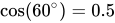
Circles of latitude are often called parallels because they are parallel to each other; that is, planes that contain any of these circles never intersect each other. A location's position along a circle of latitude is given by its longitude. Circles of latitude are unlike circles of longitude, which are all great circles with the centre of Earth in the middle, as the circles of latitude get smaller as the distance from the Equator increases. Their length can be calculated by a common sine or cosine function. For example, the 60th parallel north or south is half as long as the Equator (disregarding Earth's minor flattening by 0.335%), stemming from . On the Mercator projection or on the Gall-Peters projection, a circle of latitude is perpendicular to all meridians. On the ellipsoid or on spherical projection, all circles of latitude are rhumb lines, except the Equator.

↓ Explore More Topics
In this Dossier

60th parallel south in the context of Southern Ocean

The Southern Ocean, also known as the Antarctic Ocean, comprises the southernmost waters of the world ocean, generally taken to be south of 60° S latitude and encircling Antarctica. With a size of 21,960,000 km (8,480,000 sq mi), it is the second-smallest of the five principal oceanic divisions, smaller than the Pacific, Atlantic and Indian oceans, and larger than the Arctic Ocean.

The maximum depth of the Southern Ocean, using the definition that it lies south of 60th parallel, was surveyed by the Five Deeps Expedition in early February 2019. The expedition's multibeam sonar team identified the deepest point at 60° 28' 46"S, 025° 32' 32"W, with a depth of 7,434 metres (24,390 ft). The expedition leader and chief submersible pilot, Victor Vescovo, has proposed naming this deepest point the "Factorian Deep", based on the name of the crewed submersible DSV Limiting Factor, in which he successfully visited the bottom for the first time on February 3, 2019.

↑ Return to Menu

60th parallel south in the context of Antarctic Treaty System

The Antarctic Treaty and related agreements, collectively known as the Antarctic Treaty System (ATS), regulate international relations with respect to Antarctica, Earth's only continent without a native human population. It was the first arms control agreement established during the Cold War, designating the continent as a scientific preserve, establishing freedom of scientific investigation, and banning military activity; for the purposes of the treaty system, Antarctica is defined as all the land and ice shelves south of 60°S latitude. Since September 2004, the Antarctic Treaty Secretariat, which implements the treaty system, is headquartered in Buenos Aires, Argentina.

The main treaty was opened for signature on 1 December 1959, and officially entered into force on 23 June 1961. The original signatories were the 12 countries active in Antarctica during the International Geophysical Year (IGY) of 1957–58: Argentina, Australia, Belgium, Chile, France, Japan, New Zealand, Norway, South Africa, the Soviet Union, the United Kingdom, and the United States. These countries had established over 55 Antarctic research stations for the IGY, and the subsequent promulgation of the treaty was seen as a diplomatic expression of the operational and scientific cooperation that had been achieved. As of 2024, the treaty has 58 parties.

↑ Return to Menu

60th parallel south in the context of Subantarctic

The sub-Antarctic zone is a physiographic region in the Southern Hemisphere, located immediately north of the Antarctic region. This translates roughly to a latitude of between 46° and 60° south of the Equator. The subantarctic region includes many islands in the southern parts of the Atlantic, Indian, and Pacific oceans, especially those situated north of the Antarctic Convergence. Subantarctic glaciers are, by definition, located on islands within the subantarctic region. All glaciers located on the continent of Antarctica are by definition considered to be Antarctic glaciers.

↑ Return to Menu

60th parallel south in the context of Antarctic

The Antarctic (/ænˈtɑːr(k)tɪk/, US also /æntˈɑːr(k)tɪk/; commonly /ænˈɑːrtɪk/) is the polar region of Earth that surrounds the South Pole, lying within the Antarctic Circle. It is diametrically opposite of the Arctic region around the North Pole.

The Antarctic comprises the continent of Antarctica, the Kerguelen Plateau, and other island territories located on the Antarctic Plate or south of the Antarctic Convergence. The Antarctic region includes the ice shelves, waters, and all the island territories in the Southern Ocean situated south of the Antarctic Convergence, a zone approximately 32 to 48 km (20 to 30 mi) wide and varying in latitude seasonally. The region covers some 20 percent of the Southern Hemisphere, of which 5.5 percent (14 million km) is the surface area of the Antarctica continent itself. All of the land and ice shelves south of 60°S latitude are administered under the Antarctic Treaty System.

↑ Return to Menu

60th parallel south in the context of Chilean Antarctic Territory

The Chilean Antarctic Territory, or Chilean Antarctica (Spanish: Territorio Chileno Antártico, Antártica Chilena), is a part of West Antarctica and nearby islands claimed by Chile. It comprises the region south of 60°S latitude and between longitudes 53°W and 90°W, partially overlapping the Antarctic claims of Argentine Republic (Argentine Antarctica) and the United Kingdom (British Antarctic Territory). It constitutes the Antártica commune of Chile.

The territory covers the South Shetland Islands, the Antarctic Peninsula (called O'Higgins Land—Tierra de O'Higgins—in Chile), and the adjacent islands of Alexander Island, Charcot Island and Ellsworth Land, among others. Its boundaries are defined by Decree 1747, issued on 6 November 1940 and published on 21 June 1955 by the Ministry of Foreign Affairs:

↑ Return to Menu

60th parallel south in the context of Ross Dependency

The Ross Dependency is a region of Antarctica defined by a sector originating at the South Pole, passing along longitudes 160° east to 150° west, and terminating at latitude 60° south. It is claimed by New Zealand, a claim mutually accepted only by Australia, the UK, France and Norway, which are countries that also have territorial claims in Antarctica. Under the 1961 Antarctic Treaty, of which all territorial claimants are signatories, including New Zealand, all claims are held in abeyance. Article IV states: "No acts or activities taking place while the present Treaty is in force shall constitute a basis for asserting, supporting or denying a claim to territorial sovereignty in Antarctica or create any rights of sovereignty in Antarctica".

The Dependency takes its name from Sir James Clark Ross, who discovered the Ross Sea and includes part of Victoria Land, and most of the Ross Ice Shelf. Ross, Balleny, Scott and Roosevelt Islands also form part of the Dependency.

↑ Return to Menu

60th parallel south in the context of List of Antarctic and subantarctic islands

This is a list of Antarctic and sub-Antarctic islands.

↑ Return to Menu