E-anna (Sumerian: 𒂍𒀭𒈾 É-AN.NA, "House of Heaven"), also referred to as the Temple of Inanna, was monumental ancient Sumerian temple complex in Uruk. Considered the "residence" of Inanna, it was among the most prominent and influential religious institutions of ancient Mesopotamia. Mentioned throughout the Epic of Gilgamesh and various other texts, the evolution of the gods to whom the temple was dedicated to over time is also the subject of scholarly study.

HINT:
In this Dossier
- ⭐ Core Definition: Eanna
- Eanna in the context of Ishtar
- Eanna in the context of Vorderasiatisches Museum Berlin
- Eanna in the context of Eannatum
- Eanna in the context of Anu
- Eanna in the context of Shamash
- Eanna in the context of Nabonassar (7th century BC)
Eanna in the context of Ishtar
Inanna is the ancient Mesopotamian goddess of war, love, and fertility. She is also associated with political power, divine law, sensuality, procreation, and beauty. Originally worshipped in Sumer, she was known by the Akkadians, Babylonians, and Assyrians as Ishtar. Her primary title is "the Queen of Heaven".
She was the patron goddess of the Eanna temple at the city of Uruk, her early main religious center. In archaic Uruk, she was worshipped in three forms: morning Inanna (Inana-UD/hud), evening Inanna (Inanna sig), and princely Inanna (Inanna NUN), the former two reflecting the phases of her associated planet Venus. Her most prominent symbols include the lion and the eight-pointed star. Her husband is the god Dumuzid (later known as Tammuz), and her sukkal (attendant) is the goddess Ninshubur, later conflated with the male deities Ilabrat and Papsukkal.
View the full Wikipedia page for IshtarEanna in the context of Vorderasiatisches Museum Berlin
The Vorderasiatisches Museum (German: [ˈfɔʁdɐ.ʔaˌzi̯atɪʃəs muˈzeːʊm], Near East Museum) is an archaeological museum in Berlin. It is in the basement of the south wing of the Pergamon Museum and has one of the world's largest collections of Southwest Asian art. 14 halls distributed across 2,000 square meters of exhibition surface display southwest Asian culture spanning six millennia. The exhibits cover a period from the 6th millennium BCE into the time of the Muslim conquests. They originate particularly from today's states of Iraq, Syria and Turkey, with singular finds also from other areas. Starting with the Neolithic finds, the emphasis of the collection is of finds from Sumer, Babylonia and Assyria, as well as northern Syria and eastern Anatolia.
Excavations in historically important cities like Uruk, Shuruppak, Assur, Hattusha, Tell el Amarna, Tell Halaf (Guzana), Sam'al, Toprakkale and Babylon built the foundation of the museum's collection. Further acquisitions came from Nimrud, Nineveh, Susa and Persepolis. The museum shows finds from the cultures of Sumer, Akkad, Babylonia, Assyria, the Hittites and the Aramaeans. These finds often found their way to Berlin via the German Oriental Society. In 1899, the Middle East Department at the royal museums was created. In 1929, they were provisionally accommodated in the Bode Museum and the Pergamon Museum, where they have been accessible to the public since 1930. During the Second World War, there were hardly any war-related losses. The mobile exhibits, which were taken as art spoilage to the Soviet Union, were returned to East Germany in 1958. The collection had already opened again as the Vorderasiatisches Museum in 1953.
View the full Wikipedia page for Vorderasiatisches Museum BerlinEanna in the context of Eannatum
Eannatum (Sumerian: 𒂍𒀭𒈾𒁺 É.AN.NA-tum2; fl. c. 2450 BC) was a Sumerian Ensi (ruler or king) of Lagash. He established one of the first verifiable empires in history, subduing Elam and destroying the city of Susa, and extending his domain over the rest of Sumer and Akkad. One inscription found on a boulder states that Eannatum was his Sumerian name, while his "Tidnu" (Amorite) name was Lumma.
View the full Wikipedia page for EannatumEanna in the context of Anu
Anu (Akkadian: 𒀭𒀀𒉡 ANU, from 𒀭 an "Sky", "Heaven") or Anum, originally An (Sumerian: 𒀭 An), was the divine personification of the sky, king of the gods, and ancestor of many of the deities in ancient Mesopotamian religion. He was regarded as a source of both divine and human kingship, and opens the enumerations of deities in many Mesopotamian texts. At the same time, his role was largely passive, and he was not commonly worshipped. It is sometimes proposed that the Eanna temple located in Uruk originally belonged to him, rather than Inanna. While he is well attested as one of its divine inhabitants, there is no evidence that the main deity of the temple ever changed; Inanna was already associated with it in the earliest sources. After it declined, a new theological system developed in the same city under Seleucid rule, resulting in Anu being redefined as an active deity. As a result he was actively worshipped by inhabitants of the city in the final centuries of the history of ancient Mesopotamia.
Multiple traditions regarding the identity of Anu's spouse existed, though three of them—Ki, Urash, and Antu—were at various points in time equated with each other, and all three represented earth, similar to how he represented heaven. In a fourth tradition, more sparsely attested, his wife was the goddess Nammu instead. In addition to listing his spouses and children, god lists also often enumerated his various ancestors, such as Anshar or Alala. A variant of one such family tree formed the basis of the Enūma Eliš.
View the full Wikipedia page for AnuEanna in the context of Shamash
Shamash (Akkadian: šamaš), also known as Utu (Sumerian: utu 𒀭𒌓 "Sun"), was the ancient Mesopotamian sun god. He was believed to see everything that happened in the world every day, and was therefore responsible for justice and protection of travelers. As a divine judge, he could be associated with the underworld. Additionally, he could serve as the god of divination, typically alongside the weather god Adad. While he was universally regarded as one of the primary gods, he was particularly venerated in Sippar and Larsa. The moon god Nanna (Sin) and his wife Ningal were regarded as his parents, while his twin sister was Inanna (Ishtar). Occasionally other goddesses, such as Manzat and Pinikir, could be regarded as his sisters too. The dawn goddess Aya (Sherida) was his wife, and multiple texts describe their daily reunions taking place on a mountain where the sun was believed to set. Among their children were Kittum, the personification of truth, dream deities such as Mamu, as well as the god Ishum. Utu's name could be used to write the names of many foreign solar deities logographically. The connection between him and the Hurrian solar god Shimige is particularly well attested, and the latter could be associated with Aya as well.
While no myths focusing on Utu are known, he often appears as an ally of other figures in both Sumerian and Akkadian compositions. According to narratives about Dumuzi's death, he helped protect him when the galla demons tried to drag him to the underworld. In various versions of the Epic of Gilgamesh and in earlier Gilgamesh myths, he helps this hero defeat the monstrous Humbaba. In the myth Inanna and An, he helps his sister acquire the temple Eanna. In How Grain Came to Sumer, he is invoked to advise Ninazu and Ninmada.
View the full Wikipedia page for ShamashEanna in the context of Nabonassar (7th century BC)
Nabonassar (Babylonian cuneiform: 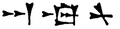 Nabû-nāṣir, meaning "Nabu (is) protector") was a high priest (šatammu) of the Eanna temple in Uruk in the reign of the Neo-Assyrian king Esarhaddon (r. 681–669 BC), attested as such from 678 to 675 BC. He is very likely to have been the father of Nebuchadnezzar, governor of Uruk under Esarhaddon's successor Ashurbanipal (r. 669–631 BC), and the grandfather of Nabopolassar (r. 626–605 BC), the first king of the Neo-Babylonian Empire, making Nabonassar the progenitor of the Chaldean dynasty of Babylonian kings.
In addition to Nebuchadnezzar, it is probable that Nabonassar was also the father of Bēl-uballiṭ, who is recorded as high priest of the same temple in 642 BC, and of Bel-uballit's colleague and brother, Nabu-ušabši.
View the full Wikipedia page for Nabonassar (7th century BC)