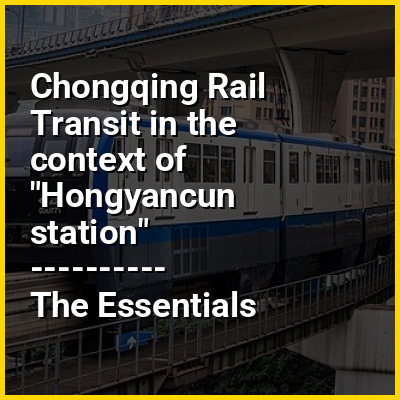
Chongqing Rail Transit in the context of "Hongyancun station"

Play Trivia Questions online!

or

Skip to study material about Chongqing Rail Transit in the context of "Hongyancun station"

Ad spacer

⭐ Core Definition: Chongqing Rail Transit

The Chongqing Rail Transit (branded as CRT; also known as Chongqing Metro) is the rapid transit system in the city of Chongqing, China. In operation since 2005, it serves the transportation needs of the city's main business and entertainment areas in downtown as well as the inner suburbs. As of December 2023, CRT consists of twelve lines with a total track length of 561.18 km (349 mi). Lines 1, 4, 5, 6, 9, 10, 18, the Loop line, Jiangtiao line, and Bitong line are conventional heavy-rail metro lines, while Lines 2 and 3 are high-capacity monorails. To keep up with urban growth, construction on several other lines is under way.

The Chongqing Rail Transit is a unique transit system owing to the nature of Chongqing being a densely populated yet mountainous city with multiple river valleys. Two lines use heavy-monorail technology, leveraging the ability to negotiate steep grades and tight curves and rapid transit capacity. They are capable of transporting 32,000 passengers per hour per direction. However the busiest section of Line 3 reaches a peak passenger volume of 37,700 pphpd in 2019. At 98 km (61 mi), the system's two monorail lines form the longest monorail system in the world, with Line 3 being the world's longest single monorail line. The length and the capacity of its monorail network both also make it the world's busiest monorail system, with a total of 94 million and 250 million rides in 2015 on Line 2 and Line 3, respectively. Line 3 is therefore the world's busiest single monorail line.
↓ Menu

>>>PUT SHARE BUTTONS HERE<<<

👉 Chongqing Rail Transit in the context of Hongyancun station

Hongyancun station (Chinese: 红岩村站; pinyin: Hóngyáncūn zhàn) is a station on Line 9 of Chongqing Rail Transit in Chongqing Municipality, China, that opened in 2022. It is located in Yuzhong District. Line 5 also reaches the station since November 2023.

The station is the deepest metro station in the world. The deepest point of the station is 116 meters (381 ft) below the ground and the top of rail is 106 meters (348 ft) below the surface. Regardless, the depth breaks China's previous record depth of Line 10's Hongtudi station and surpasses the depth of the Kyiv Metro's Arsenalna station, the previous record for deepest metro station.

↓ Explore More Topics
In this Dossier

Chongqing Rail Transit in the context of Monorail

A monorail is a railway in which the track consists of a single rail or beam. Colloquially, the term "monorail" is often used to describe any form of elevated rail or people mover. More accurately, the term refers to the style of track. Monorail systems are most frequently implemented in large cities, airports, and theme parks.

↑ Return to Menu

Chongqing Rail Transit in the context of Arsenalna (Kyiv Metro)

Arsenalna (Ukrainian: Арсенальна, IPA: [ɐrseˈnɑlʲnɐ] ) is a station on the Kyiv Metro's Sviatoshynsko-Brovarska Line. The station was opened along with the first stage and is currently the second-deepest station in the world at 105.5 metres (346 ft), after Hongyancun station of the Chongqing Metro. The depth is attributed to the geography of Kyiv, whose high bank of the Dnipro River rises above the rest of the city. Also unusual is the station's design, which lacks a central concourse and thus is similar in layout to stations of the London Underground.

Since 1986, the station has the status of "Architectural Monument of Local Significance", Protection Number 187.

↑ Return to Menu

Chongqing Rail Transit in the context of Line 3 (Chongqing Rail Transit)

CRT Line 3 (and the branch line branded as Konggang line) runs from north to south, linking the districts separated by Chongqing's two main rivers, the Yangtze (Chang Jiang) and Jialing rivers. Built by Japan's ODA project, it uses Hitachi, Ltd. monorail vehicles and technology. The first phase of the line began construction on 5 April 2007. The initial segment from Lianglukou to Yuanyang (18 stations, 17.5 km (10.9 mi)) opened on September 29, 2011, with a northern extension from Yuanyang to Jiangbei Airport opening on December 30, 2011 and a southern extension from Ertang (Currently Chongqing Jiaotong University) to terminus Yudong on December 28, 2012. At 55.5 km (34.5 mi), plus 9.97 km (6.20 mi) for Konggang branch line opened on December 28, 2016, Line 3 is the longest single monorail in the world by track length. Line 3 is also the world's busiest monorail line with a daily ridership of over 675,000 passengers per day.

There are interchange stations in central Yuzhong district for transfer to Jiefangbei CBD with Line 1 at Lianglukou and with Line 2 at Niujiaotuo.

↑ Return to Menu

Chongqing Rail Transit in the context of Line 15 (São Paulo Metro)

Line 15 (Silver) (Portuguese: Linha 15–Prata) is one of the six lines that make up the São Paulo Metro and one of the thirteen lines that make up the Metropolitan Rail Transportation Network. It is South America's first mass-transit monorail and is the first system in the world to use the Bombardier Innovia Monorail 300. When completed it will be the largest and highest capacity monorail system in the Americas and second worldwide only to the Chongqing Monorail. The first section, from Vila Prudente to Oratório, opened on 30 August 2014, initially running 10 AM–3 PM on weekends only. As of 26 October 2016, the line is operational from 4:40 AM–12 AM. The line has a free connection to Line 2-Green on Vila Prudente station and future connection to CPTM Line 10-Turquoise on Ipiranga station.

Built using completely driverless technology, the line is currently 14.6 km (9.1 mi) long and has eleven stations in the stretch between Vila Prudente and Jardim Colonial. When complete, it will be approximately 27 kilometres (17 mi) long and have eighteen stations, beginning at Ipiranga and ending at the future Hospital Cidade Tiradentes. The proposed completion of the full line is projected to be beyond 2022.

↑ Return to Menu