Boolean function in the context of "NAND gate"

Play Trivia Questions online!

or

Skip to study material about Boolean function in the context of "NAND gate"


⭐ Core Definition: Boolean function

In mathematics, a Boolean function is a function whose arguments and result assume values from a two-element set (usually {true, false}, {0,1} or {−1,1}). Alternative names are switching function, used especially in older computer science literature, and truth function (or logical function), used in logic. Boolean functions are the subject of Boolean algebra and switching theory.

A Boolean function takes the form , where is known as the Boolean domain and is a non-negative integer called the arity of the function. In the case where , the function is a constant element of . A Boolean function with multiple outputs, with is a vectorial or vector-valued Boolean function (an S-box in symmetric cryptography).

↓ Menu

👉 Boolean function in the context of NAND gate

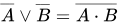
In digital electronics, a NAND (NOT AND) gate is a logic gate which produces an output which is false only if all its inputs are true; thus its output is complement to that of an AND gate. A LOW (0) output results only if all the inputs to the gate are HIGH (1); if any input is LOW (0), a HIGH (1) output results. A NAND gate is made using transistors and junction diodes. By De Morgan's laws, a two-input NAND gate's logic may be expressed as , making a NAND gate equivalent to inverters followed by an OR gate.

The NAND gate is significant because any Boolean function can be implemented by using a combination of NAND gates. This property is called "functional completeness". It shares this property with the NOR gate. Digital systems employing certain logic circuits take advantage of NAND's functional completeness.

↓ Explore More Topics
In this Dossier

Boolean function in the context of Logic gate

A logic gate is a device that performs a Boolean function, a logical operation performed on one or more binary inputs that produces a single binary output. Depending on the context, the term may refer to an ideal logic gate, one that has, for instance, zero rise time and unlimited fan-out, or it may refer to a non-ideal physical device (see ideal and real op-amps for comparison).

The primary way of building logic gates uses diodes or transistors acting as electronic switches. Today, most logic gates are made from MOSFETs (metal–oxide–semiconductor field-effect transistors). They can also be constructed using vacuum tubes, electromagnetic relays with relay logic, fluidic logic, pneumatic logic, optics, molecules, acoustics, or even mechanical or thermal elements.

↑ Return to Menu

Boolean function in the context of Truth table

A truth table is a mathematical table used in logic—specifically in connection with Boolean algebra, Boolean functions, and propositional calculus—which sets out the functional values of logical expressions on each of their functional arguments, that is, for each combination of values taken by their logical variables. In particular, truth tables can be used to show whether a propositional expression is true for all legitimate input values, that is, logically valid.

A truth table has one column for each input variable (for example, A and B), and one final column showing the result of the logical operation that the table represents (for example, A XOR B). Each row of the truth table contains one possible configuration of the input variables (for instance, A=true, B=false), and the result of the operation for those values.

↑ Return to Menu

Boolean function in the context of Molecular logic gate

A molecular logic gate is a molecule that performs a logical operation based on at least one physical or chemical inputs and a single output. The field has advanced from simple logic systems based on a single chemical or physical input to molecules capable of combinatorial and sequential operations such as arithmetic operations (i.e. moleculators and memory storage algorithms). Molecular logic gates work with input signals based on chemical processes and with output signals based on spectroscopic phenomena.

Logic gates are the fundamental building blocks of computers, microcontrollers and other electrical circuits that require one or more logical operations. They can be used to construct digital architectures with varying degrees of complexity by a cascade of a few to several million logic gates, and are essentially physical devices that produce a singular binary output after performing logical operations based on Boolean functions on one or more binary inputs. The concept of molecular logic gates, extending the applicability of logic gates to molecules, aims to convert chemical systems into computational units. The field has evolved to realize several practical applications in fields such as molecular electronics, biosensing, DNA computing, nanorobotics, and cell imaging.  

↑ Return to Menu

Boolean function in the context of Circuit complexity

In theoretical computer science, circuit complexity is a branch of computational complexity theory in which Boolean functions are classified according to the size or depth of the Boolean circuits that compute them. A related notion is the circuit complexity of a recursive language that is decided by a uniform family of circuits (see below).

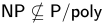
Proving lower bounds on size of Boolean circuits computing explicit Boolean functions is a popular approach to separating complexity classes. For example, a prominent circuit class P/poly consists of Boolean functions computable by circuits of polynomial size. Proving that would separate P and NP (see below).

↑ Return to Menu

Boolean function in the context of Boolean circuit

In computational complexity theory and circuit complexity, a Boolean circuit is a mathematical model for combinational digital logic circuits. A formal language can be decided by a family of Boolean circuits, one circuit for each possible input length.

Boolean circuits are defined in terms of the logic gates they contain. For example, a circuit might contain binary AND and OR gates and unary NOT gates, or be entirely described by binary NAND gates. Each gate corresponds to some Boolean function that takes a fixed number of bits as input and outputs a single bit.

↑ Return to Menu