Circuit complexity in the context of "Boolean circuit"

Play Trivia Questions online!

or

Skip to study material about Circuit complexity in the context of "Boolean circuit"


⭐ Core Definition: Circuit complexity

In theoretical computer science, circuit complexity is a branch of computational complexity theory in which Boolean functions are classified according to the size or depth of the Boolean circuits that compute them. A related notion is the circuit complexity of a recursive language that is decided by a uniform family of circuits (see below).

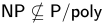
Proving lower bounds on size of Boolean circuits computing explicit Boolean functions is a popular approach to separating complexity classes. For example, a prominent circuit class P/poly consists of Boolean functions computable by circuits of polynomial size. Proving that would separate P and NP (see below).
↓ Menu

👉 Circuit complexity in the context of Boolean circuit

In computational complexity theory and circuit complexity, a Boolean circuit is a mathematical model for combinational digital logic circuits. A formal language can be decided by a family of Boolean circuits, one circuit for each possible input length.

Boolean circuits are defined in terms of the logic gates they contain. For example, a circuit might contain binary AND and OR gates and unary NOT gates, or be entirely described by binary NAND gates. Each gate corresponds to some Boolean function that takes a fixed number of bits as input and outputs a single bit.

↓ Explore More Topics
In this Dossier

Circuit complexity in the context of Computational complexity theory

In theoretical computer science and mathematics, computational complexity theory focuses on classifying computational problems according to their resource usage, and explores the relationships between these classifications. A computational problem is a task solved by a computer. A computation problem is solvable by mechanical application of mathematical steps, such as an algorithm.

A problem is regarded as inherently difficult if its solution requires significant resources, whatever the algorithm used. The theory formalizes this intuition, by introducing mathematical models of computation to study these problems and quantifying their computational complexity, i.e., the amount of resources needed to solve them, such as time and storage. Other measures of complexity are also used, such as the amount of communication (used in communication complexity), the number of gates in a circuit (used in circuit complexity) and the number of processors (used in parallel computing). One of the roles of computational complexity theory is to determine the practical limits on what computers can and cannot do. The P versus NP problem, one of the seven Millennium Prize Problems, is part of the field of computational complexity.

↑ Return to Menu