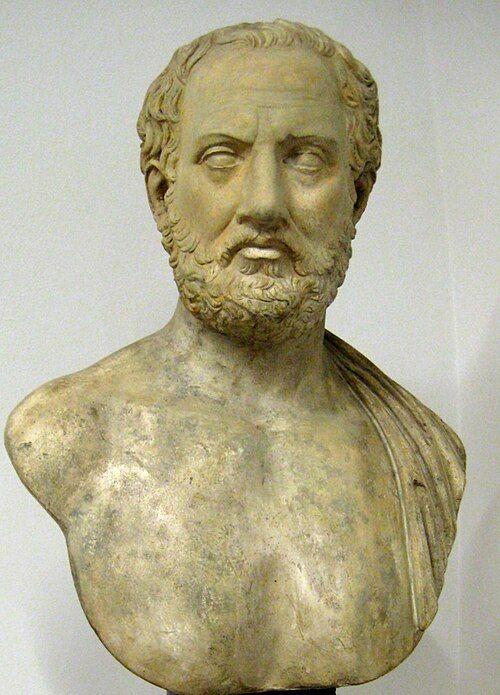
Materials covered in this trivia questions quiz
Study Hint 1
Question: In the context of Historical_method, Thucydides is considered a foundational figure due to his emphasis on…
Trivia Question Study Fact: Historical method relies on a historian's ability to assess the credibility of various sources – including primary sources, secondary sources, and archaeological evidence – and synthesize them to create a reliable account of past events. This process involves evaluating the authority of each source and combining their information thoughtfully.
Trivia Question Explanation: Thucydides’ approach to documenting the Peloponnesian War involved meticulous gathering and critical examination of evidence, a hallmark of the historical method that prioritizes accurate and reliable accounts of the past.
Return to Question
Study Hint 2
Question: In the context of Pericles’ leadership, Thucydides’ assessment of him highlights what key aspect of his influence on Athens?
Trivia Question Study Fact: According to Thucydides, Pericles held a position of significant influence in Athens during the period between the Greco-Persian Wars and the Peloponnesian War, and was recognized as the foremost citizen of the city. This era, roughly from 461 to 429 BC, is often referred to as the 'Age of Pericles' due to his leadership and impact on Athenian society.
Trivia Question Explanation: Thucydides, a contemporary historian, explicitly referred to Pericles as "the first citizen of Athens," signifying his preeminence and influence during the Golden Age of Athens and the period leading up to the Peloponnesian War.
Return to Question
Study Hint 3
Question: In the context of Corfu, Thucydides is considered a key source for understanding the island’s role as a…
Trivia Question Study Fact: According to Thucydides, the ancient city of Korkyra (modern Corfu) held significant naval power in the 5th century BCE, ranking alongside Athens and Corinth as one of the three dominant maritime forces in Greece. This prominence was demonstrated through its involvement in conflicts like the Battle of Sybota, which ultimately contributed to the outbreak of the Peloponnesian War.
Trivia Question Explanation: Thucydides specifically details Korkyra’s naval strength, stating it was one of three great naval powers in Greece alongside Athens and Corinth during the 5th century BCE, and his account of the Battle of Sybota highlights this maritime capability.
Return to Question
Study Hint 4
Question: In the context of Pericles' Funeral Oration, Thucydides is considered…
Trivia Question Study Fact: Thucydides documented Pericles' Funeral Oration as part of his historical account of the Peloponnesian War, presenting it not as a direct transcript but as a reconstruction of the speech delivered to honor Athenian soldiers killed in the first year of the conflict.
Trivia Question Explanation: Thucydides’ *History of the Peloponnesian War* includes the Funeral Oration, but it is understood to be his interpretation and reconstruction of Pericles’ words, rather than a verbatim record.
Return to Question
Study Hint 5
Question: In the context of Ancient Greek literature, Thucydides is considered…
Trivia Question Study Fact: Within Ancient Greek literature, Thucydides distinguished himself as a historian during the 5th century BC, documenting events contemporary to his life. His historical accounts offered a departure from earlier traditions, focusing on factual reporting and analysis of cause and effect rather than mythical or poetic narratives.
Trivia Question Explanation: Thucydides, alongside Herodotus, was a prominent historian of the 5th century BC who wrote accounts of events occurring during his life, marking a shift towards factual and analytical historical writing.
Return to Question
Study Hint 6
Question: In the context of Thucydides’s work, what core principle underpins the school of political realism, which he is credited with founding?
Trivia Question Study Fact: Thucydides, an Athenian historian and general, is considered the father of political realism. This school of thought posits that the actions of individuals and the relationships between states are fundamentally shaped by fear and self-interest, rather than divine intervention.
Trivia Question Explanation: Thucydides’s work is foundational to political realism, a theory asserting that fear and self-interest, rather than divine influence, are the driving forces behind political actions and state relations.
Return to Question
Study Hint 7
Question: In the context of Historical_research, Thucydides is considered a foundational figure due to his pioneering approach to what aspect of historical documentation?
Trivia Question Study Fact: Historical research relies on a combination of primary and secondary sources, alongside material evidence like archaeological findings. A historian's expertise involves assessing the credibility of these sources and integrating their insights to create a well-supported and trustworthy account of past events and their contexts.
Trivia Question Explanation: Thucydides is renowned for moving away from traditional, myth-based historical accounts and instead emphasizing a systematic, evidence-based approach to understanding the past, meticulously examining sources and events to establish factual accuracy.
Return to Question
Study Hint 8
Question: In the context of the Oracle of Delphi, Thucydides is considered…
Trivia Question Study Fact: The Pythia, serving as the high priestess and oracle at the Temple of Apollo in Delphi, was a highly influential figure in the classical world, consulted for prophecies from as early as the 8th century BC until the late 4th century AD. Numerous prominent ancient authors, including Thucydides, documented the Delphic Oracle, highlighting its importance as a religious and political institution.
Trivia Question Explanation: The provided text lists Thucydides among a large number of ancient authors who mentioned the Oracle of Delphi, demonstrating its widespread recognition and documentation in classical literature.
Return to Question
Study Hint 9
Question: In the context of Spartan hegemony, Thucydides is considered…
Trivia Question Study Fact: During the period of Spartan hegemony (404-371 BC), understanding Sparta’s internal political system is challenging because Spartans intentionally avoided creating detailed records of their own governance. Consequently, historical accounts of Sparta during this time rely on the writings of non-Spartan observers like Thucydides, Xenophon, Herodotus, and Plutarch, with Plutarch writing centuries after the period ended.
Trivia Question Explanation: Because Spartans themselves did not keep detailed records of their internal affairs, historians rely on the accounts of outside observers like Thucydides to reconstruct their political system, even though he was not a Spartan.
Return to Question
Study Hint 10
Question: In the context of the Alcmaeonidae, Thucydides is considered most notably for his assessment of which prominent family member?
Trivia Question Study Fact: The Alcmaeonidae were a prominent Athenian noble family who significantly influenced Athenian political development from the 7th to the 5th centuries BC, contributing to the overthrow of tyranny, the establishment of democracy, and providing military leadership during the Peloponnesian War. Figures like Cleisthenes and Pericles emerged from this family, with Thucydides later praising Pericles as 'the first citizen of Athens'.
Trivia Question Explanation: Thucydides, a contemporary historian, famously praised Pericles, a member of the Alcmaeonidae family, as 'the first citizen of Athens' for his leadership and contributions to the city.
Return to Question