Zoroaster in the context of "Nietzsche"

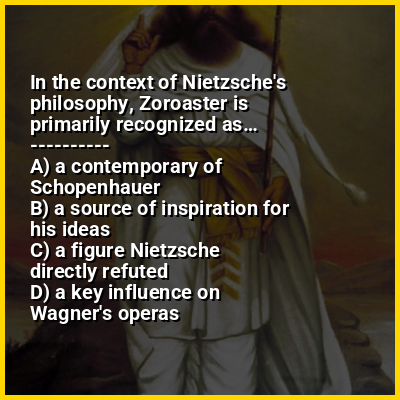
⭐ In the context of Nietzsche's philosophy, Zoroaster is primarily recognized as…

Ad spacer

⭐ Core Definition: Zoroaster

Zarathushtra Spitama, more commonly known as Zoroaster or Zarathustra, was an Iranian religious reformer who challenged the tenets of the contemporary Ancient Iranian religion, becoming the spiritual founder of Zoroastrianism. In the oldest Zoroastrian scriptures, the Gathas, which he is traditionally believed to have authored, he is described as a preacher and a poet-prophet. Some have claimed, with much scholarly controversy, to find his influence in Heraclitus, Plato, Pythagoras, and, perhaps less controversially, in the Abrahamic religions, including Judaism, Christianity, and Islam, particularly through concepts of cosmic dualism and personal morality.

He spoke an Eastern Iranian language, named Avestan by scholars after the corpus of Zoroastrian religious texts written in that language. Based on this, it is tentative to place his homeland somewhere in the eastern regions of Greater Iran (perhaps in modern-day Afghanistan or Tajikistan), but his exact birthplace is uncertain. His life is traditionally dated to sometime around the 7th and 6th centuries BC; though most scholars, using linguistic and socio-cultural evidence, suggest a dating to somewhere in the second millennium BC.
↓ Menu

>>>PUT SHARE BUTTONS HERE<<<
In this Dossier

Zoroaster in the context of Zoroastrianism

Zoroastrianism, also called Mazdayasna or Behdin, is an Iranian religion centred on the Avesta and the teachings of Zarathushtra Spitama, who is more commonly referred to by the Greek translation, Zoroaster (Greek: Ζωροάστρις Zōroastris). Among the world's oldest organized faiths, its adherents exalt an uncreated, benevolent, and all-wise deity known as Ahura Mazda (𐬀𐬵𐬎𐬭𐬀⸱𐬨𐬀𐬰𐬛𐬁), who is hailed as the supreme being of the universe. Opposed to Ahura Mazda is Angra Mainyu (𐬀𐬢𐬭𐬀⸱𐬨𐬀𐬌𐬥𐬌𐬌𐬎), who is personified as a destructive spirit and the adversary of all things that are good. As such, the Zoroastrian religion combines a dualistic cosmology of good and evil with an eschatological outlook predicting the ultimate triumph of Ahura Mazda over evil. Opinions vary among scholars as to whether Zoroastrianism is monotheistic, polytheistic, henotheistic, or a combination of all three. Zoroastrianism shaped Iranian culture and history, while scholars differ on whether it significantly influenced ancient Western philosophy and the Abrahamic religions, or gradually reconciled with other religions and traditions, such as Christianity and Islam.

Originating from Zoroaster's reforms of the ancient Iranian religion, Zoroastrianism began during the Avestan period (possibly as early as the 2nd millennium BCE), but was first recorded in the mid-6th century BCE. For the following millennium, it was the official religion of successive Iranian polities, beginning with the Achaemenid Empire, which formalized and institutionalized many of its tenets and rituals, and ending with the Sasanian Empire, which revitalized the faith and standardized its teachings. In the 7th century CE, the rise of Islam and the ensuing Muslim conquest of Iran marked the beginning of the decline of Zoroastrianism. The persecution of Zoroastrians by the early Muslims in the nascent Rashidun Caliphate prompted much of the community to migrate to the Indian subcontinent, where they were granted asylum and became the progenitors of today's Parsis. Once numbering in the millions, the world's total Zoroastrian population is estimated to comprise between 110,000 and 120,000 people, with most of them residing either in India (50,000–60,000), in Iran (15,000–25,000), or in North America (22,000). The religion is thought to be declining due to restrictions on conversion, strict endogamy, and low birth rates.

↑ Return to Menu

Zoroaster in the context of Friedrich Nietzsche

Friedrich Wilhelm Nietzsche (15 October 1844 – 25 August 1900) was a German philosopher. He began his career as a classical philologist, turning to philosophy early in his academic career. In 1869, aged 24, Nietzsche became the youngest professor to hold the Chair of Classical Philology at the University of Basel. Plagued by health problems for most of his life, he resigned from the university in 1879, and in the following decade he completed much of his core writing. In 1889, aged 44, he suffered a collapse and thereafter a complete loss of his mental faculties, with paralysis and vascular dementia, living his remaining 11 years under the care of his family until his death. His works and his philosophy have fostered not only extensive scholarship but also much popular interest.

Nietzsche's work encompasses philosophical polemics, poetry, cultural criticism and fiction, while displaying a fondness for aphorisms and irony. Prominent elements of his philosophy include his radical critique of truth in favour of perspectivism; a genealogical critique of religion and Christian morality and a related theory of master–slave morality; the aesthetic affirmation of life in response to both the "death of God" and the profound crisis of nihilism; the notion of Apollonian and Dionysian forces; and a characterisation of the human subject as the expression of competing wills, collectively understood as the will to power. He also developed influential concepts such as the Übermensch and his doctrine of eternal return. In his later work he became increasingly preoccupied with the creative powers of the individual to overcome cultural and moral mores in pursuit of new values and aesthetic health. His body of work touched a wide range of topics, including art, philology, history, music, religion, tragedy, culture and science, and drew inspiration from Hebrew literature, Indian literature and Greek tragedy, as well as figures such as Zoroaster, Arthur Schopenhauer, Ralph Waldo Emerson, Richard Wagner, Fyodor Dostoevsky and Johann Wolfgang von Goethe.

↑ Return to Menu

Zoroaster in the context of Gatha (Zoroaster)

The Gathas (/ˈɡɑːtəz, -tɑːz/) are five hymns in the Avestan language from the Zoroastrian oral tradition of the Avesta. The oldest surviving text fragment dates from 1323 CE, but they are believed by scholars to have been composed before 1000 BCE and passed down orally for centuries. They are traditionally believed to have been composed by the prophet Zarathushtra (Zoroaster) himself. They form the core of the Zoroastrian liturgy (the Yasna). They are arranged in five different modes or metres.

The Avestan term gāθā (𐬔𐬁𐬚𐬁 "hymn", but also "mode, metre") is cognate with Sanskrit gāthā (गाथा), both from the Proto-Indo-Iranian word *gaHtʰáH, from the root *gaH- "to sing".

↑ Return to Menu

Zoroaster in the context of Ancient Iranian religion

Ancient Iranian religions were a set of ancient beliefs and practices of the Iranian peoples before the rise of Zoroastrianism. The religion closest to it was the historical Vedic religion that was practiced during the Vedic period. The major deities worshipped were Ahura Mazda and Mithra from Iran to Rome, but Atar was also worshipped, as names of kings and common public showing devotion to these three exist in most cases. But some sects, the precursors of the Magi, also worshipped Ahura Mazda, the chief of the Ahuras. With the rise of Zoroaster and his new, reformatory religion, Ahura Mazda became the principal deity, while the Daevas were relegated to the background. Many of the attributes and commandments of Varuna, called Fahrana in Median times, were later attributed to Ahura Mazda by Zoroaster.

The Iranian peoples emerged as a separate branch of the Indo-Iranians in the 2nd millennium BC, during which they came to dominate the Eurasian Steppe and the Persian Plateau. Their religion is derived from Iranian religions, and therefore shares many similarities with the Vedic religion of India. Although the Persian peoples left little written or material evidence of their religious practices, their religion is possible to reconstruct from scant Iranian, Babylonian and Greek accounts, similarities with Vedic and other Indo-European religions, and material evidence.

↑ Return to Menu

Zoroaster in the context of Avestan period

The Avestan period (c. 1500 – c. 400 BCE) is the period of Iranian history when the collection of canonical texts of Zoroastrianism called the Avesta was produced. The period saw important developments to religious thought and to Persian mythology and the tradition of epic poetry exemplified by the Shahnameh.

Scholars can reliably distinguish between two different linguistic strata in the Avesta labeled "Old Avestan" and "Young Avestan". These two strata represent two different stages in the development of the Avestan language and the society of its speakers. The Old Avestan society is the one to which Zoroaster and his immediate followers belonged. The Young Avestan society is less clearly delineated and reflects a longer time span.

↑ Return to Menu

Zoroaster in the context of Manichaeism

Manichaeism (/ˌmænɪˈkɪzəm/; in Persian: آئین مانی, romanizedĀʾīn-i Mānī; Chinese: 摩尼教; pinyin: Móníjiào) was a major world religion founded in the third century CE by the Parthian Iranian prophet Mani (C.E. 216–274) in the Sasanian Empire. Variably described as a Christian heresy and a Gnostic movement, Manichaeism was an organized and doctrinal religious tradition in its own right. It taught an elaborate dualistic cosmology describing the struggle between a good spiritual world of light, and an evil material world of darkness. Through an ongoing process that takes place in human history, light is gradually removed from the world of matter and returned to the world of the divine.

Mani's teachings were intended to integrate, succeed, and surpass the "partial truths" of various prior faiths and belief systems, including Platonism, Christianity, Zoroastrianism, Buddhism, Marcionism, Hellenistic and Rabbinic Judaism, Gnostic movements, Ancient Greek religion, Babylonian and other Mesopotamian religions, and mystery cults. Some forms of Manichaeism see Mani as the final prophet after Zoroaster, the Buddha, and Jesus. The Manichaean scriptural canon includes seven works attributed to Mani, written originally in Syriac. Manichaean sacramental rites included prayers, almsgiving, and fasting. Communal life centered on confession and the singing of hymns.

↑ Return to Menu

Zoroaster in the context of Gemistos Plethon

Georgios Gemistos Plethon (Greek: Γεώργιος Γεμιστὸς Πλήθων; Latin: Georgius Gemistus Pletho c. 1355/1360 – 1452/1454), commonly known as Gemistos Plethon, was a Greek scholar and one of the most renowned philosophers of the Late Byzantine era. He was a chief pioneer of the revival of Greek scholarship in Western Europe. As revealed in his last literary work, the Nomoi or Book of Laws, which he circulated only among close friends, he rejected Christianity in favour of a return to the worship of the classical Hellenic gods, mixed with ancient wisdom based on Zoroaster and the Magi.

In 1438–1439 he reintroduced Plato's ideas to Western Europe during the Council of Florence, in a failed attempt to reconcile the East–West schism. Plethon also formulated his political vision in several speeches throughout his life. The boast in one of the speeches that "We are Hellenes by race and culture" and his proposal of a reborn Byzantine Empire following a utopian Hellenic system of government centered in Mystras, have generated discussion about Byzantine and modern Greek identity. In this regard, Plethon has been labelled both "the last Hellene" and "the first modern Greek".

↑ Return to Menu

Zoroaster in the context of Manicheism

Manichaeism (/ˌmænɪˈkɪzəm/; in Persian: آئین مانی, romanizedĀʾīn-i Mānī; Chinese: 摩尼教; pinyin: Móníjiào) was a major world religion founded in the third century CE by the Parthian Iranian prophet Mani (216–274) in the Sasanian Empire. Variably described as a Christian heresy and a Gnostic movement, Manichaeism was an organized and doctrinal religious tradition in its own right. It taught an elaborate dualistic cosmology describing the struggle between a good spiritual world of light, and an evil material world of darkness. Through an ongoing process in human history, light is gradually removed from the world of matter and returned to the world of the divine.

Mani's teachings were intended to integrate, succeed, and surpass the "partial truths" of various prior faiths and belief systems, including Platonism, Christianity, Zoroastrianism, Buddhism, Marcionism, Hellenistic and Rabbinic Judaism, Gnosticism, Ancient Greek religion, Babylonian religion, other ancient Mesopotamian religions, and the Greco-Roman mysteries. Some forms of Manichaeism viewed Mani as the final prophet after Zoroaster, the Buddha, and Jesus. The canon of Manichaean scripture included seven works attributed to Mani, written originally in the Syriac language. Manichaean sacramental rites included prayers, almsgiving, and fasting. Communal life centered on confession and the singing of hymns.

↑ Return to Menu