Workhouse in the context of "Poor law union"

Play Trivia Questions online!

or

Skip to study material about Workhouse in the context of "Poor law union"


⭐ Core Definition: Workhouse

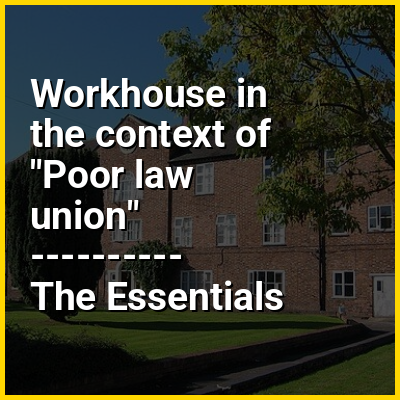
In Britain and Ireland, a workhouse (Welsh: tloty, lit. "poor-house") was a total institution where those unable to support themselves financially were offered accommodation and employment. In Scotland, they were usually known as poorhouses. The earliest known use of the term workhouse is from 1631, in an account by the mayor of Abingdon reporting that "we have erected within our borough a workhouse to set poorer people to work".

The origins of the workhouse can be traced to the Statute of Cambridge 1388, which attempted to address the labour shortages following the Black Death in England by restricting the movement of labourers, and ultimately led to the state becoming responsible for the support of the poor. However, mass unemployment following the end of the Napoleonic Wars in 1815, the introduction of new technology to replace agricultural workers in particular, and a series of bad harvests, meant that by the early 1830s the established system of poor relief was proving to be unsustainable. The New Poor Law of 1834 attempted to reverse the economic trend by discouraging the provision of relief to anyone who refused to enter a workhouse. Some Poor Law authorities hoped to run workhouses at a profit by utilising the free labour of their inmates. Most were employed on tasks such as breaking stones, crushing bones to produce fertiliser, or picking oakum using a large metal nail known as a spike.
↓ Menu

👉 Workhouse in the context of Poor law union

A poor law union was a geographical territory, and early local government unit, in Great Britain and Ireland.

Poor law unions existed in England and Wales from 1834 to 1930 for the administration of poor relief. Prior to the Poor Law Amendment Act 1834 the administration of the English Poor Laws was the responsibility of the vestries of individual parishes, which varied widely in their size, populations, financial resources, rateable values and requirements. From 1834 the parishes were grouped into unions, jointly responsible for the administration of poor relief in their areas and each governed by a board of guardians. A parish large enough to operate independently of a union was known as a poor law parish. Collectively, poor law unions and poor law parishes were known as poor law districts. The grouping of the parishes into unions caused larger centralised workhouses to be built to replace smaller facilities in each parish. Poor law unions were later used as a basis for the delivery of registration from 1837, and sanitation outside urban areas from 1875. Poor law unions were abolished by the Local Government Act 1929, which transferred responsibility for public assistance to county and county borough councils.

↓ Explore More Topics
In this Dossier

Workhouse in the context of George Gilbert Scott

Sir George Gilbert Scott RA (13 July 1811 – 27 March 1878), largely known as Sir Gilbert Scott, was a prolific English Gothic Revival architect, chiefly associated with the design, building and renovation of churches and cathedrals, although he started his career as a leading designer of workhouses. Over 800 buildings were designed or altered by him.

Scott was the architect of many notable buildings, including the Midland Grand Hotel at St Pancras Station, the Albert Memorial, and the Foreign and Commonwealth Office, all in London, St Mary's Cathedral, Glasgow, the main building of the University of Glasgow, St Mary's Cathedral in Edinburgh and King's College Chapel, London.

↑ Return to Menu

Workhouse in the context of Charlie Chaplin

Sir Charles Spencer Chaplin Jr. (16 April 1889 – 25 December 1977) was an English comic actor, filmmaker, and composer who rose to fame in the era of silent film. He became a worldwide icon through his screen persona, the Tramp, and is considered one of the film industry's most important figures. His career spanned more than 75 years, from his childhood in the Victorian era until a year before his death in 1977, and encompassed both accolade and controversy.

Chaplin's childhood in London was one of poverty and hardship. His father was absent and his mother struggled financially – he was sent to a workhouse twice before the age of nine. When he was 14, his mother was committed to a mental asylum. Chaplin began performing at an early age, touring music halls and later working as a stage actor and comedian. At 19, he was signed to the Fred Karno company, which took him to the United States. He was scouted for the film industry and began appearing in 1914 for Keystone Studios. He soon introduced and adopted the Tramp as his screen persona. He directed his own films and continued to hone his craft as he moved to Essanay Studios, where the Tramp persona was developed emotionally in The Tramp (1915). He then attracted a large fanbase and demanded more money as he moved to Mutual and First National corporations. By 1918, he was one of the world's best-paid and best-known figures.

↑ Return to Menu

Workhouse in the context of Family separation

Family separation is the condition where family members are involuntarily separated from each other, often because of immigration systems, although it can happen for other reasons such as military service or involuntary adoption. Family separation can have a serious impact on mental health. Because family separation interferes with the right to family life, family reunification is a reason for immigration in many countries.

↑ Return to Menu

Workhouse in the context of The People of the Abyss

The People of the Abyss is a 1903 book by Jack London, containing his first-hand account of several weeks spent living in the Whitechapel district of the East End of London in 1902. London attempted to understand the working-class of this deprived area of the city, sleeping in workhouses or on the streets, and staying as a lodger with a poor family.

↑ Return to Menu

Workhouse in the context of Walthamstow Village

Walthamstow Village is the oldest part of Walthamstow, east London. It was designated a Conservation Area by the London Borough of Waltham Forest in 1967, and another Conservation Area on nearby Orford Road was subsequently added. The area centres on St. Mary's Church, which was founded in the 12th century. Across the road from this is a 15th-century timber-framed hall house called "The Ancient House", which was restored in 1934 and 2002. Nearby are almshouses dating from the 16th and 18th centuries, and the Vestry House Museum, which has been used as a workhouse and police station, but has been a museum since 1931. It also holds the archives of the borough and a local studies library.

Orford Road, the ancient road leading up to St Mary's church, has in recent years developed as a street of small restaurants, cafes and a local supermarket. There are also several pubs in the area.

↑ Return to Menu

Workhouse in the context of Macroom

Macroom (/məˈkrm/; Irish: Maigh Chromtha) is a market town in County Cork, Ireland, located in the valley of the River Sullane, halfway between Cork city and Killarney. Its population has grown and receded over the centuries as it went through periods of war, famine and workhouses, forced emigration and intermittent prosperity. The 2011 census gave an urban population of 3,879 people, while the 2016 census recorded 3,765 people. The town is in a civil parish of the same name.

Macroom began as a meeting place for the druids of Munster. It is first mentioned is in 6th-century records, and the immediate area hosted a major battle c. 987 involving the Irish king Brian Boru. During the Middle Ages, the town was invaded by a succession of warring clans, including the Murcheatach Uí Briain and Richard de Cogan families. In the early modern period the MacCarthys took control and later the area found prosperity via milling. The MacCarthys built a series of tower houses, some of which survive. The family lost influence during the Williamite wars of the 1690s, after which authority over the town castle waxed and waned between the MacCarthys and a number of Anglo-Irish families.

↑ Return to Menu